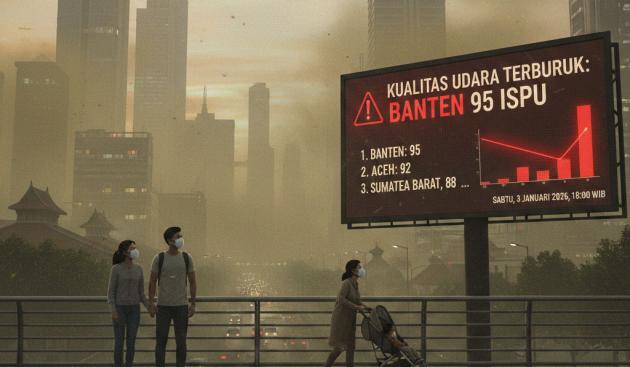
The air quality in Banten Province was recorded as the worst in all of Indonesia on Saturday night, January 3, 2026.
Based on data from the Air Pollution Standard Index (ISPU) page of the Ministry of Environment and Forestry at 18:00 Western Indonesian Time, the air quality index in the Banten region reached a figure of 95.
This figure places Banten at the top of the list of regions with the highest level of air pollution, followed by Aceh Province in second place with an index of 92 and West Sumatra in third place with an index of 88.
Although ranked as the worst, the air quality in Banten is still categorized within the “Moderate” range according to the standards of Ministerial Regulation No. 14 of 2020.
Based on these regulations, an index in the range of 51-100 means the air quality has not yet entered the unhealthy category, but has already exceeded the good category, which is in the range of 0-50.
To date, the data shows that not a single region in Indonesia has entered the hazardous category or exceeded an index of 300, which means serious health risks can still be avoided.
The calculation of this ISPU value is a representation of ambient air quality at specific locations monitored through 72 measurement stations in various regions.
There are seven main pollutant parameters that form the basis of the assessment, namely PM10, PM2.5, NO2, SO2, CO, O3, and HC.
These figures are used by the government to periodically monitor the environmental impact on human health, aesthetic value, and the survival of other living beings.
Nationally, the distribution of the worst air quality tonight is dominated by provinces on the islands of Sumatra and Java. After Banten, Aceh, and West Sumatra, the list of the top ten regions with the highest indices is filled by South Sumatra (86), Riau (84), North Sumatra (80), Lampung (74), Central Kalimantan (70), Central Java (69), and South Kalimantan (66).
Banten Province
Banten Province is a region on the western tip of Java, Indonesia, historically significant as the site of the powerful Banten Sultanate, a major Islamic kingdom and a thriving pepper trade port from the 16th to early 19th centuries. Today, it is known for its industrial zones near Jakarta and important cultural heritage sites like the Great Mosque of Banten and the ruins of the Surosowan Palace. The province was officially formed in 2000 after being separated from West Java.
Indonesia
Indonesia is a Southeast Asian archipelago nation comprised of over 17,000 islands, whose history is marked by powerful Hindu-Buddhist empires like Srivijaya and Majapahit, followed by centuries of Dutch colonial rule before gaining independence in 1945. Culturally, it is renowned for its immense diversity, being home to hundreds of ethnic groups and languages, with the world’s largest Muslim population, and iconic sites like the ancient Borobudur temple and the vibrant artistic traditions of Bali.
Aceh Province
Aceh Province is the westernmost and most conservative region of Indonesia, located at the northern tip of Sumatra. It has a long history as a powerful and independent Islamic sultanate, known for its resistance to colonial rule, and was the area hardest hit by the 2004 Indian Ocean tsunami. Today, it operates under special autonomy with Islamic Sharia law officially implemented.
West Sumatra
West Sumatra is a province on the island of Sumatra, Indonesia, most famous as the homeland of the Minangkabau people, known for their unique matrilineal society and distinctive Rumah Gadang architecture with curved roof peaks. Historically, it was the seat of the Pagaruyung Kingdom, a significant center of trade and culture that influenced the region from the 14th to the 19th centuries. Today, it is renowned for its scenic highlands, like Lake Maninjau, its vibrant cultural traditions, and its spicy cuisine, most notably rendang.
South Sumatra
South Sumatra is an Indonesian province on the island of Sumatra, historically home to the powerful Srivijaya Empire, a major Buddhist maritime kingdom that dominated regional trade from the 7th to the 13th centuries. Today, it is known for its natural resources, the Musi River in its capital Palembang, and cultural sites like the Srivijaya archaeological park, which reflects its ancient significance.
Riau
Riau is a province on the east coast of Sumatra, Indonesia, historically significant as the heart of the Malay sultanates and a major center of Malay culture and language. Its history is deeply tied to the powerful Sultanate of Siak Sri Indrapura, which controlled regional trade and politics from the 18th century. Today, the region is known for its petroleum and palm oil industries, while preserving traditional arts, architecture, and the annual “Festival Budaya Melayu” (Malay Culture Festival).
North Sumatra
North Sumatra is an Indonesian province on the island of Sumatra, most famous for being home to Lake Toba—the world’s largest volcanic lake, formed by a super-eruption around 74,000 years ago. The region has a rich cultural history as the heartland of the Batak people, whose distinct traditions and *adat* (customary law) remain influential today. Its capital, Medan, also features key historical sites like the Maimun Palace from the era of the Deli Sultanate.
Lampung
Lampung is a province located on the southern tip of Sumatra, Indonesia, historically known as an important part of the Srivijaya and Majapahit maritime empires. Its culture is notably influenced by its indigenous people, the Lampungese, who are renowned for their traditional woven cloth called *tapis* and their elaborate ceremonial traditions. Today, the province is also a major gateway to Sumatra via the port of Bakauheni and is known for its natural attractions, including volcanoes and the iconic Krakatoa volcano located off its western coast.