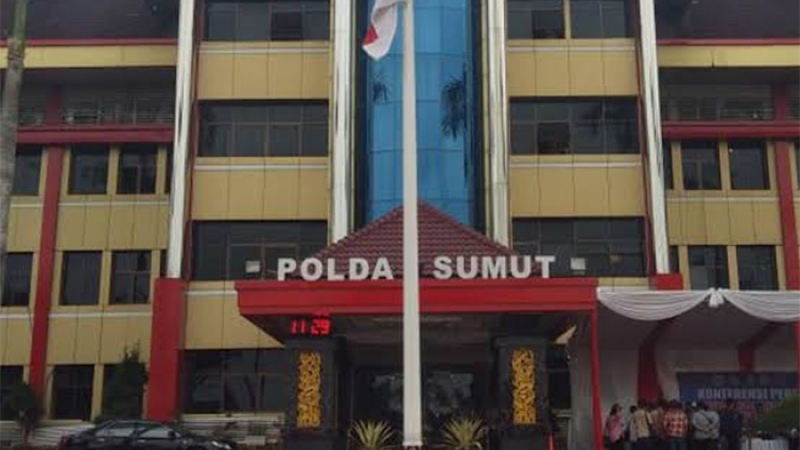
Officials from the Tebing Tinggi City Communication and Information Office were caught in a sting operation by officers from the North Sumatra Regional Police’s Special Criminal Investigation Directorate. Information obtained indicates the sting operation is related to an E-Catalog project at the Tebing Tinggi City Communication and Information Office.
A number of officials from the Tebing Tinggi City Communication and Information Office and private parties were also secured in the operation.
When contacted for confirmation via mobile phone, the Head of Public Relations for the North Sumatra Regional Police acknowledged the sting operation conducted by investigators from the Special Criminal Investigation Directorate at the Tebing Tinggi City Communication and Information Office.
However, the spokesperson was not yet willing to provide details. They only stated that further disclosure would be released, as the case is still under investigation and development.
“It is true there was a sting operation. The case is still being developed by investigators. The results will be communicated later, please be patient,” they stated.
North Sumatra Regional Police Headquarters
The North Sumatra Regional Police Headquarters, located in Medan, is the central command for law enforcement in Indonesia’s North Sumatra province. Historically, it was established during the Dutch colonial era as part of the colonial police structure and was later reorganized under the Indonesian National Police after independence. Today, it operates as a modern police institution responsible for maintaining security and order across the region.
Tebing Tinggi Communication and Information Office
The Tebing Tinggi Communication and Information Office (Dinas Komunikasi dan Informatika Kota Tebing Tinggi) is a local government agency in Tebing Tinggi, North Sumatra, Indonesia. It is responsible for managing public communication, information technology, and media relations for the city, a role established as part of Indonesia’s broader decentralization and modernization of regional governance in the post-reformasi era.
North Sumatra Regional Police
The North Sumatra Regional Police (Polda Sumut) is the provincial police force of North Sumatra, Indonesia, responsible for law enforcement and security in the region. It was formally established as part of the Indonesian National Police (Polri) following the country’s independence, with its modern structure evolving to address the area’s unique security challenges, including maintaining order in a diverse province with a significant urban center like Medan.
Special Criminal Investigation Directorate
The Special Criminal Investigation Directorate (SCID) is a specialized law enforcement unit within the Ghana Police Service, established to investigate and prosecute serious and complex crimes, particularly organized crime, financial fraud, and cybercrime. Its history is rooted in the need for a dedicated, expert body to tackle sophisticated criminal networks that threaten national security and economic stability, evolving over recent decades to address modern transnational threats.
Tebing Tinggi City Communication and Information Office
The Tebing Tinggi City Communication and Information Office (Dinas Komunikasi dan Informatika Kota Tebing Tinggi) is a local government agency responsible for managing public communication, information technology, and media relations within the city of Tebing Tinggi, Indonesia. Established as part of the city’s administrative structure, its history is tied to the broader development of regional autonomy and digital governance reforms in Indonesia following the late 1990s. It serves as the official channel for disseminating government information and promoting civic engagement to the public.
E-Catalog project
The “E-Catalog project” is not a specific historical place or cultural site, but rather a modern digital initiative. It typically refers to a project aimed at creating an electronic catalog or database, often used by libraries, museums, or archives to digitize and provide online access to their collections. As such, its “history” is part of the broader digital transformation of cultural heritage institutions over recent decades.