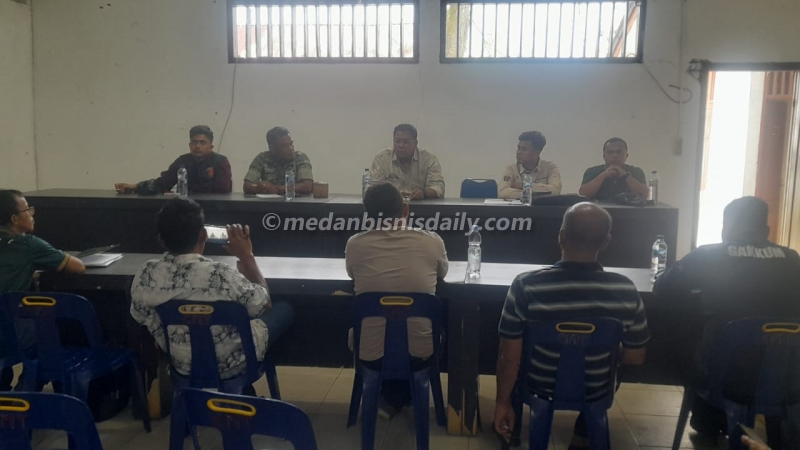
A joint team has completed monitoring in the HKm permit area of the Parna Jaya Cooperative.
The activity, carried out over two days, was a follow-up to a public hearing and a subsequent meeting regarding community aspirations.
During the monitoring, the joint team referred to the results of the public hearing, which had received complaints from the community.
“There were several points monitored at the location,” it was stated.
These included verifying whether there was any logging in the forest area, road opening and widening, mining of C-class materials, and construction of buildings within the forest area.
“The verification results from the field will be recorded in the conclusions of the official report,” it was added.
The results of this Joint Team’s monitoring, it was said, will form the final conclusion. “To determine whether the issues raised by the community correspond to the facts on the ground,” it was explained.
It was added that several findings from the Joint Team based on the monitoring results recorded in the official report will be conveyed to the relevant parties.
Subsequently, it will yield a final conclusion. “So this issue does not drag on,” it was emphasized.
Findings from the Joint Monitoring Team
According to the joint team’s monitoring results, fallen pine trees were found in the protected forest area and the working area of the Parna Jaya Sejahtera Cooperative’s HKm.
Furthermore, there were activities of road widening and clearing with varying widths of approximately 1.5 meters to 3.5 meters, including paths used for community access, pine resin tapping, transportation, and special interest tourism routes.
At specific coordinate points, the team also found mining activities for C-class materials; however, that location is known to be outside the HKm area or falls under other use area (APL).
Another finding was the presence of residential buildings within the protected forest area and the HKm area. Additionally, simple work huts made of planks were found, with the surrounding condition being shrubland.
Based on field monitoring results, pine resin tapping activities by the Parna Jaya Sejahtera Services Cooperative had stopped for over four months.
The Chairman of the Parna Jaya Sejahtera Cooperative stated that several findings reported by the community have been recurring.
“Previously, it was reported to the police, who then went to the field. However, no violations were found at the HKm location,” he said.
He expressed hope that the monitoring results from the joint team would reach a conclusion promptly. “We support government programs and continue to follow regulations,” he affirmed.
Kenegerian Ambarita
Kenegerian Ambarita is a traditional Batak village located on Samosir Island in Lake Toba, Indonesia, known for its well-preserved stone furniture and meeting grounds. Historically, it served as the seat and judicial court of the Siallagan clan, a Batak sub-group, with its iconic stone chairs and tables dating back centuries and used by village elders for meetings and trials. The site offers a direct glimpse into the ancient megalithic culture and social structure of the Toba Batak people.
Samosir Regional Legislative Council (DPRD)
The Samosir Regional Legislative Council (DPRD) is the local legislative body for Samosir Regency, located on Samosir Island in North Sumatra, Indonesia. It was established as part of Indonesia’s decentralization and regional autonomy reforms, with the primary function of representing the local population, creating regional regulations (Perda), and overseeing the executive branch of the Samosir Regency government.
<div class="my
Kenegerian Ambarita
Kenegerian Ambarita is a traditional Batak village located on Samosir Island in Lake Toba, Indonesia, famous for its well-preserved stone furniture and meeting courtyards. Historically, it served as the seat and judicial center of the Siallagan clan, a Batak Toba kingly lineage, with its iconic stone chairs and tables dating back centuries and once used for meetings and trials. Today, it stands as a significant cultural heritage site, offering visitors insight into the ancient rituals and social structure of the Batak people.
Samosir Island
Samosir Island is a large volcanic island situated in the middle of Lake Toba in North Sumatra, Indonesia. It is the cultural heartland of the Batak people and is believed to be the location of their ancient kingdoms. The island is also renowned for its stunning landscapes, traditional Batak villages with distinctive boat-shaped houses, and the many stone graves and megalithic sites that dot its interior.
Lake Toba
Lake Toba is a massive volcanic lake on the Indonesian island of Sumatra, formed by a super-eruption around 74,000 years ago—one of the largest known explosive events on Earth. It is a significant cultural site for the indigenous Batak people, whose traditional villages and unique architecture dot its shores. Today, it is a major tourist destination renowned for its stunning natural scenery and rich local heritage.
Siallagan clan
The Siallagan clan is a traditional Batak village located on Samosir Island in Lake Toba, Indonesia. It is historically known for its ancient stone chairs and tables, where clan leaders once held meetings and judicial proceedings, including reputed executions. Today, the well-preserved site serves as a significant cultural landmark that offers insight into the pre-colonial social structure and rituals of the Batak people.
Batak
Batak refers to both an ethnic group and a cultural region in North Sumatra, Indonesia, centered around Lake Toba. Historically, the Batak people developed several independent kingdoms and are known for their distinctive traditional houses (*rumah adat*), intricate wood carvings, and vibrant cultural traditions. The region’s history was significantly shaped by the formation of the colossal Lake Toba supervolcano tens of thousands of years ago, and later by the influence of trade, Christianity, and the modern Indonesian state.
Toba Batak
The Toba Batak are an ethnic group from North Sumatra, Indonesia, centered around Lake Toba—the world’s largest volcanic lake. Their history is deeply tied to this region, where they developed a distinct culture known for its intricate wooden architecture, such as the traditional *rumah adat* (ancestral house), and a rich tradition of music and weaving. Historically organized into clan-based villages, they were largely isolated until the 19th century, which helped preserve their unique social structure and animist beliefs, though many later converted to Christianity.
Samosir Regional Legislative Council (DPRD)
The Samosir Regional Legislative Council (DPRD) is the local legislative body for Samosir Regency in North Sumatra, Indonesia. It was established as part of Indonesia’s decentralization and regional autonomy reforms following the fall of the New Order regime, with the primary role of representing the people of Samosir—including the indigenous Batak communities—in creating local regulations and overseeing the regional government.
Samosir Regency
Samosir Regency is an administrative region located on Samosir Island and part of the mainland within Lake Toba in North Sumatra, Indonesia. It is the cultural heartland of the Batak Toba people, with a history deeply tied to the ancient Batak kingdoms and the massive volcanic eruption that formed Lake Toba tens of thousands of years ago. The area is renowned for its traditional villages, such as Tomok and Simanindo, which preserve unique Batak architecture, stone tombs, and vibrant cultural performances.