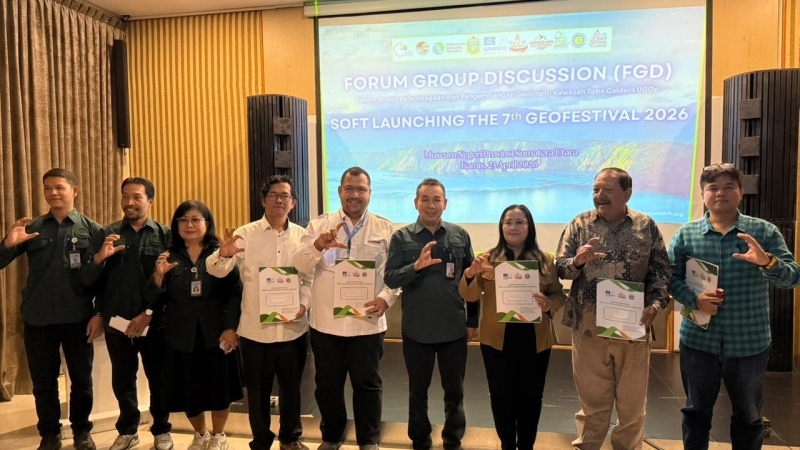
Geo Festival (Geofest) 2026 was officially launched through a soft launch held at the North Sumatra Regional Museum Mini Theatre in Medan on Thursday (23/4/2026). This festival serves as a collaborative platform for three world geoparks: Raja Ampat (pre-event), Caldera Toba (main event), and Lenggong Geopark (post-event).
The event was attended by experts, government officials, stakeholders, and strategic partners, who also signed a Memorandum of Understanding (MoU) to strengthen future collaboration.
The Acting Head of the North Sumatra Culture, Tourism and Creative Economy Office, represented by the Office Secretary, emphasized the importance of transforming the management of Caldera Toba from a mere tourist destination into a sustainable geopark-based area.
“Tourism is not just about visits, but also about cultural and environmental conservation, as well as community empowerment,” he said while opening the event with a gong strike.
The soft launch also featured a Focus Group Discussion (FGD) with speakers. They highlighted the importance of integrating geopark management through regulation and institutional strengthening.
Around 50 participants from various backgrounds took part in this discussion, including online contributions from an advisor to the Indonesian Geopark Network and a representative from Lenggong Geopark Malaysia.
Geofest 2026 will reach its peak on July 1-5, 2026, at Caldera Toba, featuring a series of activities such as conservation actions, geo-tours, geological product exhibitions, international seminars, and cultural performances.
An estimated 200 participants from domestic and international locations are expected to attend, including geologists, environmental activists, academics, and government officials, to formulate a more globally integrated geopark management strategy.
North Sumatra Regional Museum Mini Theatre
The North Sumatra Regional Museum Mini Theatre is a cultural performance space located within the North Sumatra Museum in Medan, Indonesia. It serves as a venue for traditional dance, music, and theatrical performances that showcase the diverse ethnic heritage of the region, including Batak, Malay, and other local cultures. The theatre supports the museum’s mission to preserve and promote North Sumatra’s history and traditions through live artistic expression.
Medan
Medan is the capital of North Sumatra, Indonesia, and the largest city on the island of Sumatra. Its history as a major trading hub dates back to the 16th century, but it grew rapidly in the late 19th century under Dutch colonial rule, becoming a center for the tobacco and rubber industries. Today, Medan is known for its diverse cultural heritage, blending Malay, Batak, Chinese, and Indian influences, with landmarks like the Maimun Palace and Great Mosque.
Raja Ampat
Raja Ampat is an archipelago located off the northwest tip of Bird’s Head Peninsula in West Papua, Indonesia, renowned for its stunning marine biodiversity and pristine coral reefs. The name “Raja Ampat” means “Four Kings,” referencing a local legend involving four brothers who discovered eggs that hatched into a princess and four kings, who later ruled the four main islands. Historically, the area has been inhabited by indigenous Papuan communities for thousands of years, and it became a globally recognized dive destination in the early 2000s after conservation efforts highlighted its ecological importance.
Caldera Toba
Caldera Toba is a massive supervolcano located in North Sumatra, Indonesia, formed by a catastrophic eruption approximately 74,000 years ago—one of the largest volcanic events in the last 2 million years. The eruption created a vast caldera that now contains Lake Toba, the largest volcanic lake in the world, with Samosir Island at its center. Today, it is a major tourist destination known for its stunning landscape and the Batak culture that thrives in the region.
Lenggong Geopark
Lenggong Geopark in Perak, Malaysia is a UNESCO Global Geopark renowned for its archaeological significance, containing evidence of human activity spanning nearly two million years. It is home to the Lenggong Valley, which features ancient caves and open-air sites, including the Tambun Rock Art and the Perak Man, the oldest complete human skeleton discovered in Southeast Asia. The geopark’s unique geology and rich cultural heritage make it a vital site for understanding early human history and the region’s natural evolution.
Indonesian Geopark Network
The Indonesian Geopark Network is a national initiative that connects geoparks across Indonesia, aiming to promote geological heritage conservation, sustainable development, and community-based tourism. Established to support UNESCO’s Global Geoparks program, the network includes diverse sites like Batur Global Geopark in Bali and Gunung Sewu in Java, which showcase Indonesia’s rich volcanic landscapes, ancient fossils, and cultural traditions. Through this network, Indonesia seeks to preserve its unique natural and geological history while fostering local economic growth and environmental education.
Lenggong Geopark Malaysia
Lenggong Geopark in Malaysia is a UNESCO Global Geopark located in Perak, known for its exceptional archaeological and geological significance. It is home to one of the oldest known human settlements in Southeast Asia, with evidence of human activity dating back over 1.8 million years, including the discovery of the Perak Man, a 10,000-year-old skeleton. The site also features limestone caves, ancient tools, and volcanic rock formations, offering a unique glimpse into prehistoric life and the region’s geological history.