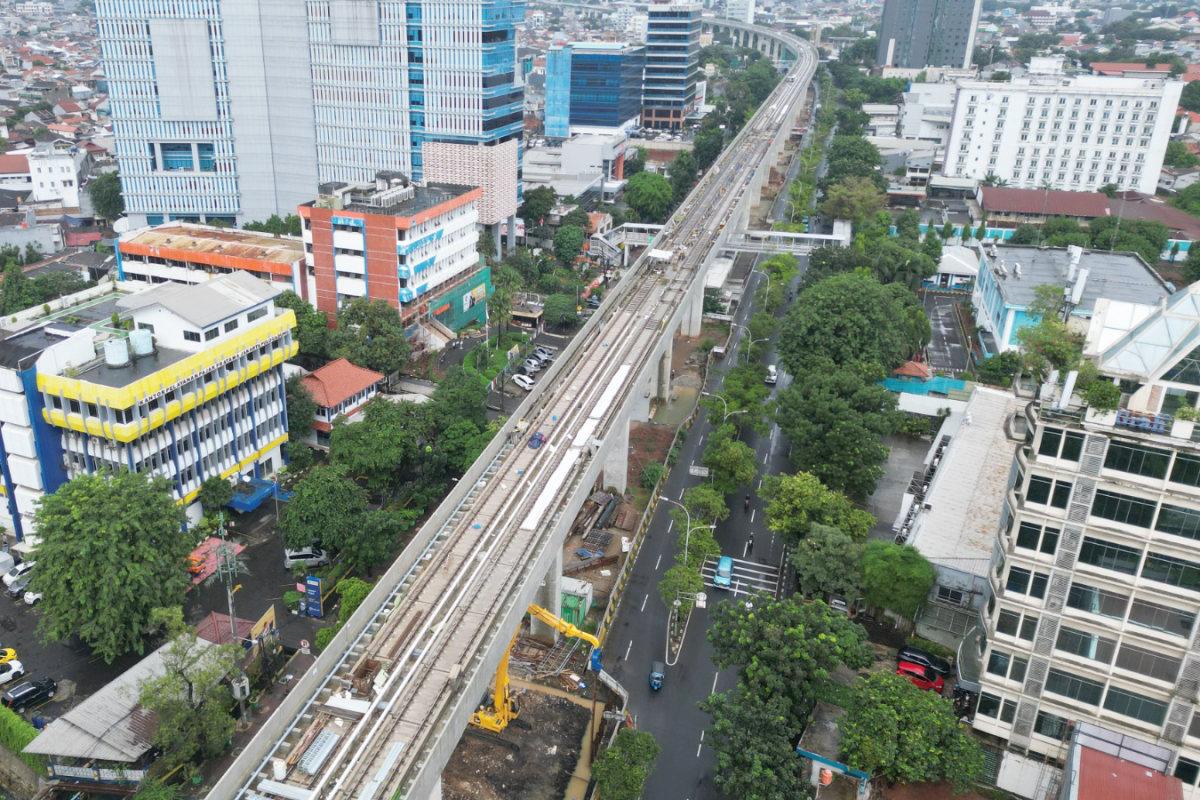
The Jakarta Provincial Government will prioritize the construction of the LRT route from Velodrome to Manggarai and then to Dukuh Atas.
“from Manggarai to Dukuh Atas,”
This decision was made by the Governor during a coordination meeting, taking into account various inputs and the budget of the Jakarta Provincial Government.
“For the LRT, the decision is to extend from Manggarai to Dukuh Atas to complete a single line from Velodrome to Dukuh Atas,” said Pramono at Jakarta City Hall on Wednesday (20/5).
He explained that the length of the Velodrome-Dukuh Atas LRT route will be 14.2 kilometers with a total of 12 stations. Additionally, there will be an extra investment of around 2.7 trillion Indonesian rupiah for the LRT construction.
Pramono emphasized that the extension of the LRT route from Velodrome to Dukuh Atas is intended to ensure the construction is fully completed.
“Why was this decision made from Manggarai to Dukuh Atas? So that the route is truly finished to completion,” he said.
After the completion of this route, construction will continue with the route from Velodrome to Jakarta International Stadium (JIS), Ancol, then to PIK 2 and Soekarno-Hatta Airport. He asked his staff to complete this route promptly.
“From Velodrome, JIS, Ancol, then it will continue to PIK 2 and to Soekarno-Hatta; the route will be completed later. Currently, it is only finished up to Ancol,” stated Pramono.
If the entire LRT route is completed, along with the MRT project from Balaraja to Cikarang, Pramono believes that connectivity and the transportation network in Jakarta will improve significantly.
Velodrome
A velodrome is a specialized, banked cycling track designed for track cycling events, often found within a larger sports complex. The first modern velodromes were built in the late 19th century, with the sport peaking in popularity in the early 20th century; today, iconic venues like London’s Lee Valley VeloPark, built for the 2012 Olympics, continue the tradition. These tracks are typically made of wood or concrete and feature steeply banked curves to allow cyclists to maintain high speeds.
Manggarai
Manggarai is a densely populated area in South Jakarta, Indonesia, best known for its historic and bustling railway station, Stasiun Manggarai, which is one of the busiest transit hubs in the city. The name originates from the Manggarai ethnic group from Flores, East Nusa Tenggara, as the area was once a settlement for people from that region during the Dutch colonial era. Today, Manggarai serves as a key transportation and commercial center, reflecting Jakarta’s dynamic urban growth.
Dukuh Atas
Dukuh Atas is a prominent transit hub and commercial area in Central Jakarta, Indonesia, known for its integration of multiple transportation modes, including commuter trains, the MRT, and TransJakarta buses. Historically, the area was part of a Dutch-era settlement named “Dukuh” (meaning hamlet), and it has evolved into a key node for urban mobility and modern development. Today, it is also recognized for the iconic “Dukuh Atas” skyline and its role in Jakarta’s mass transit network.
<
Velodrome
A velodrome is an arena designed for track cycling, featuring a steeply banked oval track. The first modern velodrome was built in the late 19th century, and these venues gained popularity with the rise of competitive cycling, including their use in the Olympic Games since 1896. Notable examples include the Vigorelli Velodrome in Milan, a historic site opened in 1935.
Manggarai
Manggarai is both a district in South Jakarta, Indonesia, and the name of a major railway station located there. The area is historically significant as the site of the Manggarai Waterkant, a colonial-era water reservoir built by the Dutch in the early 20th century to supply clean water to Batavia. Today, Manggarai Station serves as a key transit hub for Jakarta’s commuter rail system, connecting the city with surrounding suburbs.
Dukuh Atas
Dukuh Atas is a prominent transit hub and area in central Jakarta, Indonesia, known for its integration of multiple public transport systems including the MRT, KRL commuter rail, and TransJakarta bus rapid transit. Historically, the name “Dukuh Atas” refers to a former village or settlement area that existed during the colonial era, which has since transformed into a modern urban center. Today, it serves as a key transportation node and is surrounded by high-rise office buildings, hotels, and commercial facilities.
Jakarta International Stadium (JIS)
Jakarta International Stadium (JIS) is a modern multi-purpose stadium located in North Jakarta, Indonesia, which officially opened in 2022. It was built to replace the aging Gelora Bung Karno Stadium as a venue for major events, including the 2023 FIFA U-20 World Cup (though Indonesia was later stripped of hosting rights). With a capacity of over 82,000, it is one of the largest stadiums in Asia and features a retractable roof, making it a landmark of contemporary Indonesian architecture and infrastructure development.
Ancol
Ancol is a large recreational and resort area located in Jakarta, Indonesia, along the coast of Jakarta Bay. Originally a swampy area with a history as a Dutch colonial-era landfill and later a site for a leper colony, it was transformed in the 1960s under President Sukarno into a major tourism complex. Today, Ancol is home to popular attractions such as Dunia Fantasi (Fantasy World) theme park, Sea World Ancol, and numerous hotels and beaches.
PIK 2
PIK 2, also known as Pantai Indah Kapuk 2, is a large-scale, integrated residential and commercial development located in Tangerang, Banten, Indonesia. Built on reclaimed land along the northern coast of Jakarta, it emerged in the 2010s as an extension of the earlier PIK area, transforming former fish ponds and swamps into a modern, upscale township. The site is notable for its luxury housing, golf courses, and the “China Town” themed district, reflecting the area’s rapid urbanization and the influence of Chinese-Indonesian developers.
Soekarno-Hatta Airport
Soekarno-Hatta International Airport, located in Tangerang near Jakarta, Indonesia, is the country’s main gateway and one of the busiest airports in Southeast Asia. Named after Indonesia’s first president and vice president, Sukarno and Mohammad Hatta, it opened in 1985 to replace the outdated Kemayoran and Halim Perdanakusuma airports. The airport’s design incorporates traditional Javanese and modern architectural elements, reflecting Indonesia’s cultural heritage.
Balaraja
Balaraja is a district and town located in Tangerang Regency, Banten, Indonesia. Historically, it served as a significant administrative and economic hub during the colonial era, with its name derived from a local legend involving a king (“raja”). Today, Balaraja is known for its role as a transit and industrial area, connecting Jakarta to western Banten.

![Ilustrasi perempuan Indonesia pakai bedak [Ilustrasi AI]](https://asiacity.news/wp-content/uploads/2025/07/19139-rias-pengantin-150x150.webp)

![Partai Kebangkitan Bangsa (PKB) menggelar lomba desain karikatur Ketua Umum PKB Muhaimin Iskandar alias Gus Imin. [Suara.com/dok]](https://asiacity.news/wp-content/uploads/2025/07/43754-karikatur-150x150.webp)