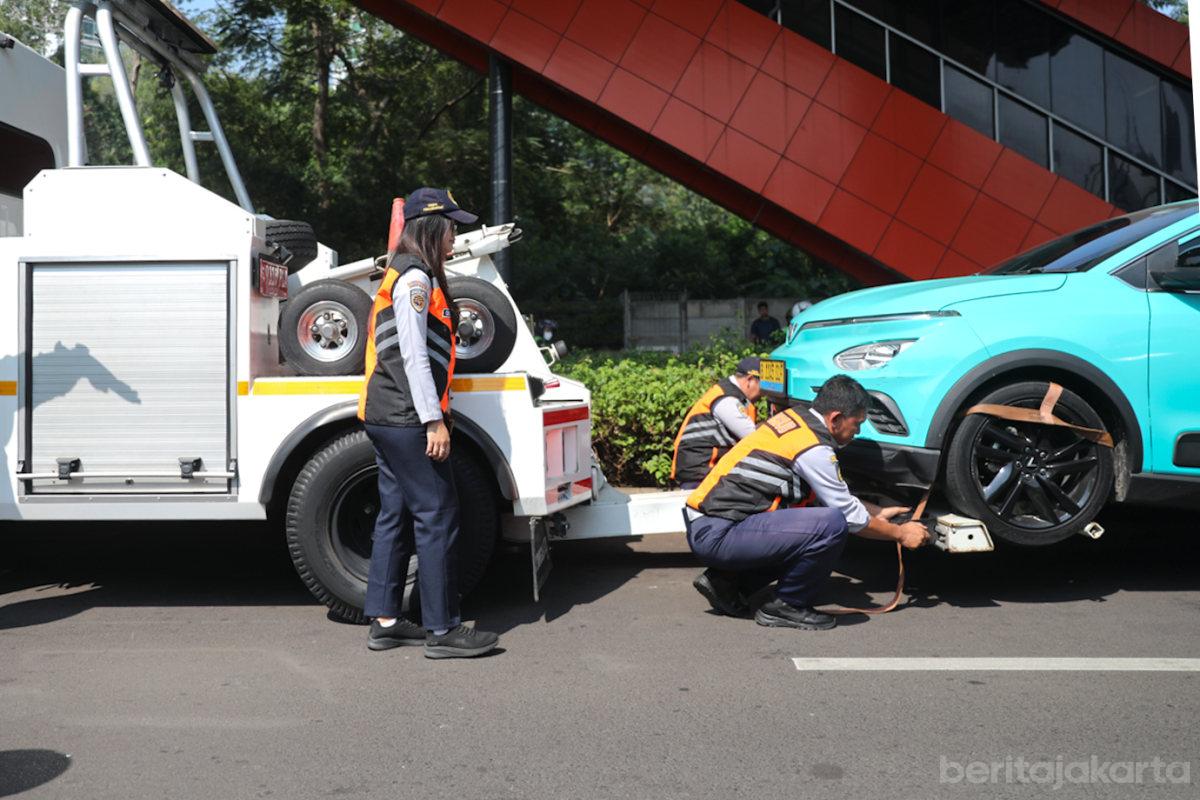
The Jakarta Transportation Agency (Dishub) conducted a simultaneous illegal parking crackdown operation in five administrative city areas starting Monday, June 8.
“illegal parking crackdown,”
A total of 600 combined personnel were deployed in the operation, which also involved elements from the Civil Service Police Unit, the Population and Civil Registration Agency, the Social Affairs Agency, the Indonesian Military, and the National Police.
The head of the Jakarta Transportation Agency stated that the operation will run for a full week.
“A total of 600 personnel attended this joint assembly and will conduct simultaneous crackdowns on illegal parking and illegal parking attendants in five cities in Jakarta,” he said while leading the Illegal Parking Crackdown Operation Assembly at Monas, Central Jakarta.
He stated that in the second week, crackdowns will be carried out three times a week, and in the third week, twice a week, before a comprehensive evaluation is conducted.
According to him, the crackdown is carried out to restore the function of roads as a means of public mobility and to reduce illegal parking practices that often cause traffic jams.
In the operation, officers will apply a number of actions, including Valve Stem Removal Operation against vehicles parked carelessly and towing of vehicles that violate regulations.
“We urge the public not to park in prohibited places. We will be present to take action in the form of towing or valve stem removal,” he said.
He mentioned that one of the main causes of rampant illegal parking in Jakarta is that some people still park vehicles in locations where parking prohibition or no-stopping signs have been installed.
This condition is exacerbated by the presence of illegal parking attendants who direct vehicles to park in prohibited areas. Therefore, in addition to taking action against vehicles, officers will also crack down on illegal parking attendants. He said that the Population and Civil Registration Agency and the Social Affairs Agency are involved in verifying population data of parking attendants caught in the operation.
“If they are found not to be Jakarta residents, they will be returned to their area of origin through coordination with the Social Affairs Agency. Meanwhile, Jakarta residents will be given guidance according to applicable regulations,” he explained.
He added that the crackdown operation focuses on 15 points that have been prone to illegal parking. In West Jakarta, the crackdown is carried out in the Cengkareng, Kalideres, and Kembangan areas. In Central Jakarta, it covers Kebon Sirih, KH Wahid Hasyim Street, and Thamrin City.
Meanwhile, in South Jakarta, the operation targets the Casablanca area, HR Rasuna Said Street, and Prof Dr Satrio Street. In North Jakarta, the crackdown is carried out in Kelapa Gading, Pademangan, and Tanjung Priok. In East Jakarta, it covers East Jatinegara, West Jatinegara, and the Jatinegara Station area.
“The limited availability of parking lots is also a challenge that needs attention. Therefore, the Transportation Agency together with the Civil Service Police Unit will continue to conduct supervision and crackdowns in the field to create traffic order and comfort for road users,” he concluded.
Monas
Monas, officially known as the National Monument (Monumen Nasional), is a 132-meter obelisk located in the center of Merdeka Square, Jakarta, Indonesia. It was built between 1961 and 1975 under the order of President Sukarno to commemorate the struggle for Indonesian independence from Dutch colonial rule. The monument features a golden flame at its peak, symbolizing the nation’s enduring spirit, and houses a museum and observation deck that offer insights into Indonesia’s history.
Cengkareng
Cengkareng is a district in West Jakarta, Indonesia, best known as the location of Soekarno-Hatta International Airport, the country’s main gateway. Historically, the area was a swampy, rural
Monas
Monas, officially known as the National Monument (Monumen Nasional), is a 132-meter tower located in Merdeka Square, Jakarta, Indonesia. Built to commemorate the struggle for Indonesian independence, its construction began in 1961 under President Sukarno and was completed in 1975. The monument features a flame-shaped gold-plated peak and houses a museum and observation deck, symbolizing the nation’s enduring spirit and history.
Cengkareng
Cengkareng is a district in West Jakarta, Indonesia, best known as the location of Soekarno-Hatta International Airport, the country’s main gateway. Historically, the area was a swampy, rural region that developed rapidly in the late 20th century after the airport’s construction in the 1980s. Today, it is a bustling, densely populated area with a mix of residential neighborhoods, commercial zones, and industrial estates.
Kalideres
Kalideres is a district located in West Jakarta, Indonesia, historically known as a key transit and residential area. Its name is derived from the Kali Deres River that flows through the region, and it developed rapidly during the colonial era as a hub for transportation and trade. Today, Kalideres is recognized for its bustling bus terminal and diverse communities, reflecting Jakarta’s urban growth.
Kembangan
Kembangan is a residential area in the eastern part of Singapore, originally a village (kampong) that grew around the rubber and coconut plantations established in the early 20th century. Its name is derived from the Malay word for “expansion” or “development,” reflecting its transformation from a rural settlement into a modern housing estate. Today, Kembangan is known for its mix of public and private housing, local amenities, and its proximity to the Kembangan MRT station.
Kebon Sirih
Kebon Sirih is a historic area in Central Jakarta, Indonesia, known for its colonial-era architecture and cultural significance. Its name, meaning “betel nut garden,” originates from a plantation that once existed there during the Dutch colonial period. Today, it is recognized for landmarks like the Kebon Sirih Mosque and its role as a center for traditional markets and community life.
KH Wahid Hasyim Street
KH Wahid Hasyim Street is a major thoroughfare in Jakarta, Indonesia, named after Abdurrahman Wahid, the country’s fourth president, who was popularly known as Gus Dur. The street runs through the central business district and is historically significant as a hub for commerce, education, and cultural exchange, lined with colonial-era buildings and modern establishments. It also connects key areas like Tanah Abang and Menteng, reflecting Jakarta’s blend of historical and contemporary urban life.
Thamrin City
Thamrin City is a large shopping center located in central Jakarta, Indonesia, known for its vast selection of textiles, clothing, and local handicrafts. Originally developed in the early 2000s, it was built on the site of the former Hotel Indonesia traffic circle area, becoming a bustling hub for budget-friendly fashion and wholesale trade. The mall reflects Jakarta’s dynamic urban growth and serves as a popular destination for both locals and tourists seeking affordable goods.
Casablanca
Casablanca is Morocco’s largest city and a major economic hub, known for its modern architecture and vibrant port. Its history dates back to the 15th century, when it was a small fishing village called Anfa, but it was later destroyed by the Portuguese and rebuilt in the 18th century. The city gained international fame through the 1942 film *Casablanca*, though the movie was actually filmed in Hollywood.

![Polda Metro Jaya menggelar patroli skala besar pada Minggu (31/8/2025) untuk mengamankan di Jakarta di tengah gelombang demonstrasi yang terjadi dalam satu pekan terakhir [Suara.com/ANTARA/Dokumentasi Pribadi]](https://asiacity.news/wp-content/uploads/2025/09/65317-patroli-polisi-150x150.webp)