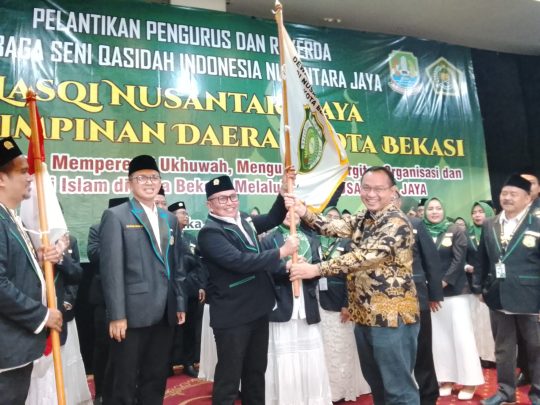
BEKASI CITY – The West Java Provincial Board of the Indonesian Nusantara Jaya Qasidah Arts Institution (LASQI NJ) officially inaugurated H. Sholihin as the chairman of the DPD LASQI NJ for Bekasi City, held at Graha Hartika on Saturday (04/25/2026).
After the inauguration, Sholihin outlined several programs to further promote Islamic arts and culture in Bekasi City. One of them is to encourage Qasidah art to be included in school extracurricular activity programs.
“We want LASQI to enter schools. Provide education about Islamic arts and culture through qasidah and marawis, so school children can learn Qasidah art. I believe our children have great talent. Yes, maybe from junior high, senior high, and equivalent levels later,” said the man affectionately known as Gus Shol.
In addition, LASQI Bekasi City will collaborate with the local government to repopularize Qasidah art in the community. Government support as policy makers is crucial to support Islamic arts and culture.
“I think there must be collaboration with the local government. What does collaboration mean? LASQI is part of Bekasi City. When there are ceremonial event moments, or at the neighborhood, community, sub-district, district, up to city level, please involve LASQI for that collaboration,” he explained.
“Yes, God willing. God willing, we the management will meet to convey that LASQI exists. So that the government provides recognition. LASQI will also contribute to Bekasi City in terms of arts and culture,” he concluded.
Meanwhile, the General Chairman of the West Java LASQI Provincial Board, Maman Imanulhaq, appreciated Sholihin’s inauguration as Chairman of the DPD LASQI Bekasi City. He also entrusted several things to Gus Shol.
“I entrust several things: First, always preach the spirit of Islam; second, always explore the values of Islamic wisdom,” he said.
The man affectionately known as Kang Maman also supports the LASQI Bekasi City program that encourages Qasidah art to enter the education sector in Bekasi City.
“I support the Qasidah entering schools program; if necessary, we will find a solution so that schools can have Qasidah instruments available,” he said.
Graha Hartika
Graha Hartika
Graha Hartika Wulansari
Graha Hartika Wulansari
Graha Hartika
Related news

Aleg Ahmadi Madonk Officially Reports to Police as Alleged Victim of Violence

Viral story of a woman from Bekasi suffering from bone tuberculosis until she could not walk.

The Sun Gazer: Love from the Sky

The smell of garbage from the market landfill disrupts activities at Pondokgede General Hospital.