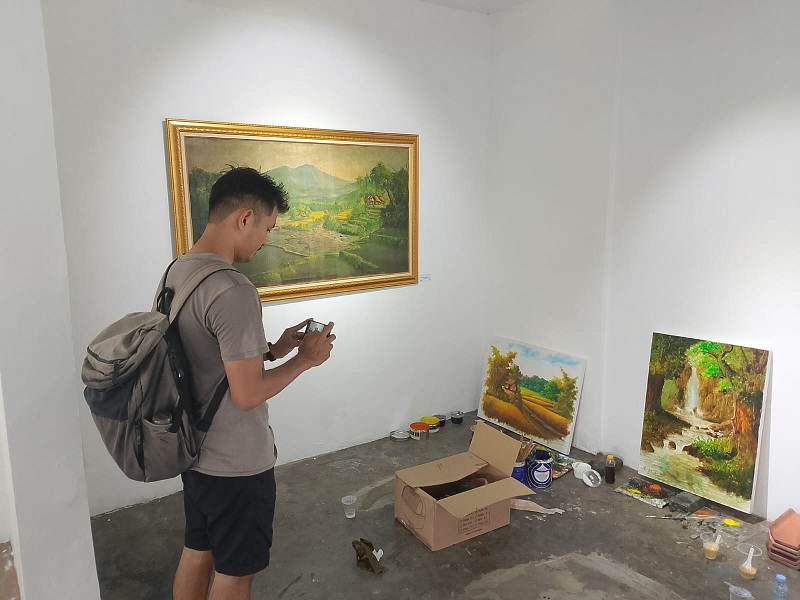
The changing times have transformed how artists sell their works. In the past, buyers had to come directly to painting galleries in Kampung Seni Jelekong, but now orders come in through online shopping applications. Amidst expanding market opportunities, painters are required to adapt to a fast-paced work rhythm, price competition, and digital platforms.
Morning has just arrived at Kampung Seni Jelekong, Baleendah District, Bandung Regency. In a simple studio, stacks of canvases lean against the walls, while the smell of oil paint mixes with the humid air typical of South Bandung.
In a corner of the room, a painter stares at their phone screen before starting to brush. Their reference is no longer a landscape brought directly by the buyer, but a digital photo just sent through an online shopping app.
This scene has become the new daily reality for the artists. The village, known for decades as the largest painting center in West Java, is undergoing a major transformation with the rise of digital trade.
If previously transactions were conducted face-to-face between painters and buyers who came to the galleries, now most orders come from e-commerce platforms. The presence of online stores opens up a much wider market for the painters. Buyers are no longer limited to tourists or collectors from Bandung and Jakarta, but also come from various regions across Indonesia.
This situation has led to increased sales volume and opportunities for greater income compared to conventional sales systems.
However, behind these opportunities lies a significant shift in the painters’ work patterns. Time has become a crucial factor. Many orders must be completed within three to five days to meet the shipping deadlines set by digital platforms.
“In the past, buyers came directly to the gallery; they could see the process and quality of the painting firsthand. Now, most see product photos in the app. As a result, we have to work faster because there are shipping targets to meet,” said Arya Sudrajat, a painter and manager of the Bubuara Jelekong Foundation.
Market changes have also affected production techniques. To meet the increasing demand, some painters have started adopting new methods. Order photos are first printed onto canvas, then refined with brushstrokes and the painter’s hand touch.
“This method is considered capable of reducing work time without eliminating the artistic element, which is still done manually,” Arya said.
According to him, this method emerged as a form of adaptation to the demands of the digital market, which wants fast results at competitive prices. On one hand, this technique helps painters fulfill more orders. On the other hand, there are concerns that the creative process, which has long been the identity of Jelekong paintings, is gradually shifting into a production system more akin to an industry.
Another challenge comes from price competition on online platforms. Whereas previously painting prices were determined by the painter’s reputation, the complexity of the work, or direct negotiation with the buyer, sellers now must adjust to the market mechanisms formed within the apps.
“In terms of price, it is indeed higher than the conventional sales system, but there are quite large deductions from the platform. Also, there are more and more online painting stores now,” Arya said.
He explained that painters are not entirely free to set selling prices. The platform system indirectly establishes price standards that sellers must follow.
“For example, we open a new online store. We can’t immediately sell a painting for IDR 5 million if the highest common price on that platform is only around IDR 1.5 million. In the end, we have to follow the standards already established in the app,” he said.
Nevertheless, the artists have little choice but to continue adapting. Amidst changing consumption patterns and the growing dominance of digital trade, e-commerce has become a new gateway, allowing works from the art village in South Bandung to reach homes across Indonesia.
Among the brushes, oil paints, and apps, Jelekong painters are now required not only to produce beautiful works but also to understand how the fast-moving digital market works.
Kampung Seni Jelekong
<div class="text-gray