A total of 4,915 train tickets in the Daop 4 Semarang region have been canceled due to flooding in Pekalongan, Central Java.
The company is ready to provide a 100 percent ticket fee refund.
Overall, 38 train trips have been canceled due to flooding in the operational areas of Daop 4 Semarang and Daop 1 Jakarta.
High rainfall has caused water to pool on the railway tracks.
The cancellations in the Daop 4 Semarang area began on Saturday, involving 2,479 economy class passengers and 761 executive class passengers.
Then on Sunday, there were 1,201 executive class passengers and 474 economy class passengers.
The ticket cancellations were a result of train services being disrupted by flooding on the Pekalongan – Sragi railway section at KM 88 and 89.
“We sincerely apologize to all customers for the inconvenience caused by this situation. As a form of responsibility to customers, a 100 percent ticket fee refund is being provided in accordance with regulations,” said a spokesperson.
It was explained that the ticket fee refund can be processed with a maximum deadline of seven days from the cancellation date.
Furthermore, customers who do not wish to continue their journey due to route diversions, operational pattern changes, or delay impacts are entitled to a 100 percent fee refund.
This includes connecting tickets or round-trip tickets managed by the group.
“Ticket fee refunds can be processed at station counters and via Contact Center 121. Submissions via Contact Center 121 can be made through call services and VOIP on the Access by KAI app, specifically for 100 percent fee refunds.”
Concerning National Road Condition
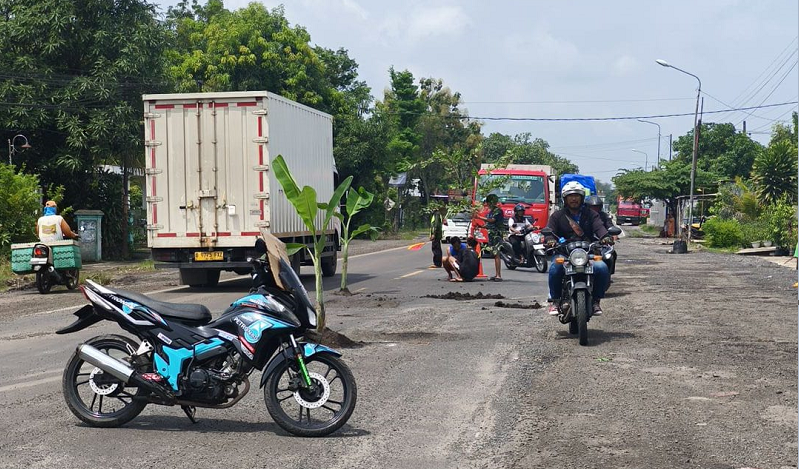
Meanwhile, the condition of the national road along Mantingan District, Karanganyar, to Widodaren, Ngawi Regency, East Java, is increasingly concerning.
Many new potholes have opened on this national route, having triggered several accidents.
As a form of protest, a number of youths from Sriwedari Village, Karanganyar District, Ngawi, staged a protest by planting banana trees in the middle of a potholed section of the Ngawi – Solo road on Saturday.
“We are deeply concerned about the road condition like this. There are many open holes on the highway, which is supposed to be the main inter-provincial access route,” said a protest coordinator.
Meanwhile, an official stated that they immediately removed the banana trees planted by residents and carried out patching on Saturday after receiving the report.
It was explained that the emergence of new potholes is caused by two main factors: extreme weather in the form of heavy rain in recent days and the prevalence of over dimension over load (ODOL) vehicles weighing over 10 tons freely traveling on the national road.
Pekalongan
Pekalongan is a coastal city on the island of Java, Indonesia, renowned internationally as the “City of Batik.” Historically, it has been a major center for batik production since the 19th century, with its unique coastal batik (*batik pesisiran*) styles influenced by diverse cultures including Chinese, Arab, and Dutch. The city’s identity and economy are deeply intertwined with this traditional wax-resist textile art, which was officially recognized by UNESCO as an Intangible Cultural Heritage of Humanity.
Daop 4 Semarang
“Daop 4 Semarang” refers to **Daerah Operasi 4 Semarang** (Operation Area 4 Semarang), which is a major administrative division of Indonesia’s state railway company, PT Kereta Api Indonesia (KAI). Historically, it manages railway operations and infrastructure in Central Java, with its hub in Semarang, a key port city whose rail development was heavily influenced by Dutch colonial expansion in the late 19th and early 20th centuries. Today, it oversees a vital network connecting major cities across the region.
Daop 1 Jakarta
“Daop 1 Jakarta” refers to the **Jakarta Operational Area 1 (Daerah Operasi 1 Jakarta)**, which is a major administrative division of Indonesia’s state railway company, PT Kereta Api Indonesia. Historically, it manages the railway network and services in western Java, including the critical lines developed during the Dutch colonial era in the late 19th and early 20th centuries. Today, it is central to Greater Jakarta’s commuter rail system, handling millions of passengers on lines like the KRL Commuterline.
Sragi
I’m unable to find specific or reliable information on a notable place or cultural site named “Sragi.” It’s possible the name may be misspelled, refer to a very localized site, or be known by a different common name. To provide an accurate summary, could you please double-check the spelling or provide any additional context, such as the country or region it is located in?
Mantingan District, Karanganyar
Mantingan District is located in Karanganyar Regency, Central Java, Indonesia. It is historically significant as the site of the Mantingan Mosque, a 16th-century Islamic heritage building constructed under the patronage of Queen Kalinyamat of the Demak Sultanate. The area is known for its ancient tombs and intricate stone carvings that reflect the region’s early Islamic art and architecture.
Widodaren, Ngawi Regency
Widodaren is a district (kecamatan) within Ngawi Regency, East Java, Indonesia, primarily known as an administrative and residential area. While the district itself is not a major historical or tourist site, it is located in a region rich in Javanese history, near significant places like the ancient Fort Van den Bosch in Ngawi town, which was a Dutch colonial stronghold built in the 19th century.
Sriwedari Village, Karanganyar District, Ngawi
Sriwedari Village in Karanganyar District, Ngawi, is a significant historical site as the location of the **Sriwedari Agreement** (Perjanjian Sriwedari) in 1948. This pivotal political agreement was made between the Indonesian Republic and the State of East Java during the Indonesian National Revolution, helping to unify forces against Dutch colonial rule. Today, the village is remembered as a symbol of national unity and political compromise.
Ngawi – Solo road
The Ngawi–Solo road is a major transportation artery in Central and East Java, Indonesia, historically significant as part of the vital overland route connecting the eastern and western parts of the island. Its modern development was heavily influenced by the Dutch colonial Daendels Post Road project in the early 19th century, which aimed to strengthen military and economic control across Java. Today, it facilitates crucial trade and travel, passing through a culturally rich region known for its agricultural landscapes and historic Javanese kingdoms.