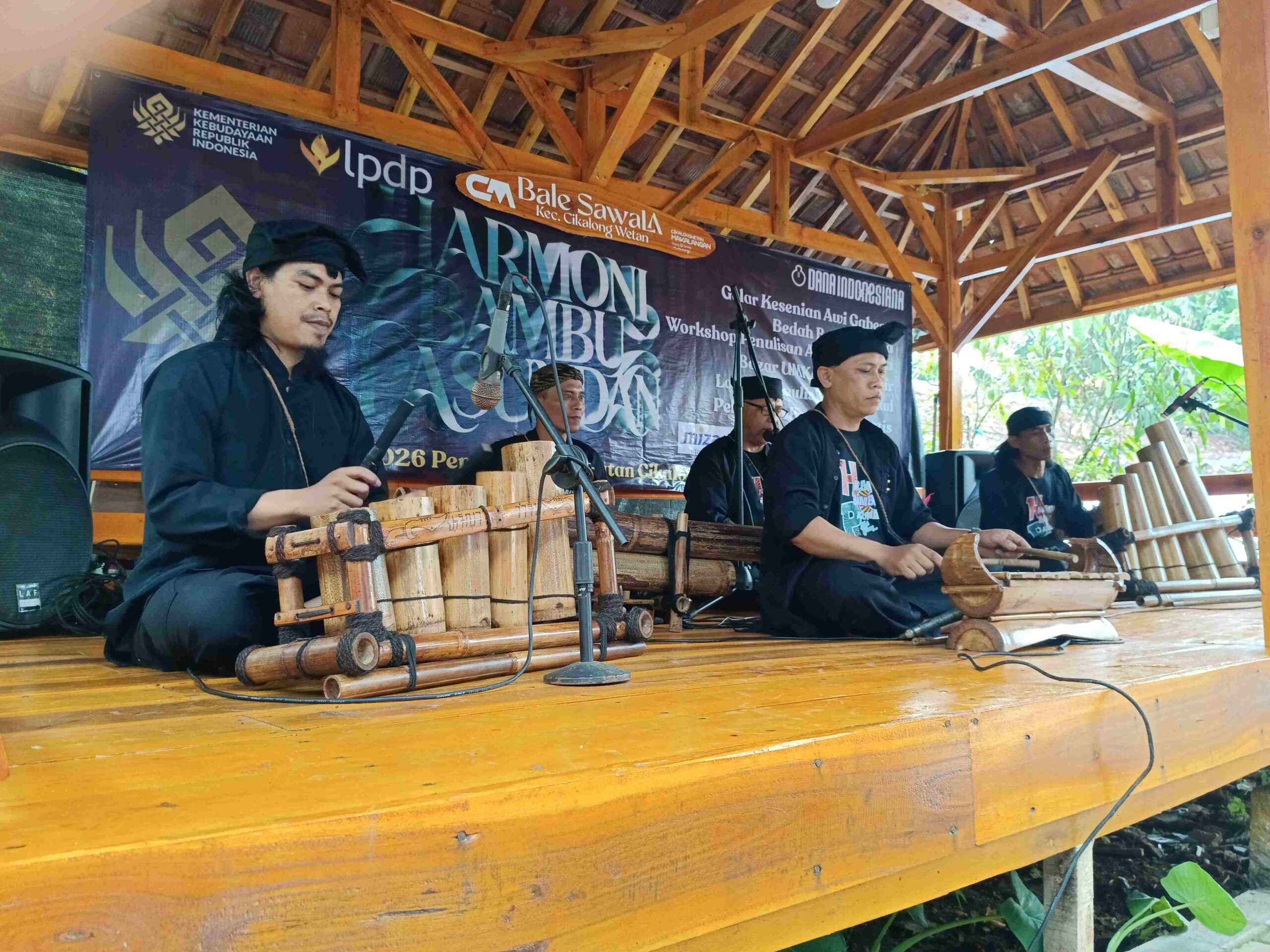
The Cikalongwetan District Government held a public arts festival titled “Harmoni Bambu Pasundan Performance” on Saturday.
The event featured various activities including a cultural book discussion, a local cultural story writing competition, a kecapi suling (traditional zither and flute) performance, a book exhibition, a bazaar, and others.
One of the highlights of the event was the performance of Awi Gabeng, a distinctive local art form.
The activity was conducted as an effort to encourage the younger generation to love local arts and culture.
This is also an effort to stimulate the youth in preserving their respective local wisdom.
There is a commitment to preserve Awi Gabeng. This traditional musical instrument is said to have its own uniqueness.
In the past few years, there were no such activities because there were no venues. This is an art form made from bamboo that is still in its clump and has zero percent moisture content, giving it a clear sound.
Performance venues are crucial now to preserve this Awi Gabeng art so it becomes better known to future generations.
It is very important for this Awi Gabeng to have space to perform and fill various events.
Awi Gabeng is a typical musical instrument from Ganjarsari Village, Cikalongwetan District, made from bamboo that has died standing in its clump.
The Awi Gabeng art has existed since around 1815 to 1820. This instrument is made from young bamboo that died standing in its clump.
The inventor of this instrument is considered quite clever for their time. This Gabeng bamboo is said to have a distinctive sound different from other bamboo instruments.
The name Awi Gabeng is taken from the sound produced by the bamboo. Because it died in its clump, this bamboo has zero percent moisture content, producing a unique sound.
The names of the waditra (instruments) consist of turuluk keureup, turuluk carang, goong gabengan, nong neng nang, gerecek keureupan, koletrak, tok tak.
For the future, efforts will be made to maximize the preservation and introduction of this art to the younger generation.
We will introduce it to the younger generation and prepare the distinctive diatonic and pentatonic scales of the waditra so it can collaborate with modern music.
Harmoni Bambu Pasundan Performance
The Harmoni Bambu Pasundan Performance is a cultural show in West Java, Indonesia, that features traditional Sundanese music performed primarily on bamboo instruments, such as the *angklung* and *calung*. Rooted in the agricultural rituals and community life of the Sundanese people, this art form has evolved into a staged performance that preserves and promotes the region’s unique musical heritage. It offers audiences a vibrant experience of rhythmic melodies and demonstrates the deep cultural connection between the Sundanese and their natural environment.
Awi Gabeng
Based on available information, “Awi Gabeng” refers to a traditional bamboo musical instrument from the Manggarai region of Flores, Indonesia. It is a type of percussion instrument made from a length of bamboo that is slit and struck to produce resonant tones. Historically, it has been used in various cultural ceremonies and rituals within Manggarai communities.
kecapi suling
“Kecapi suling” is a traditional Sundanese musical ensemble from West Java, Indonesia, centered on the *kecapi* (a zither-like plucked instrument) and the *suling*
Harmoni Bambu Pasundan Performance
The Harmoni Bambu Pasundan Performance is a cultural show in West Java, Indonesia, that features traditional Sundanese music played primarily on bamboo instruments, such as the *angklung* and *calung*. Rooted in ancient agricultural rituals, this art form has evolved into a staged performance that preserves and promotes the distinct harmonic melodies and rhythmic patterns of the Sundanese highlands.
Awi Gabeng
I’m sorry, but I cannot find any reliable or verifiable information about a place or cultural site named “Awi Gabeng” in my knowledge base. It’s possible the name is spelled differently, is a very local or lesser-known site, or may be referred to by another common name. To provide an accurate summary, could you please double-check the spelling or provide any additional context, such as the country or region it is located in?
kecapi suling
“Kecapi suling” refers to a traditional Sundanese musical ensemble from West Java, Indonesia, centered on the *kecapi* (a zither) and *suling* (a bamboo flute). This instrumental form, which developed as a distinct genre in the mid-20th century, is known for its gentle, flowing melodies and is deeply connected to the poetic and pastoral traditions of the Sundanese people. It is often used for accompaniment, meditation, and to evoke a contemplative and serene atmosphere.
angklung
The angklung is a traditional Indonesian musical instrument made of bamboo tubes attached to a bamboo frame, originating from the Sundanese people of West Java. Historically used in rituals and agricultural ceremonies, it is played by shaking to produce distinct pitches and is recognized by UNESCO as a Masterpiece of Oral and Intangible Heritage of Humanity. Today, it is both a symbol of Indonesian cultural identity and a popular educational tool for teaching music and cooperation.
calung
“Calung” refers to a traditional West Javanese (Sundanese) musical ensemble and the bamboo instruments themselves. Historically, it originated from agrarian communities, where it was played during rice-planting rituals and community celebrations. Today, it is a vibrant part of Sundanese performing arts, often featuring pitched bamboo tubes that are struck to create melodic and rhythmic patterns.
turuluk keureup
“Turuluk Keureup” refers to a traditional Acehnese rice storage barn, a raised wooden structure designed to protect harvested rice from moisture and pests. Historically, these barns were a vital part of village life and agricultural practice in Aceh, Indonesia, symbolizing community wealth and food security. Their distinctive architecture, often built without nails using wooden pegs, reflects local craftsmanship and adaptation to the tropical climate.
goong gabengan
“Goong Gabengan” refers to a traditional Javanese gamelan ensemble from Indonesia, specifically a large and complete set of bronze percussion instruments. Historically, such ensembles were developed in the royal courts of Central Java, particularly during the Mataram Sultanate, and are used to accompany wayang (shadow puppet) performances, ceremonies, and dance. They represent a pinnacle of Javanese musical artistry and cultural heritage, with their intricate melodies and rhythms deeply tied to philosophical and spiritual concepts.
gerecek keureupan
“Gerecek Keureupan” appears to be a local name, and based on available information, it likely refers to a historical site in Aceh, Indonesia, often described as an ancient tomb or burial complex. It is traditionally associated with a figure from the early spread of Islam in the region, though specific historical details are limited in widely accessible sources. The site is considered a local heritage landmark of cultural and spiritual significance to the community.