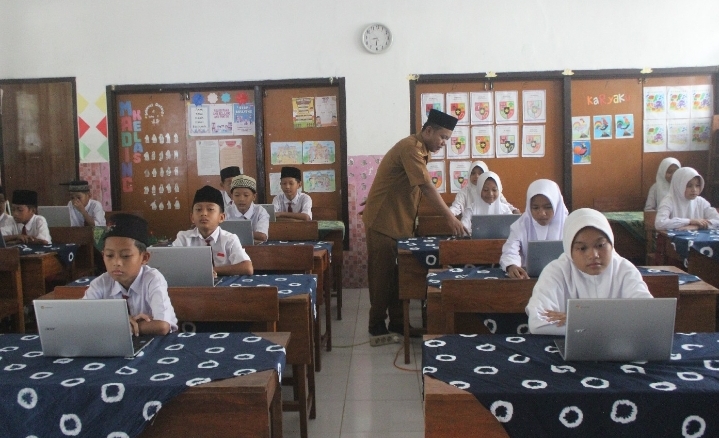
The Ministry of Basic and Secondary Education announced the results of the Academic Ability Test (TKA) for elementary and middle school levels yesterday (26/5/2026). The average scores for several subjects remain relatively low, especially mathematics. The Head of the Agency for Basic and Secondary Education Policy noted that the average mathematics score for elementary school reached 43.41 out of a scale of 100.
Meanwhile, for middle school, it was 40.34. These figures are still slightly better compared to the average mathematics score for high school level last year, which was 36.10. For the Indonesian language subject, the average scores of participants were higher. Elementary school recorded a score of 60.14 and middle school 60.83. The average for high school last year was 55.38.
“If we look at the scores, they are better compared to high school, vocational school, or equivalent levels,” said the official at the Ministry of Basic and Secondary Education office in Jakarta yesterday (26/5).
According to him, the agency is still investigating the factors causing the low achievement in mathematics in the TKA. The analysis is being conducted comprehensively, covering aspects of teachers, the learning process, and the material taught. Perfect Scores Despite the low average, the agency also found students who achieved perfect scores. Around 4,000 students scored 100 for the Indonesian language subject, while about 800 students did so for mathematics.
He emphasized that the TKA results are not a tool for labeling schools, local governments, or students. According to him, the TKA serves as an evaluation instrument to improve the quality of national education. The test results are used for evaluating education quality through five integrated data sets: student literacy and numeracy ability profiles, report card validation data, academic competency mapping, curriculum evaluation, and objective references for new student admissions selection. Assessment Method The Head of the Center for Educational Assessment at the Ministry of Basic and Secondary Education explained that the assessment uses a calculation method of the proportion of correct answers transformed into a scale of 0 to 100. A student will receive a score of 50 if they can answer 15 questions correctly out of a total of 30 questions.
“70 percent of the TKA questions for middle school and elementary school levels are created centrally, while 30 percent of the questions come from each district or city, randomized for each province,” she explained.
She assessed that socialization and school readiness also influence TKA results. This is evident from the higher TKA achievements at the elementary and middle school levels compared to the high school level. When viewed by type of educational institution, there is a significant difference in Indonesian language scores at the middle school level between regular schools and madrasahs. However, at the elementary school and Islamic elementary school levels, Indonesian language achievements are relatively similar. For mathematics, the results from both types of schools are considered equally low.
“So, the challenge is the same between the Ministry of Basic and Secondary Education and the Ministry of Religious Affairs for mathematics,” she clarified. Problem Findings She also reported obstacles that arose during the implementation of the TKA. These range from limited computers or laptops, internet access, to the exam schedule that combines elective and compulsory subjects.
These issues will become material for future evaluation in the implementation of the TKA for the high school level next year. It is planned that the series of implementations will be moved forward by one week from the previous schedule. Registration for the high school level TKA in 2026 will open from August 18 to September 27, 2026. The implementation will start from October 24 to November 8, 2026.