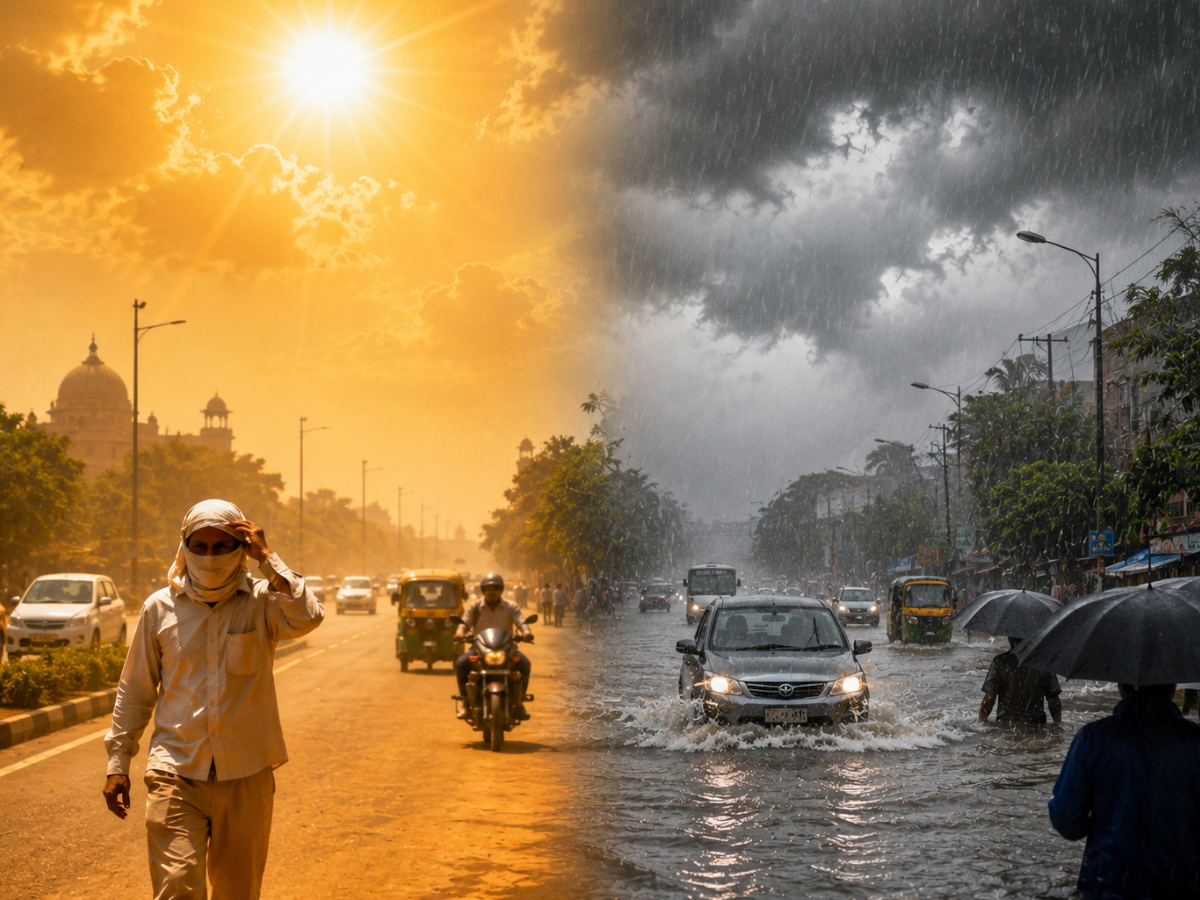
Heavy rain expected in several states as weather takes a sudden turn during the heatwave, bringing relief to many.
Today Weather Report: Amid intense heat across the country, the weather is set to change once again. According to the IMD, an alert for storms and rain has been issued for 13 states, including Uttar Pradesh and Bihar, on Tuesday. During this time, strong winds at speeds of up to 85 kilometers per hour may occur. In view of this, the weather department has advised people to remain alert. Especially in the hill states, there may be some inconvenience for residents.
Rain and Storm Alert in These States
The IMD has issued an alert for rain and storms in 13 states: Uttar Pradesh, Bihar, Himachal Pradesh, Uttarakhand, Jharkhand, West Bengal, Tamil Nadu, Kerala, Odisha, Assam, Tripura, Andhra Pradesh, and Punjab. During this period, strong winds at speeds of 80-85 kilometers per hour may also blow. The weather department has asked fishermen and farmers to stay alert for rain and storms.
Heatwave Conditions Here
Regarding Tuesday, according to the weather department’s press release, heatwave conditions will persist in Delhi, Rajasthan, Punjab, Haryana, and Uttar Pradesh. In many areas, maximum temperatures could reach 43-47 degrees Celsius, causing people to sweat profusely. In Punjab and Haryana, heatwaves accompanied by strong winds are likely until May 26-27. Here, afternoons will have intense sunshine, and nights will also be very warm. In Delhi, a rain and storm alert has been issued from May 29 onwards.
Rain in South India
According to the weather department, light to moderate rain will occur in coastal areas of Tamil Nadu, Puducherry, Kerala, Lakshadweep, and Andhra Pradesh in South India. During this time, strong winds at speeds of 40-50 kilometers per hour will blow. Heavy rain is likely in many areas of Kerala and Tamil Nadu on May 25-26. Strong winds will also blow in Telangana and Andhra Pradesh. The IMD has advised fishermen not to go to the coast.
In Northeast India, light rain accompanied by lightning and strong winds is likely in Assam, Meghalaya, Mizoram, Manipur, Nagaland, Arunachal Pradesh, and Tripura. Heavy rain may occur in Assam and Meghalaya on May 26-27.
Uttar Pradesh
Uttar Pradesh, a state in northern India, is a historically and culturally rich region often considered the heartland of Indian civilization. It is home to ancient cities like Varanasi and Ayodhya, as well as the iconic Taj Mahal in Agra, a UNESCO World Heritage site. The region has been a center of power for major empires, including the Maurya, Gupta, and Mughal dynasties, and is deeply significant in Hindu mythology and the history of Buddhism and Islam.
Bihar
Bihar, a state in eastern India, has a rich history as a major center of ancient Indian civilization, serving as the heart of the powerful Magadha empire and the Maurya and Gupta dynasties. It is renowned as the birthplace of Buddhism, where Gautama Buddha attained enlightenment in Bodh Gaya, and also holds significance for Jainism. Today, Bihar is known for its cultural heritage, including ancient universities like Nalanda, though it also faces challenges related to economic development.
<h3 class="text-lg font-sem
Varanasi
Varanasi, one of the world’s oldest continuously inhabited cities, is a major spiritual and cultural hub in India, located on the banks of the Ganges River. For millennia, it has been a center of Hindu pilgrimage, learning, and worship, believed to have been founded by the god Shiva. The city is renowned for its ghats, where rituals and cremations occur, and its deep association with the cycle of life, death, and rebirth.
Ayodhya
Ayodhya is a historic city in northern India, considered one of the seven sacred cities in Hinduism. It is traditionally believed to be the birthplace of Lord Rama, a major deity, and served as the capital of the ancient Kosala kingdom. The city has been a focal point of religious and political history, most notably due to the long-standing dispute over the Babri Masjid mosque, which was ultimately resolved in 2019 with the construction of a Ram temple on the site.
Taj Mahal
The Taj Mahal is a stunning white marble mausoleum located in Agra, India, built between 1631 and 1648 by Mughal emperor Shah Jahan in memory of his beloved wife, Mumtaz Mahal. It is widely regarded as a masterpiece of Mughal architecture, blending Persian, Islamic, and Indian styles. Today, it is a UNESCO World Heritage Site and one of the most iconic symbols of love in the world.
Agra
Agra is a city in northern India, best known as the home of the Taj Mahal, a stunning white marble mausoleum built by Mughal Emperor Shah Jahan in memory of his wife Mumtaz Mahal. It served as the capital of the Mughal Empire during the 16th and 17th centuries, and its rich history is also reflected in other architectural marvels like the Agra Fort and Fatehpur Sikri. Today, Agra is a major tourist destination, drawing millions of visitors worldwide to witness its UNESCO World Heritage sites.
Bodh Gaya
Bodh Gaya is a significant Buddhist pilgrimage site in Bihar, India, where Siddhartha Gautama attained enlightenment and became the Buddha around 500 BCE. The most important landmark is the Mahabodhi Temple, a UNESCO World Heritage site, which marks the spot of this event and houses the sacred Bodhi Tree, a descendant of the original tree under which he meditated. Today, it remains a major spiritual center for Buddhists worldwide, drawing visitors who seek to connect with the origins of their faith.
Nalanda
Nalanda was a renowned ancient Buddhist monastery and university in present-day Bihar, India, flourishing from the 5th to the 12th century CE. It attracted scholars from across Asia and was a major center of learning, offering studies in philosophy, medicine, and astronomy. The site was destroyed by invaders in the late 12th century, but its ruins remain a UNESCO World Heritage Site.
Uttar Pradesh
Uttar Pradesh is a northern state in India known for its rich history and cultural significance. It is home to the Taj Mahal in Agra, a UNESCO World Heritage site built by Mughal Emperor Shah Jahan, as well as the ancient city of Varanasi, one of the world’s oldest continuously inhabited cities and a major Hindu pilgrimage site. The region has been a center of power for empires such as the Maurya, Gupta, and Mughal dynasties, shaping its diverse heritage.
Bihar
Bihar, located in eastern India, is a region rich in ancient history, once serving as the epicenter of powerful empires like the Maurya and Gupta dynasties. It is famously the birthplace of Buddhism, as Gautama Buddha attained enlightenment in Bodh Gaya, and also holds significance for Jainism. Despite facing periods of decline and colonial rule, Bihar remains a vital cultural and historical heartland, home to sites like Nalanda University, one of the world’s oldest residential universities.

)