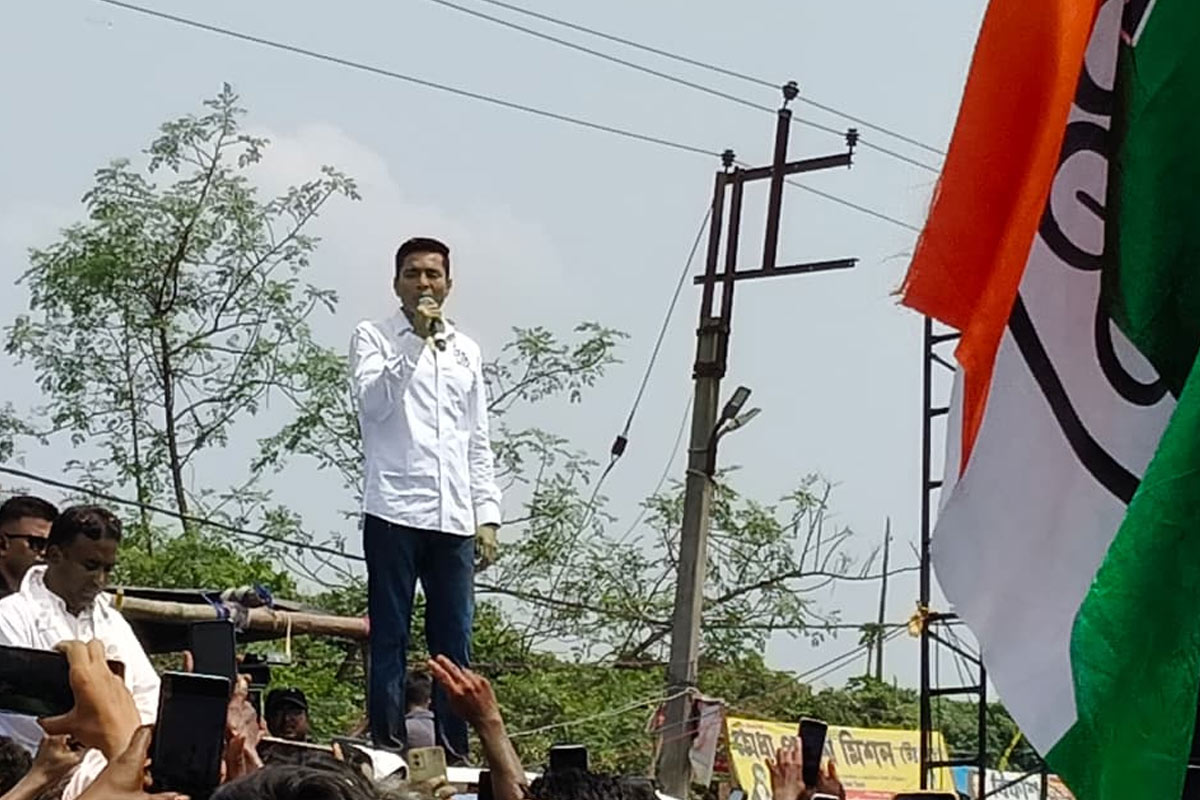
On Saturday, a road show was held in support of the Trinamool candidates from Farakka and Samserganj. The road show in Farakka was conducted alongside the Trinamool candidate from Farakka and the candidate from Samserganj.
In Murshidabad, the attack against the central government and the BJP was escalated. It was stated that a movement would be launched as the central government has taken no steps regarding the Ganga erosion in Farakka and Samserganj. It was said that after forming the government for the fourth time, houses would be built for the affected people. It was also stated that despite repeated letters about the Ganga erosion problem, the center has taken no action.
More News on This Topic
On Saturday, a road show was held in support of the Trinamool candidates from Farakka and Samserganj. The road show was conducted from Al Amin Education Mission ground in Farakka to Jigri More, alongside the Trinamool candidate from Farakka and the candidate from Samserganj. There, the central government and the BJP were attacked over the Ganga erosion issue. The BJP government at the center has taken no measures regarding the erosion.
It was said, “I take the responsibility of the two assemblies. I will get the unused land of the Farakka Barrage back from the central government and build houses for the erosion-affected people of Farakka and Samserganj.” Simultaneously, the BJP was targeted over the special intensive revision process of the voter list. The BJP was attacked with allegations that names of minorities are being selectively removed and that division is being created between Hindus and Muslims.
Speaking in Murshidabad, a comment was also made on the Delimitation Bill, saying, “Yesterday there was no Women’s Reservation Bill. It was the Delimitation Bill. Even if the BJP wants, it will not be allowed. It has not been allowed to happen either.” After concluding the road show, a public meeting was held in Lalbagh. At this meeting, a person known as part of an opposition group joined Trinamool.
More News on This Topic
Farakka
Farakka is a town in West Bengal, India, most notable for the **Farakka Barrage** built across the Ganges River. Completed in 1975, the barrage was constructed to divert water into the Hooghly River to maintain the navigability of the Kolkata port and address siltation issues. Its operation has been a long-standing point of water-sharing discussions and disputes between India and Bangladesh.
Samserganj
Samserganj is a small town located in the Murshidabad district of West Bengal, India, situated along the banks of the Bhagirathi River. Historically, it was a minor river port and trading center during the era of the Bengal Nawabs and the British colonial period, primarily dealing in agricultural produce like rice and jute. Today, it remains a local market town known for its riverine landscape and connection to the region’s historical commerce.
Murshidabad
Murshidabad was the prosperous capital of the Bengal Subah under the Nawabs of Bengal in the 18th century, succeeding Dhaka. It is historically significant as the site of the Battle of Plassey in 1757, which marked the beginning of British colonial rule in India. Today, it is known for its architectural relics like the Hazarduari Palace and the Katra Mosque, reflecting its former grandeur.
<div class="my
Farakka
The Farakka Barrage is a major dam and water diversion structure on the Ganges River in West Bengal, India, completed in 1975. Its primary purpose is to divert a portion of the Ganges’ flow into the Hooghly River via a canal to flush silt and maintain the navigability of the Kolkata Port. The project has a significant history of water-sharing disputes and environmental impact, particularly concerning water availability downstream in Bangladesh.
Samserganj
Samserganj is a town in the Murshidabad district of West Bengal, India, historically significant due to its location along the Bhagirathi River. It served as an important river port and trading center during the era of the Bengal Nawabs and the British colonial period, facilitating commerce in goods like silk and agricultural produce. Today, it remains a local administrative and market hub, though less prominent than in its historical past.
Murshidabad
Murshidabad, located in West Bengal, India, was the last independent capital of Bengal before British colonial rule. It flourished in the 18th century under Nawab Murshid Quli Khan, after whom it is named, and was a major center of silk, trade, and administration. Its historical significance is marked by landmarks like the Hazarduari Palace and the site of the Battle of Plassey (1757), which cemented British power in India.
Ganga
The Ganges (Ganga) is a sacred river in northern India, central to Hinduism and considered the physical embodiment of the goddess Ganga. Historically, major ancient cities and empires, like Varanasi and the Mauryan Empire, flourished along its banks. It remains a vital site for religious rituals, pilgrimage, and daily life for millions of people.
Farakka Barrage
The Farakka Barrage is a major dam and water diversion structure on the Ganges River in West Bengal, India. It was constructed between 1961 and 1975 primarily to divert water into the Hooghly River to maintain the navigability of the Kolkata Port by flushing silt. Its operation has been a source of long-standing water-sharing disputes between India and Bangladesh, impacting the downstream flow of the Ganges.
Lalbagh
Lalbagh is a historic botanical garden in Bangalore, India, originally commissioned in the 1760s by Hyder Ali and later expanded by his son Tipu Sultan. It is renowned for its vast collection of tropical plants, ancient trees, and the iconic Glass House, modeled after London’s Crystal Palace. Today, it serves as a major public park and a center for horticultural research and flower shows.
Bhagirathi River
The Bhagirathi River is a Himalayan headstream of the Ganges River in northern India, considered its traditional source. It originates at the Gangotri Glacier, a site of immense religious significance in Hinduism, and is named after the legendary King Bhagiratha, who is said to have brought the celestial Ganga to Earth through his penance. The river merges with the Alaknanda at Devprayag to formally form the Ganga (Ganges).
Hazarduari Palace
Hazarduari Palace, located in Murshidabad, West Bengal, India, was built in the 19th century during the reign of Nawab Nazim Humayun Jah under British supervision. Its name, meaning “Palace with a Thousand Doors,” derives from its 1,000 doors—of which 900 are false—designed as a security measure against potential attacks. Today, it serves as a museum showcasing the rich history and artifacts of the Nawabs of Bengal.