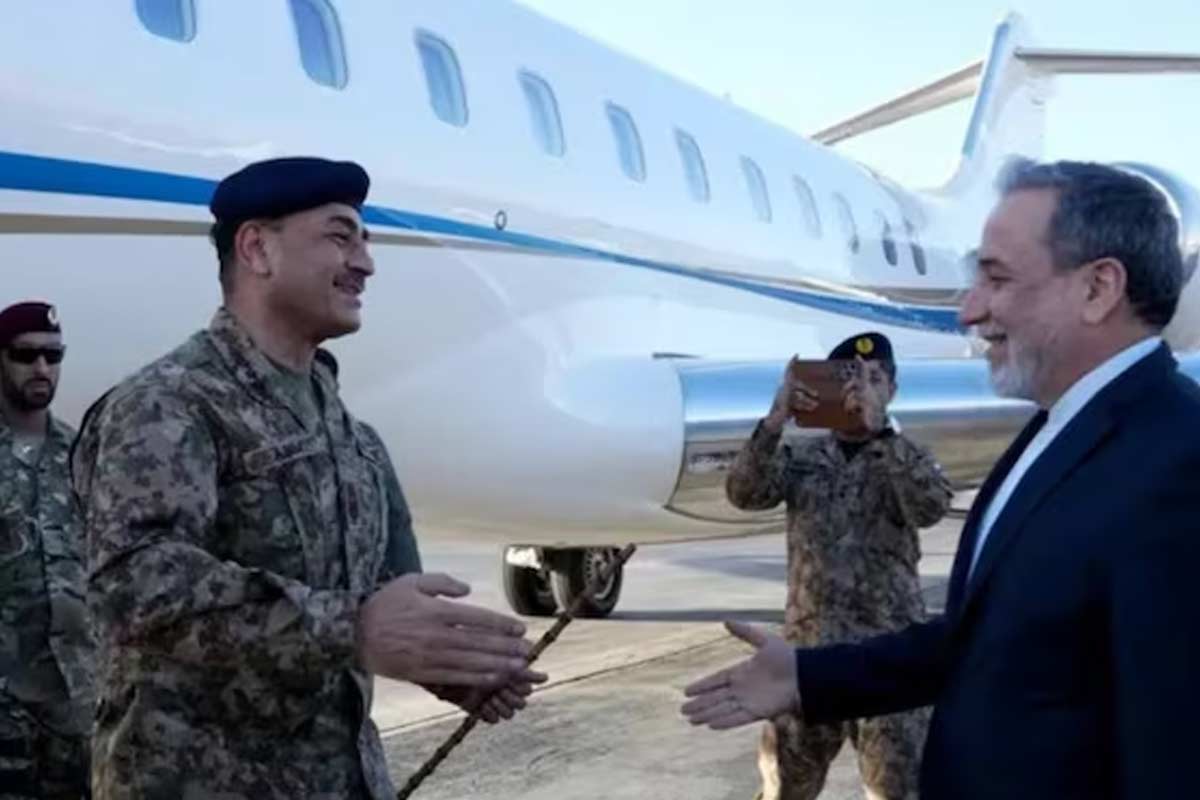
‘Peace envoy’ Munir is present in Tehran. The objective is to deliver Trump’s ‘message’ to Iran to stop the war in West Asia. However, in this situation, the behavior of the Pakistani army chief has revealed another story. It has become clear once again that the administration of the neighboring country is essentially a ‘puppet’ controlled by the army.
In the video circulating online, it can be seen that Asim Munir is the first to disembark from the plane. He is being welcomed by Iran’s Foreign Minister Abbas Araghchi. Behind him is Pakistan’s Interior Minister (equivalent to the Home Minister) Mohsin Naqvi. He is the second person to get off the plane. That’s not all; the security personnel standing behind Munir is holding a bulletproof shield. This level of security is typically reserved for heads of state, not army chiefs. Observers note that this clearly reveals the actual position of the military in Pakistan, even though it is considered an ‘open secret’ in that country.
Read More:
Meanwhile, to resolve the war deadlock, Iran and America held talks in Islamabad. However, after lengthy discussions, those talks have failed. It is heard that both sides have already agreed to sit for a second round of talks. The meeting will be held again in Islamabad. Munir arrived in Iran just before this. In this context, Washington has lavished praise on Pakistan. The White House Press Secretary stated, “Pakistan has acted as an extraordinary mediator. Their efforts to finalize an Iran-America agreement are truly commendable.” According to sources, the two countries will return to the negotiation table in Islamabad within the next 2-3 days. Everyone is watching to see if any agreement will be reached in those talks.
Tehran
Tehran is the capital and largest city of Iran, officially becoming the national capital in 1786 under the Qajar dynasty. It serves as the country’s political, economic, and cultural heart, home to significant modern landmarks and museums like the Golestan Palace, a historic royal complex dating back to the 16th century.
West Asia
West Asia, also known as the Middle East, is a transcontinental region that is the historical cradle of some of the world’s earliest civilizations, including Mesopotamia and ancient Persia. It is home to globally significant religious sites for Islam, Christianity, and Judaism, such as Mecca, Jerusalem, and Babylon. Its history is deeply marked by the rise and fall of vast empires, the development of major world religions, and its central role in ancient and modern trade routes.
Pakistan
Pakistan is a modern nation-state established in 1947 as a homeland for Muslims of British India, with a rich history rooted in the ancient Indus Valley Civilization. Its cultural landscape is a tapestry of diverse ethnic groups, languages, and traditions, shaped by influences from the Gandhara kingdom, various Islamic empires, and its colonial past. Key historical sites include the archaeological ruins of Mohenjo-daro, the Mughal-era Lahore Fort, and the Islamic architectural marvel of the Badshahi Mosque.
Iran
Iran, historically known as Persia, is a country in Western Asia with one of the world’s oldest continuous civilizations, dating back to the Elamite and Achaemenid Empires over 2,500 years ago. It is renowned for its profound cultural heritage, including magnificent architectural sites like Persepolis, intricate Persian carpets, poetry, and its influential role in art, science, and philosophy throughout history. Today, Iran is a modern Islamic republic where ancient traditions and a rich historical identity remain deeply woven into its national fabric.
America
“America” most commonly refers to the United States of America, a nation founded in 1776 after declaring independence from Great Britain. Its modern identity is shaped by a complex history of colonial settlement, revolution, westward expansion, and waves of immigration, making it a culturally diverse society built on democratic ideals.
Islamabad
Islamabad is the purpose-built capital city of Pakistan, established in the 1960s to replace Karachi. It was meticulously planned by Greek architect Constantinos Apostolou Doxiadis and is known for its modern layout, wide boulevards, and greenery, set against the backdrop of the Margalla Hills. The city is also home to significant modern landmarks like the Faisal Mosque, one of the largest mosques in the world, completed in 1986.
White House
The White House is the official residence and workplace of the President of the United States, located in Washington, D.C. It was designed by James Hoban, with construction beginning in 1792 and the first president, John Adams, moving in in 1800. The building has been expanded and renovated over the centuries, notably after being burned by British forces in 1814, and stands as a powerful symbol of the U.S. government and its history.
Washington
Washington, D.C., the capital of the United States, was founded in 1790 as a planned city to serve as the nation’s permanent seat of government. Its history is deeply tied to the American political system, with iconic landmarks like the White House, Capitol Building, and Washington Monument symbolizing federal authority and democratic ideals. The city’s design, influenced by Pierre L’Enfant, features grand avenues and numerous museums, memorials, and government institutions that reflect the country’s historical narrative.