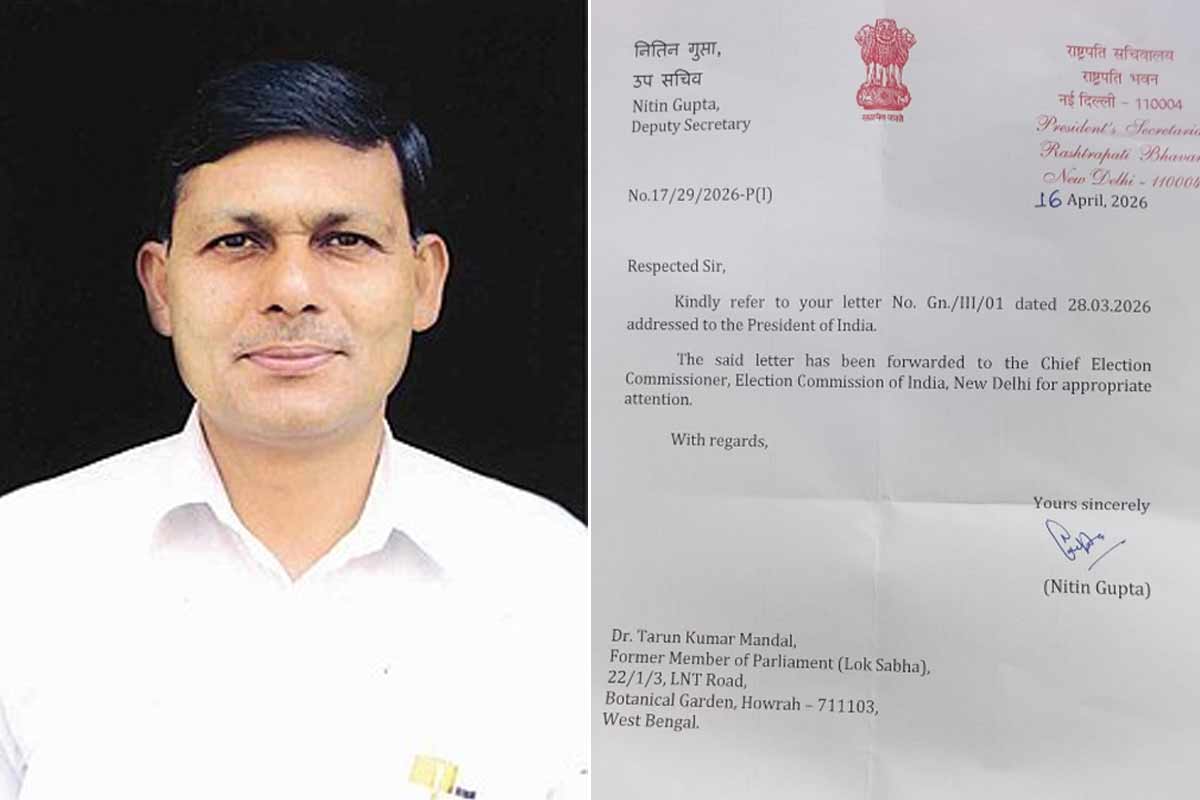
On the 29th of the coming month, voting will take place in Joynagar in the second phase. Before that, Tarun Mondal wants his name to be settled.
He was a multiple-term Member of Parliament. Yet, after a special intensive revision or SIR, his name remained under review in the voter list. Following a tribunal hearing, the name of Joynagar’s former SUCI MP Tarun Mondal was struck off. He then sent letters seeking resolution to the state’s Chief Electoral Officer, the Calcutta High Court, and other authorities, requesting his name be reinstated in the voter list. Those letters were ignored. Now, Tarun Mondal has directly written to the President. He argues: if such indifference is shown toward a former public representative, how can ordinary citizens expect any remedy?
The final list was published on February 28 after the SIR. It showed nearly 60 lakh voters’ names were under review, including that of former Joynagar MP Tarun Mondal. The inclusion of a former representative’s name in the pending list drew significant criticism. Hoping for a legal resolution, it was found that Tarun Mondal’s name was canceled at the tribunal. That was in March. Subsequently, Tarun Mondal wrote to CEO Manoj Agarwal, the Calcutta High Court Chief Justice, and Lok Sabha Speaker Om Birla, requesting his name be added. No solution was reached.
He then wrote to the President, stating: “Through speed post and email over two days, I sent documents and letters to the President of India, the Chief Justice, the Chief Election Commissioner, the Prime Minister, and the Home Minister, seeking a swift resolution. Only from the President’s Secretariat have I received acknowledgment of my application today, stating that it has been forwarded to Chief Election Commissioner Gyanesh Kumar for appropriate attention. Notably, despite filing an appeal online at the tribunal on March 29, no hearing has been held, and no other designated office has contacted me to date. Over three weeks have passed since the application was submitted. If such indifference is shown toward a former central government official and former Lok Sabha MP, it is easy to imagine the extent of neglect faced by over 34 lakh applicants in the state.”
Joynagar
Joynagar is a town located in West Bengal, India, known for its rich cultural heritage and historical significance. It is particularly famous for the Joynagarer Moa, a traditional sweet made from date palm jaggery and puffed rice, which has received a Geographical Indication (GI) tag. The area also has historical ties to the Bhakti movement and the Gaudiya Vaishnavism tradition, with several old temples and shrines reflecting its religious and cultural past.
Calcutta High Court
The Calcutta High Court, established in 1862, is the oldest high court in India, located in Kolkata (formerly Calcutta). Its iconic red-brick building, designed in a Gothic style by architect Walter Granville, was completed in 1872 and stands as a historic landmark. The court has played a pivotal role in Indian legal history, serving as the highest judicial authority in the region during the British colonial period.
Lok Sabha
Lok Sabha is the lower house of India’s bicameral Parliament, established in 1952 under the Constitution of India. Its members are directly elected by the people for a five-year term, and it plays a key role in lawmaking, budget approval, and government oversight. The first session of the Lok Sabha convened on May 13, 1952, marking a foundational moment in India’s democratic history.
President of India
The President of India is the ceremonial head of state and the supreme commander of the Indian Armed Forces, a role established when India became a republic on January 26, 1950. The position was created under the Constitution of India, replacing the British monarch as the nominal head of the executive. The President resides in the Rashtrapati Bhavan in New Delhi, a historic building originally built as the Viceroy’s House during British colonial rule.
Chief Justice
The Chief Justice is a historic restaurant and bar located in Portland, Oregon, housed in a building that was originally the Multnomah County Courthouse annex. Constructed in 1911, the building served as a judicial center for decades, and its name pays homage to the legal history of the site. Today, it is known for its elegant, vintage atmosphere and is a popular spot for dining and cocktails.
Chief Election Commissioner
The Chief Election Commissioner is the head of the Election Commission of India, an independent constitutional authority established in 1950 to oversee free and fair elections. The position was created to ensure the integrity of India’s democratic process, with the first commissioner appointed following the country’s first general elections in 1951-52. The commissioner is appointed by the President of India and serves a fixed term, playing a crucial role in administering elections at the national, state, and local levels.
Prime Minister
The term “Prime Minister” refers to the head of government in many parliamentary systems, a role that emerged in 18th-century Great Britain with figures like Sir Robert Walpole, often considered the first de facto prime minister. The position evolved to become the central executive authority, responsible for leading the cabinet and shaping national policy. Today, prime ministers are typically appointed by a monarch or president and must maintain the confidence of the legislature to govern effectively.
Home Minister
The “Home Minister” is not a place or cultural site, but a government official title. In many countries, the Home Minister oversees internal affairs, including law enforcement, public safety, and immigration. Historically, this role has been crucial in shaping domestic policy and responding to national crises.