-
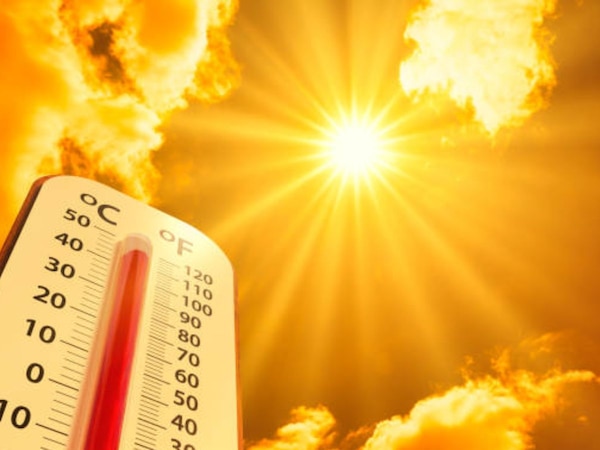
Will this year break the record for extreme heat? It is only April, but the heat is already like May and June. Just imagine, if April is this hot, what will happen in May and June? Conditions are so severe that this year could break a record spanning 125,000 years. You need to know about this today. But first, let’s feel the April heat through the numbers.
Today, the maximum temperature in the national capital, Delhi, was 42 degrees Celsius. On the same day last year, April 23, 2025, Delhi’s maximum temperature was between about 38 and 39 degrees Celsius. That means in just one year, the temperature has directly increased by 2 to 3 degrees.
Weather blazing like embers in April itself
Such a big change in just one year is not a small matter. It is a major warning. If we analyze the trend of average temperatures in April over the past five years, the picture becomes even clearer. In 2022, the average maximum temperature in April was 37 degrees, in 2023 it was 37.5, in 2024 it was 38 degrees, and in 2025 it was 39 degrees Celsius. Meanwhile, this month’s average maximum temperature is 40.5 degrees Celsius.
These figures clarify the situation to a great extent. April used to be called pre-summer. But the temperature is now like peak summer. For the first time, an alert has been issued for heat waves at night in Madhya Pradesh. Spring typically lasted 60 days. But this year, it has shrunk to just 10-20 days. If this is the situation now, imagine what will happen in June and July – will fire rain down from the sky?
A high-pressure system over the plains
You might be wondering why it is so hot. Many people give one answer: climate change. But what change is occurring? How serious is its impact? We will explain it to you in simple language. One reason for this intense heat is the HEAT DOME forming over the plains of India. That is, a dome of fire that is trapping the heat and not letting it escape.
A high-pressure system has formed over the plains of India. That means an invisible lid has been created, trapping the hot air. Normally, hot air becomes lighter, rises toward the sky, and cools down. But the heavy pressure of the HEAT DOME pushes the hot air back downward.
The HEAT DOME prevents cloud formation
When air is pushed downward, its temperature increases even more. The worst effect of the HEAT DOME is that it prevents the formation of clouds. The sky remains clear, causing the sun’s rays to fall directly on the ground, and the temperature keeps rising. The situation is such that the plains are burning like a furnace, and this heat is expected to increase in the coming days.
The great scientist Stephen Hawking said that climate change is one of the biggest threats facing humanity. If we do not take timely steps, the consequences will be disastrous. Stephen Hawking’s statement is proving true. Climate change has begun to show disastrous results.
Water levels have dropped in 166 reservoirs
On March 5, the Central Water Commission reported that the total storage capacity of the country’s 166 major reservoirs was only 57 percent. That means only about half the water remains in the reservoirs. In South India’s Sholayar, only 31% water remains, and in Vaigai, only 38%. According to a NITI Aayog report, 60 crore people in the country may face a water crisis. By 2030, the demand for water in the country will be double the supply, meaning half of India will be desperate for drinking water.
The crisis that has been warned about for decades is now upon us. To decode this crisis, you need to understand two terms: El Niño and La Niña. El Niño is a natural phenomenon that causes the surface of the Pacific Ocean to warm up. During this time, warm winds blow from east to west. This spreads
Delhi
Delhi, the capital of India, is a historic city that has been continuously inhabited for over two millennia, serving as the seat of power for numerous empires, including the Mughals and the British Raj. Its rich history is reflected in landmarks such as the Red Fort, Qutub Minar, and Humayun’s Tomb, alongside bustling modern neighborhoods. Today, Delhi is a vibrant metropolis that blends ancient traditions with contemporary culture, making it a key political, cultural, and commercial hub.Madhya Pradesh
Madhya Pradesh, located in central India, is known as the “Heart of India” due to its rich cultural and historical heritage. It was home to ancient kingdoms such as the Mauryas and Guptas, and later became a significant center for the Mughal and Maratha empires. The state is famous for its UNESCO World Heritage sites, including the Khajuraho temples and the Sanchi Stupa, which reflect its profound architectural and spiritual legacy.India
India is a vast and ancient civilization in South Asia with a recorded history spanning over 5,000 years, home to the Indus Valley Civilization and later the birthplace of major religions like Hinduism, Buddhism, Jainism, and Sikhism. Its cultural heritage includes iconic sites such as the Taj Mahal, a 17th-century Mughal mausoleum, and a rich tradition of classical dance, music, and diverse regional cuisines. Today, India is the world’s most populous democracy, blending its deep historical roots with rapid modern development.Sholayar
Sholayar is a region in Kerala, India, known for its scenic Sholayar Dam and the surrounding Sholayar Forest Reserve, which is part of the larger Anamalai Tiger Reserve. The dam, constructed across the Sholayar River, was built primarily for hydroelectric power generation and irrigation, with its development dating back to the mid-20th century. The area holds cultural significance for local tribal communities and is a popular eco-tourism destination, offering lush landscapes and diverse wildlife.Vaigai
Vaigai is a river in Tamil Nadu, India, that has been central to the region’s history and culture for centuries. It flows through the ancient city of Madurai, where it supported the development of the Pandya and Nayak kingdoms and is closely linked to the famous Meenakshi Amman Temple. The river also inspired the “Vaigai” culture, an archaeological term for early settlements in the area dating back to the Sangam period.Pacific Ocean
The Pacific Ocean is the largest and deepest ocean on Earth, covering more than 60 million square miles. Its name, meaning “peaceful sea,” was given by Portuguese explorer Ferdinand Magellan in 1520 during his circumnavigation of the globe. Throughout history, it has been a vital route for migration, trade, and exploration, connecting diverse cultures from Asia to the Americas.