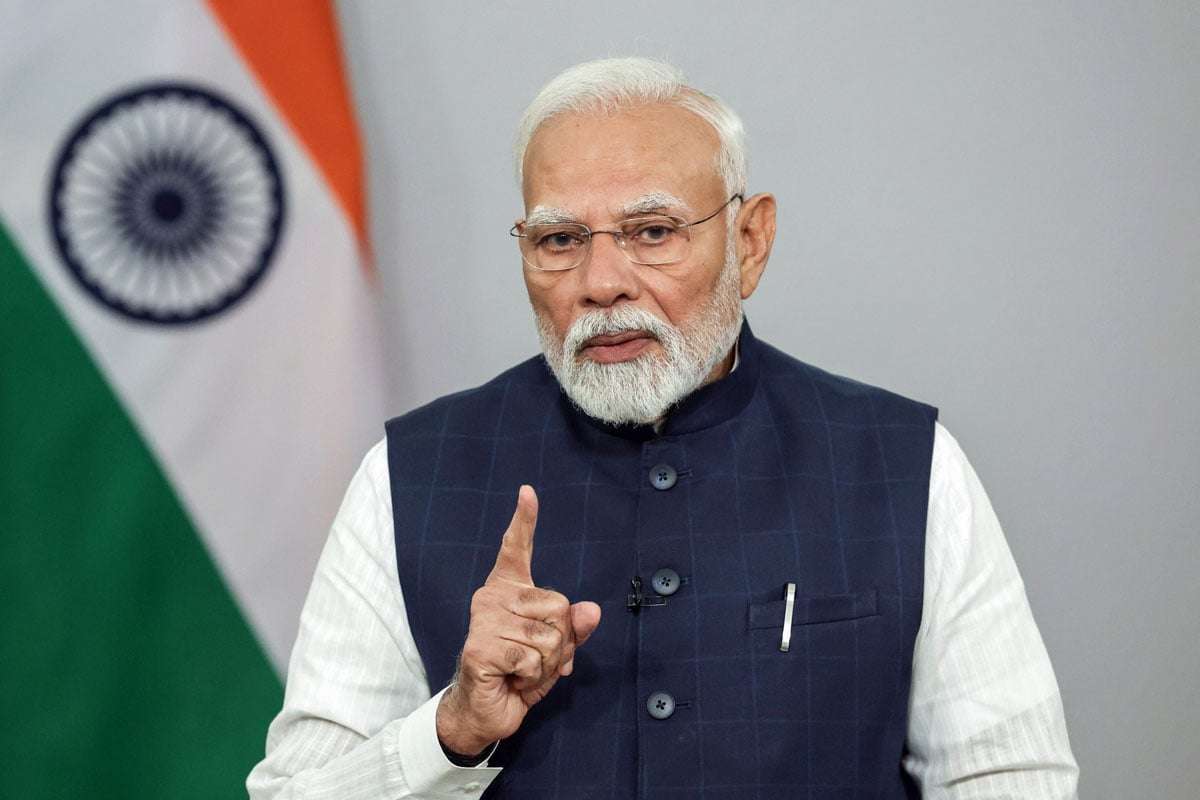
The bill to amend the constitution regarding the increase in the number of Lok Sabha seats to implement the women’s reservation bill was rejected. Following this, Modi addressed the nation on Doordarshan and All India Radio last Saturday night. Immediately after, opposition political parties alleged that the Prime Minister had used the public broadcaster to conduct political propaganda against the opposition parties.
In the name of addressing the nation on April 18, Prime Minister Narendra Modi violated the election code of conduct by politically attacking the opposition. A complaint containing the signatures of 700 prominent citizens of the country was submitted to the Election Commission with this serious allegation. Earlier, political parties like Congress, Trinamool, and CPM had raised their voices on this matter. Needless to say, the new letter from 700 citizens has increased discomfort for the ruling party and the commission.
After the bill to amend the constitution regarding the increase in the number of Lok Sabha seats to implement the women’s reservation bill was rejected, Modi addressed the nation on Doordarshan and All India Radio last Saturday night. Immediately after, opposition political parties alleged that the Prime Minister had used the public broadcaster to conduct political propaganda against the opposition parties. Now, 700 citizens, including former bureaucrats, social activists, and academics, have made the same allegation. The signatories to the complaint stated that Modi’s speech was broadcast on government-funded platforms like Doordarshan and All India Radio, which amounts to biased election campaigning using government machinery.
On Sunday, two leftist parties wrote a letter to Chief Election Commissioner Gyanesh Kumar regarding this matter. Their main allegation is that the model code of conduct for the assembly elections is in effect in West Bengal and Tamil Nadu. In this situation, the Prime Minister has used the public broadcaster to conduct political propaganda against the opposition parties. Congress President Mallikarjun Kharge has also accused the Prime Minister of violating the model code of conduct. He stated that the Prime Minister mentioned Congress 59 times in his half-hour address to the nation. Congress leaders from various states have sent letters to the commission.
West Bengal Chief Minister and Trinamool Supremo Mamata Banerjee has also spoken out against the Prime Minister on this issue. From a public meeting in Tarakeswar, Hooghly, on Saturday, she attacked this incident as an ‘abuse of state machinery’. The Trinamool leader clearly stated that Modi is conducting illegal propaganda for his own party. She also said that the Trinamool Congress will file a complaint with the commission against this.
Lok Sabha
The Lok Sabha is the lower house of India’s bicameral Parliament, established in 1952 following the country’s first general elections under its new constitution. It represents the people of India, with members directly elected by universal adult suffrage for five-year terms. As the primary legislative body, it plays a crucial role in lawmaking, budget approval, and holding the government accountable.
Doordarshan
Doordarshan is India’s public service broadcaster, established on September 15, 1959, as a small experimental television service in Delhi. It expanded significantly in the 1970s and 1980s, becoming the country’s sole television network until the advent of private channels in the 1990s. Known for iconic programs like *Ramayan* and *Mahabharat*, Doordarshan played a pivotal role in shaping Indian media and culture.
All India Radio
All India Radio (AIR) is India’s national public radio broadcaster, established in 1936 under British colonial rule as the Indian State Broadcasting Service. It was renamed All India Radio in 1936 and played a crucial role in unifying the nation after independence, broadcasting in multiple languages. Today, it operates one of the largest radio networks in the world, serving diverse audiences across urban and rural India.
Election Commission
The Election Commission is a vital institution in many democratic countries, responsible for overseeing and administering free and fair elections. Its history often traces back to the establishment of independent electoral bodies to prevent government interference, with notable examples like India’s Election Commission founded in 1950 to manage the world’s largest democratic process. By ensuring transparent voting, the Election Commission upholds the rule of law and public trust in democratic systems.
West Bengal
West Bengal is a culturally rich state in eastern India, known for its history as the epicenter of the Indian Renaissance and the Bengali Renaissance during British rule. It was once part of the Bengal Presidency, the largest British colonial province, and was a key site of the Indian independence movement, including the 1905 Partition of Bengal. Today, it is famous for its literary heritage, the Sundarbans mangrove forest, and the vibrant city of Kolkata, the former capital of British India.
Tamil Nadu
Tamil Nadu is a state in southern India known for its rich cultural heritage, classical arts, and ancient Dravidian architecture. Its history stretches back over two millennia, with powerful dynasties like the Cholas, Pandyas, and Pallavas building magnificent temples and contributing to Tamil literature and trade. Today, it remains a vibrant center of Tamil language, music, dance, and festivals, with iconic sites such as the Meenakshi Temple and Brihadeeswarar Temple.
Tarakeswar
Tarakeswar is a historic town in West Bengal, India, renowned for its ancient Taraknath Temple, which is dedicated to Lord Shiva. The temple, believed to have been built in the 18th century, is a major pilgrimage site where devotees perform rituals and seek blessings, especially during the month of Shravan. The town’s name and its deity are linked to Hindu mythology, with the site holding deep spiritual significance for centuries.
Hooghly
Hooghly is a historic district and river in West Bengal, India, known for its colonial-era landmarks along the Hooghly River, a distributary of the Ganges. The area was a key site of early European trade, with the Portuguese, Dutch, French, and British establishing settlements there from the 16th century onward. Notable sites include the 17th-century Bandel Church, one of the oldest Christian churches in Bengal, and the Hooghly Imambara, a 19th-century Shia Muslim congregation hall and mosque.