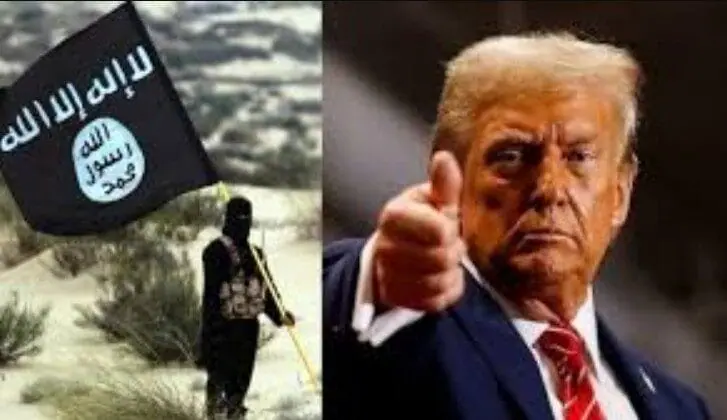
US-Nigeria joint operation kills Islamic State terrorist.
New Delhi. U.S. President Donald Trump said that ISIS’s top leader Abu-Bilal was killed by American and Nigerian forces. Trump announced the success of the planned mission on his social media platform ‘Truth Social’, stating that al-Minuki, one of the world’s most active terrorists, is now eliminated.
Trump said the U.S. military and Nigerian armed forces carried out a joint and highly complex military operation. Abu-Bilal al-Minuki was the second-highest global leader of the terrorist organization Islamic State (ISIS).
Trump stated that the mission was conducted under his direction and involved a very well-planned and complex military operation. Abu-Bilal al-Minuki was trying to hide in Africa before intelligence sources helped track his movements and location.
Thought he would hide in Africa
Trump wrote in the post, “Tonight, on my orders, the U.S. military and Nigeria’s armed forces flawlessly completed a very planned and very difficult mission to eliminate one of the world’s most active terrorists from the battlefield. ISIS’s second-in-command worldwide, Abu-Bilal al-Minuki, thought he could hide in Africa, but he didn’t know we have sources that keep telling us what he is doing.”
Trump thanked the Nigerian government
Trump further wrote, “He will no longer terrorize the people of Africa, or help plan operations to target Americans. With his death, ISIS’s global operation has been greatly reduced. Thank you to the Nigerian government for your partnership in this operation.”
Also read–
New Delhi
New Delhi is the capital of India, a planned city designed by British architect Edwin Lutyens and officially inaugurated in 1931 to replace Calcutta as the seat of government. It was built to the south of the historic Old Delhi, incorporating grand boulevards and landmarks like India Gate and the Rashtrapati Bhavan, reflecting the imperial ambitions of the British Raj. Today, it serves as the political and cultural heart of the nation, blending colonial-era architecture with modern urban life.
New Delhi
New Delhi, the capital of India, was designed by British architects Edwin Lutyens and Herbert Baker and officially inaugurated in 1931, replacing Calcutta as the center of British rule. The city is known for its grand boulevards and iconic landmarks like India Gate and the Rashtrapati Bhavan, blending colonial architecture with modern urban life. Today, it serves as the political and cultural heart of India, reflecting the nation’s rich history and dynamic growth.
India Gate
India Gate is a prominent war memorial located in New Delhi, India, built to honor the 82,000 Indian and British soldiers who died in World War I and the Third Anglo-Afghan War. Designed by Sir Edwin Lutyens and completed in 1931, its architecture resembles a triumphal arch, with the names of the fallen inscribed on its surface. Today, it stands as a symbol of national pride and is a popular gathering spot for locals and tourists.
Rashtrapati Bhavan
Rashtrapati Bhavan is the official residence of the President of India, located in New Delhi. Designed by British architect Edwin Lutyens, it was originally built as the Viceroy’s House and completed in 1929, serving as the seat of British colonial power until India’s independence in 1947. Today, it stands as a symbol of Indian democracy and features a blend of Mughal and Western architectural styles, with sprawling Mughal Gardens open to the public seasonally.