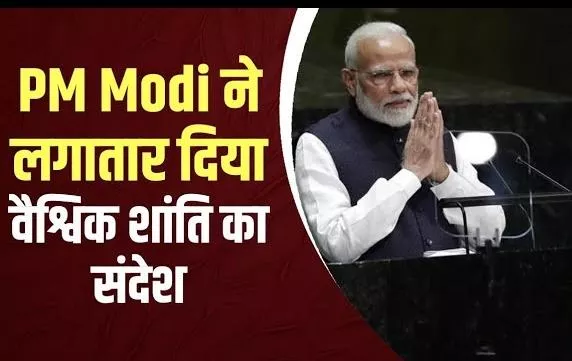
Prime Minister Narendra Modi on Thursday called for a peaceful resolution to the ongoing conflicts in West Asia and Ukraine. Modi made these remarks following talks with Austrian Chancellor Christian Stocker. Prime Minister Modi said, “The entire world is going through a very serious and tense situation today.” He stated that the impact of this tense situation in the world is being felt by everyone.
India visit will provide new energy to trade and investment
The Prime Minister said that India and Austria agree that military conflict cannot solve problems. He said, “We support stable, sustainable, and long-term peace in Ukraine and West Asia.” Prime Minister Modi also said that the Austrian Chancellor’s visit to India will provide new energy to trade and investment.
A new golden chapter has begun in India-European Union relations following the historic India-EU Free Trade Agreement. The Austrian Chancellor arrived in New Delhi on Tuesday for a four-day visit aimed at strengthening bilateral cooperation in various sectors. This is his first official visit to India.
Also Read–
West Asia
West Asia, also known as the Middle East, is a transcontinental region that is historically considered one of the cradles of civilization, home to ancient Mesopotamian cultures like Sumer and Babylon. It is a region of profound religious significance, containing holy sites for Islam, Christianity, and Judaism, and has been a central crossroads for trade, empires, and cultural exchange for millennia. Today, it encompasses diverse modern nations, from Turkey and Iran to the Arabian Peninsula, often defined by its complex geopolitics and vast energy resources.
Ukraine
Ukraine is a sovereign Eastern European nation with a rich history dating back to the medieval state of Kyivan Rus’, a cultural and political precursor to modern Eastern Slavic nations. It has endured centuries of foreign rule and conflict, most recently Russia’s full-scale invasion in 2022, while fiercely maintaining its distinct language and cultural identity. The country is renowned for its Orthodox Christian cathedrals, Cossack heritage, and vast, fertile landscapes.
India
India is a vast and ancient civilization in South Asia, home to one of the world’s oldest continuous cultures, with roots in the Indus Valley Civilization dating back over 5,000 years. It is renowned for its profound spiritual traditions, diverse languages, and monumental historical sites—from the Mughal-era Taj Mahal to ancient Hindu temple complexes—shaped by millennia of empires, religions, and colonial history. Today, it stands as the world’s largest democracy and a dynamic fusion of countless ethnicities, languages, and traditions.
Austria
Austria is a landlocked country in Central Europe with a rich cultural heritage, historically centered around the powerful Habsburg monarchy that ruled the Austro-Hungarian Empire for centuries. Today, it is renowned for its Alpine landscapes, classical music legacy (home to composers like Mozart and Strauss), and historic cities like Vienna and Salzburg, which showcase magnificent Baroque architecture and imperial history.
New Delhi
New Delhi is the capital city of India, officially inaugurated in 1931 as the new seat of the British Indian government, replacing Calcutta. It was designed by British architects Edwin Lutyens and Herbert Baker, featuring wide boulevards and grand colonial-era buildings like the Rashtrapati Bhavan and India Gate. Today, it serves as the political and administrative heart of the country, blending its planned imperial history with the vibrant, modern culture of India.
India-European Union
“India-European Union” refers to the strategic partnership between India and the European Union, established in 2004 to enhance cooperation across trade, climate, security, and technology. Its history is rooted in earlier economic agreements from the 1990s, evolving into a key diplomatic relationship that holds regular summits to address global challenges and foster mutual growth.
India-EU Free Trade Agreement
The India-EU Free Trade Agreement (FTA), formally known as the Bilateral Trade and Investment Agreement (BTIA), is a proposed comprehensive trade deal under negotiation since 2007. Its history is marked by intermittent talks aimed at boosting trade and investment by reducing tariffs and aligning regulations, though progress has been slow due to disagreements on key issues like market access, intellectual property, and data security. If concluded, it would create one of the world’s largest free trade areas, linking the European Union with one of its major Asian economic partners.