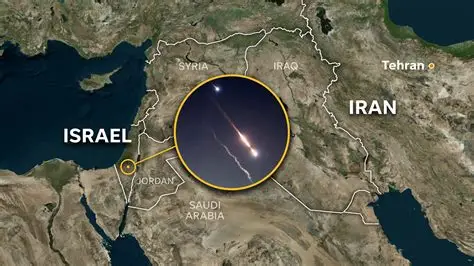
Dubai, Israel and Iran launched retaliatory strikes against each other early Monday, raising the risk of a major regional war across West Asia. Meanwhile, Houthi rebels in Yemen also attacked Jerusalem and warned of targeting Israel-linked ships in the Red Sea, further escalating tensions.
Israel targeted central and western parts of Iran early Monday in response to a series of missile attacks from Tehran. In retaliation, Iran again struck Israel. This is the most serious military clash between the two countries since a ceasefire was implemented on April 8. Explosions were heard in central Israel as its air defense system intercepted Iranian missiles.
An Iranian official warned Monday that the United States would be responsible for any consequences if Israel escalates tensions in West Asia. The spokesperson for Iran’s Foreign Ministry told journalists in Tehran on Monday, “No one believes that the Israeli regime would take any action without coordination with the United States.”
Iran-Israel tensions rise again, warnings of retaliatory strikes
The Revolutionary Guard said, “The United States is responsible for the aggression of the Israeli regime and will also be responsible for the consequences of any escalation.” Iran’s paramilitary Revolutionary Guard stated it targeted two Israeli military bases, describing the attacks as part of a “victory operation.” It said these missiles were launched after Israel struck radar sites in three areas of Iran.
Tehran had warned of retaliation on Sunday, when Israel, disregarding U.S. objections, struck the southern suburbs of Beirut without warning. Monday marks 100 days since the Iran war began on February 28, when Israel and the United States killed Supreme Leader Ayatollah Ali Khamenei and other top Iranian leaders.
Both sides agreed to a formal ceasefire on April 8, but numerous obstacles remain on the path to lasting peace, including Iran’s occupation of the Strait of Hormuz and ongoing fighting between Israel and the Lebanese Shia militia Hezbollah. With threats looming over global energy supplies, Iran still holding large stockpiles of highly enriched uranium, and Houthi rebels entering the fray, the risk of the war fully reigniting appears to be increasing.
White House silent, Trump advised Israel to show restraint
The White House did not respond to questions about the Israeli strikes or any coordination with the United States. A senior U.S. official said Sunday that President Donald Trump called Israeli Prime Minister Benjamin Netanyahu and advised him not to immediately respond to the Iranian missile attack.
Speaking on condition of anonymity, the official said Trump believed Netanyahu was ready to halt attacks. The official stated, Trump “has convinced Netanyahu for now.” No further details of the phone call were provided, and there was no response from Netanyahu’s office. Trump had earlier told a Fox News correspondent that he wanted Iran to stop attacks and return to the negotiating table. He also said Israel’s strikes on Lebanon on Sunday were not coordinated with the United States and “I am angry about this.”
Yemen’s Iran-backed Houthi rebels claimed responsibility for an attack on Israel and said Israel-linked ships in the Red Sea would again be their targets. This has raised threats to the Red Sea, the Gulf of Aden, and the connecting Bab el-Mandeb Strait. The statement by a Houthi military spokesman was broadcast on the Houthis’ Al-Masirah satellite news channel.
Panic from blasts in Iran, missile alert also issued in Saudi Arabia
Iranian state television reported that explosions were heard in Isfahan, Karaj, Tabriz, and Tehran. However, no detailed information has been provided yet. A witness in Tehran reported hearing a large blast in the western part of the capital. Following the Israeli strikes, Iran closed the airspace around Tehran’s Imam Khomeini International Airport.
Semi-official news agencies Fars and Mehr reported that Israeli strikes targeted a petrochemical plant in the town of Mahshahr in Khuzestan province. No details on damage were provided. Later, the Israeli military also confirmed the attack on the petrochemical plant.
Meanwhile, sirens blared in Saudi Arabia on Monday morning
<div class="my-