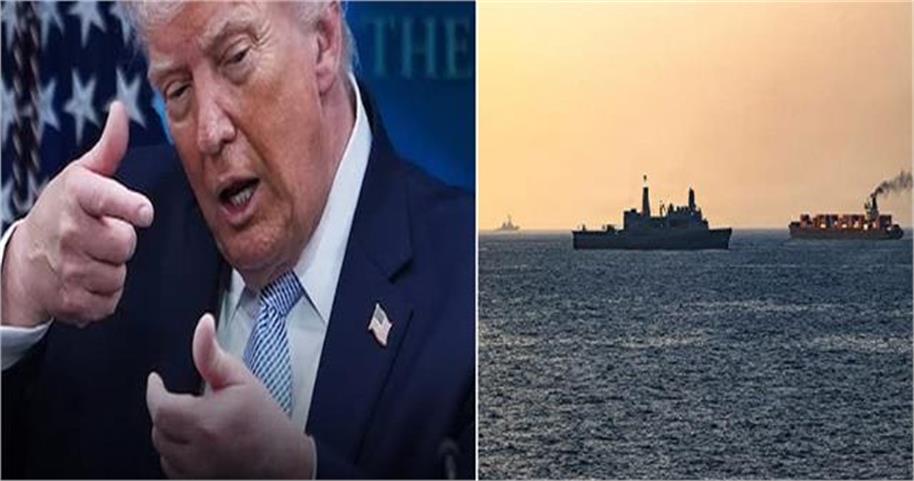
Washington, April 23, 2026. A strict statement involving former U.S. President Donald Trump is under discussion, in which he directed the U.S. Navy to carry out a “Shoot and Kill” action upon sighting suspicious boats laying mines in the Strait of Hormuz. This statement has emerged amid rising tensions and maritime security concerns in the region.
Trump said the U.S. is already working to remove mines in Hormuz and has now ordered a threefold increase in that effort. This step was taken to keep the sea route safe. Meanwhile, the situation has become more serious. The number of ships passing through Hormuz has dropped sharply. According to recent data, ship traffic has decreased by about 96% compared to normal days.
The Strait of Hormuz is one of the world’s most important maritime routes, through which a large portion of global oil supply passes. Any military activity or tension in this area directly impacts international trade and the energy market.
According to reports, this tough stance was adopted to ensure the safety of sea routes and prevent potential threats. In recent years, attacks on ships and mine-laying incidents in this region have raised global concern, prompting the U.S. and its allied countries to remain vigilant.
Experts believe that such statements could further escalate tensions in the region, but they also send a strong message that maritime security will not be compromised. However, maintaining diplomatic balance in such a situation is equally important to avoid a major military confrontation.
The international community is closely watching this development, as any instability in the Hormuz region could immediately affect the global economy and oil prices.
Strait of Hormuz
The Strait of Hormuz is a narrow, strategically vital waterway connecting the Persian Gulf to the Gulf of Oman and the Arabian Sea. It has been a crucial maritime route for centuries, serving as a primary passage for oil and gas shipments from the Middle East to global markets. Historically, its significance has made it a focal point for geopolitical tensions, particularly during the Iran-Iraq War and in ongoing disputes involving Iran and other regional powers.
Hormuz
Hormuz is a historically significant island and port city in the Persian Gulf, located off the coast of Iran. It was a major trading hub from the 13th to the 17th centuries, serving as a key link in the spice and silk routes under various empires, including the Portuguese, who occupied it from 1515 to 1622. The island is also known for its striking red soil and salt formations, which have earned it the nickname “Rainbow Island.”
Strait of Hormuz
The Strait of Hormuz is a narrow, strategically vital waterway connecting the Persian Gulf to the Gulf of Oman and the open ocean. Historically, it has been a crucial chokepoint for global oil shipments, with its importance rising dramatically in the 20th century as a major transit route for crude oil from the Middle East. The strait has also been a site of geopolitical tension, particularly during the Iran-Iraq War in the 1980s and in subsequent disputes involving Iran and other nations.
Hormuz
Hormuz is a historically significant island in the Persian Gulf, once the center of the powerful Kingdom of Hormuz, a major trading hub between the 13th and 16th centuries. It was famously visited by Marco Polo and later conquered by the Portuguese in 1515, who built a fortress that still stands today. After changing hands between Persian and Omani control, the island is now part of Iran, known for its colorful soil, salt caves, and cultural heritage.
<div class="my-
Strait of Hormuz
The Strait of Hormuz is a strategically vital waterway connecting the Persian Gulf to the Gulf of Oman and the Arabian Sea. Historically, it has been a key chokepoint for global oil shipments, with about 20% of the world’s petroleum passing through it. Its significance has made it a focal point for geopolitical tensions, particularly between Iran and other nations, for centuries.
Hormuz
Hormuz is a historically significant island and port city in the Persian Gulf, located in present-day Iran. It was a major hub of maritime trade from the 13th to the 16th centuries, particularly under the control of the Kingdom of Hormuz, which connected the Silk Road with sea routes to India and Africa. The island is also famous for its colorful soil, known as “rainbow island,” and the ruins of the Portuguese fortress built in 1515 during their colonial occupation.
Persian Gulf
The Persian Gulf is a vital body of water in Western Asia, historically significant as a center of ancient trade and the cradle of powerful empires like the Elamite and Achaemenid. For centuries, its coastlines have been home to bustling port cities and pearl-diving economies, while its waters remain crucial for modern oil transportation and geopolitical influence. Today, the Gulf connects diverse nations including Iran, Saudi Arabia, and the UAE, blending a rich cultural heritage with contemporary global importance.
Gulf of Oman
The Gulf of Oman is a body of water connecting the Arabian Sea to the Strait of Hormuz, bordered by Oman, the United Arab Emirates, and Iran. Historically, it has served as a crucial maritime trade route for centuries, linking the civilizations of the Middle East, South Asia, and East Africa. Its strategic importance continues today as a key passage for global oil shipments.
Arabian Sea
The Arabian Sea is a region of the northern Indian Ocean, bordered by the Arabian Peninsula, Iran, Pakistan, India, and the Horn of Africa. Historically, it has been a vital maritime trade route for centuries, connecting the Middle East, East Africa, and South Asia through the spice and silk trades. Its strategic importance continues today, supporting major shipping lanes and fishing industries for surrounding nations.
Portugal
Portugal, located on the Iberian Peninsula, is one of Europe’s oldest nation-states, founded in 1143. It was a major global power during the Age of Discovery in the 15th and 16th centuries, establishing a vast empire with colonies in South America, Africa, and Asia. Today, it is known for its rich cultural heritage, including Fado music, historic cities like Lisbon and Porto, and iconic landmarks such as the Belém Tower.
Iran
Iran, historically known as Persia, is a country in West Asia with a rich cultural heritage spanning over 5,000 years. It was the center of the ancient Persian Empire, known for its monumental sites like Persepolis, and later became a major hub of Islamic art, science, and literature. Today, Iran is renowned for its stunning architecture, such as the mosques of Isfahan, and its deep traditions in poetry, carpets, and cuisine.
Oman
Oman is a country on the southeastern coast of the Arabian Peninsula, known for its rich maritime history as a major trading hub along the ancient incense route. Historically, it was a powerful empire in the 17th and 18th centuries, with territories extending to East Africa and Zanzibar. Today, it is celebrated for its stunning landscapes, traditional architecture, and cultural heritage, including forts like Bahla and Nizwa.