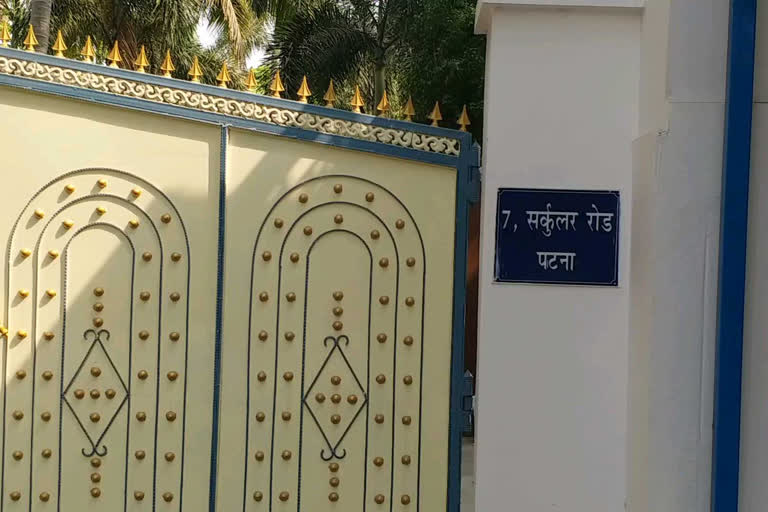
Patna, April 11, 2026. There has been a sudden surge of activity in Bihar’s politics concerning Nitish Kumar. Reports indicate that belongings are being shifted from the Chief Minister’s residence at 1 Anne Marg to the bungalow at 7 Circular Road. This development has intensified speculation about whether the Chief Minister is preparing to resign.
It is noteworthy that on Thursday, Bihar Chief Minister Nitish Kumar took oath as a Rajya Sabha member. He will now begin a new parliamentary innings as a member of the Rajya Sabha. His move to the Rajya Sabha will pave the way for the formation of a new government in Bihar. Furthermore, upon arriving in Delhi on Thursday, he clarified in conversations with journalists that he will now remain active in national politics. This step of his has accelerated the process of leadership change in Bihar. It should be noted that Nitish Kumar began his career from the Bihar Legislative Assembly in 1985. He has been a Lok Sabha MP 6 times and after becoming Chief Minister, was elected as a member of the Legislative Council 4 times. Today, Nitish has taken oath as a Rajya Sabha member. With this, he has achieved the distinction of being a member of all four houses. Nitish Kumar has become the second Chief Minister after Lalu Yadav to become a member of all four houses.
According to sources, activities of removing belongings from the residence have been observed over the past few days, following which discussions have begun in political corridors. However, no official statement has been issued on this matter yet, but the opposition and political analysts are viewing it as a sign of a major change.
1 Anne Marg has been the official residence of Bihar’s Chief Minister, and such activity from there is generally considered linked to a major political decision. In this context, the question arises whether a major political development is imminent in the state.
Experts believe that if this news proves true, it could impact the state’s political direction and power equations. For now, all eyes are fixed on Nitish Kumar’s next move.
1 Anne Marg
“1 Anne Marg” is the former residence of Dr. B.R. Ambedkar, a principal architect of the Indian Constitution and a revered social reformer, located in Mumbai. It now serves as a memorial museum, preserving his personal belongings, books, and documents that highlight his life and work in advocating for social justice and Dalit rights. The site is a significant cultural landmark, commemorating his legacy and contributions to modern India.
7 Circular Road
7 Circular Road is a historic shophouse located in Singapore’s Boat Quay area, built in the early 20th century. It is a preserved example of Singapore’s traditional architectural style and was once part of the bustling commercial district along the Singapore River. Today, it houses modern businesses while retaining its distinctive heritage facade.
Rajya Sabha
The Rajya Sabha, or Council of States, is the upper house of India’s bicameral Parliament. It was established on 3 April 1952, following the adoption of India’s Constitution in 1950, to represent the states and union territories of the Indian Union. Unlike the directly elected Lok Sabha, most of its members are elected by the state legislative assemblies, ensuring a federal balance in the legislative process.
Bihar Legislative Assembly
The Bihar Legislative Assembly, also known as the Bihar Vidhan Sabha, is the unicameral state legislature of Bihar, India. It was established in 1937 under the Government of India Act, 1935, and its first sitting was held in the historic Secretariat Building in Patna. Following Indian independence, it became the primary law-making body for the state, operating from its current purpose-built building, the Bihar Vidhan Sabha Bhavan, completed in the 1990s.
Lok Sabha
The Lok Sabha is the lower house of India’s bicameral Parliament, located in New Delhi. Established by the Constitution of India in 1950, it is the primary legislative body where members are directly elected by the people. Its history is tied to India’s independence, succeeding the Constituent Assembly and first convening in 1952 after the nation’s first general elections.
Legislative Council
The Legislative Council, often abbreviated as LegCo, is a common name for the primary legislative body in many territories, particularly those with a British colonial history, such as Hong Kong. Historically, these councils were established during colonial rule as appointed or partially elected advisory bodies to the governor. Today, they typically function as the central law-making chamber in their respective regions, though their specific powers and electoral systems vary.
Lalu Yadav
“Lalu Yadav” is not a place or cultural site, but a prominent Indian politician. He served as the Chief Minister of Bihar and is a key figure in the Rashtriya Janata Dal (RJD) party, known for his influential role in Bihar’s politics since the 1990s. His tenure is often associated with significant social empowerment initiatives for backward classes, as well as periods of political controversy.