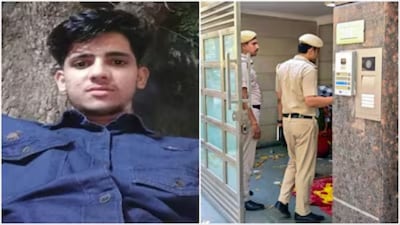
According to his mother, Mukeshi Devi, he was in contact with his cousin Trilok in Delhi at the time.
In a fresh development in the rape and murder of a 22-year-old daughter of a senior Income Tax officer in Delhi, investigators have identified the person the accused, Rahul Meena, was allegedly speaking to while fleeing the scene.
CCTV footage showed him as he exited the residence in Amar Colony.
According to his mother, he was in Delhi at the time.
During the call, Rahul allegedly told him, “I have committed a crime in Delhi. I may die now. The police will catch me soon.”
During questioning, Rahul reportedly denied involvement in the Alwar rape, claiming he had only gone there to retrieve his mobile phone and had not harmed the victim. Police sources also indicated that the mobile phones of both the accused and the victim are currently missing.
Investigators believe the accused targeted two victims across states within a span of a few hours. On Tuesday night at around 10:30 pm, Rahul allegedly entered a neighbor’s house in Rajasthan’s Alwar, where he assaulted and raped the woman.
He is also accused of strangling her and issuing threats before fleeing, warning her against reporting the incident. An FIR was registered based on her complaint.
Within hours, he is said to have traveled nearly 200 km to Delhi, reaching a housing society in south-east Delhi’s Kailash Hills at around 6:30 am. He allegedly entered his former employer’s residence at approximately 6:39 am.
The victim, an engineering graduate preparing for UPSC, was alone at home. When her parents returned from the gym around 8 am, they found her lying in a pool of blood, with the house ransacked.
Rahul is currently in custody for four days and is being subjected to sustained interrogation as officials piece together the sequence of events and possible motives behind the crime.
Amar Colony
Amar Colony is a historic neighborhood in South Delhi, India, known for its unique blend of residential and commercial spaces. Originally established in the early 20th century during the British Raj, it was developed as a housing cooperative for government employees and has since evolved into a bustling area with a mix of old bungalows and modern apartments. The colony’s layout and architecture reflect its colonial-era origins, while its lively markets and cultural diversity make it a distinctive part of Delhi’s urban fabric.
Alwar
Alwar is a historic city in the Indian state of Rajasthan, known for its rich cultural heritage and impressive architecture. It was founded in the 12th century and later became the capital of the Alwar princely state, with notable landmarks like the Bala Quila fort and the City Palace reflecting its Rajput history. Surrounded by the Aravalli hills, Alwar also offers natural attractions like the Sariska Tiger Reserve, blending history with wildlife.
Delhi</h3
Amar Colony
Amar Colony is a residential neighborhood in South Delhi, India, with its origins tracing back to the post-Partition period of the late 1940s. It was established as a refugee colony to rehabilitate families displaced from West Punjab (now in Pakistan) after the 1947 partition of India. Today, it is known for its peaceful, tree-lined streets and a strong sense of community, retaining much of its original character.
Alwar
Alwar is a historic city in the Indian state of Rajasthan, known for its rich cultural heritage and scenic beauty. It was founded in the 11th century by the Kachwaha Rajputs and later became the capital of the Alwar princely state in the 18th century. The city is famous for landmarks like the Alwar Fort, Sariska Tiger Reserve, and its vibrant bazaars, reflecting a blend of Rajput and Mughal influences.
Delhi
Delhi, the capital of India, has a rich history spanning over a millennium, having served as the seat of power for numerous empires, including the Delhi Sultanate, the Mughal Empire, and the British Raj. The city is a vibrant tapestry of ancient landmarks like the Qutub Minar and Red Fort, alongside modern developments, reflecting its role as a political and cultural hub. Today, it stands as a bustling metropolis where centuries of history coexist with contemporary life.
Rajasthan
Rajasthan, located in northwestern India, is a state renowned for its vibrant culture, majestic forts, and desert landscapes. Historically, it was home to several powerful Rajput kingdoms, which resisted Mughal expansion and later formed alliances with the British. Today, Rajasthan is a major tourist destination, celebrated for its palaces, traditional arts, and festivals that reflect its royal heritage.
Kailash Hills
The Kailash Hills, located in the Tibet Autonomous Region of China, are a sacred mountain range revered in Hinduism, Buddhism, Jainism, and Bon. The most prominent peak, Mount Kailash, is considered the earthly manifestation of Mount Meru, the cosmic axis of the universe, and has been a pilgrimage site for thousands of years, though it remains unclimbed due to its religious significance. The area is also associated with the origins of the Indus, Sutlej, Brahmaputra, and Karnali rivers, adding to its profound spiritual and geographical importance.
Bala Quila
Bala Quila, also known as the Alwar Fort, is a historic hill fortress located in Alwar, Rajasthan, India. Built in the 10th century by the Nikumbh Rajputs and later expanded by the Kachwaha rulers in the 15th century, it served as a strategic military stronghold and royal residence. The fort offers panoramic views of the city and surrounding hills, reflecting the region’s rich Rajput architectural and cultural heritage.
City Palace
The City Palace in Jaipur, India, is a historic royal complex built between 1729 and 1732 by Maharaja Sawai Jai Singh II, the founder of Jaipur. It served as the seat of the Jaipur royal family and today houses a museum showcasing artifacts, textiles, and weaponry from the Rajput era. The palace complex blends Mughal and Rajput architectural styles, featuring courtyards, gardens, and iconic structures like the Chandra Mahal and Mubarak Mahal.
Sariska Tiger Reserve
Sariska Tiger Reserve is a wildlife sanctuary located in the Alwar district of Rajasthan, India, originally established as a hunting reserve for the royal family of Alwar in the early 20th century. It was declared a tiger reserve in 1978 under India’s Project Tiger initiative to protect the endangered Bengal tiger. Despite facing challenges like poaching and the disappearance of tigers in the 2000s, the reserve has seen successful reintroduction efforts and remains an important conservation area and popular eco-tourism destination.