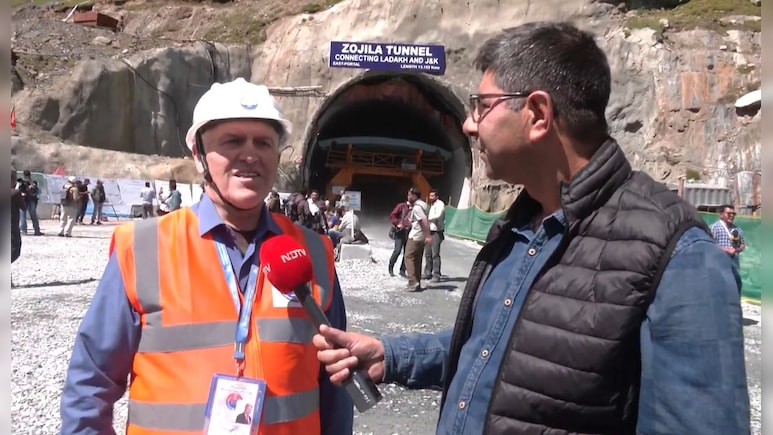
Iranian engineer working on Zojila tunnel calls India his second home.
Yousef, from Iran, is the Authority Engineer for the Zojila Tunnel
Zojila Tunnel:
While his own country was under bombs and its bridges were being destroyed, Yousef Es’haghpour Rahimabadi was busy working on building a tunnel in India.
From Iran, Yousef is the Authority Engineer for the Zojila Tunnel. Calling it an iconic tunnel, Yousef said that he is proud to have been associated with the landmark project.
The Zojila Tunnel project successfully achieved its historic final excavation breakthrough on Tuesday. Union Minister for Road Transport and Highways, Nitin Gadkari, along with Chief Minister Omar Abdullah and Lieutenant Governor Manoj Sinha witnessed the final ceremonial blast from the Kargil side to connect the excavation fronts from Baltal (Sonamarg) and Meenamarg (Drass-Kargil).
Excited at the breakthrough, Yousef called Zojila the most challenging project of his career spanning over three decades. “I have worked in many countries on many tough projects. But this is the most challenging one due to the topography and weather. That’s why I am proud to be part of the project,” Yousef said.
Yousef, who is married in India, calls India his second home and describes himself as Indo-Iranian.
Talking about his experience of working on building something as iconic as the Zojila Tunnel while his country was under heavy bombing, Yousef said that engineers are also soldiers. And that’s why he kept working on the tunnel.
“I am happy and honored to be part of a project that is for the good of people of India,” he said, adding that every Indian must be proud of the tunnel.
The Zojila Tunnel will become India’s longest road tunnel and Asia’s longest bi-directional tunnel, spanning a total project length of 30.18 km, including a 13.153 km main tunnel and 17.030 km of approach roads.
The project, estimated at Rs 6,809 crore, is part of a larger effort to strengthen all-weather connectivity along the Srinagar-Kargil-Leh corridor on National Highway-1.
The tunnel, being constructed under the Zojila Pass between Sonamarg and Drass, aims to provide uninterrupted connectivity to Ladakh, which remains cut off during winter months due to heavy snowfall and avalanche risks.
Once operational, it will reduce travel time on the stretch from over three hours to around 15 minutes, while also improving safety and strategic mobility for both civilian and defense purposes.
Zojila Tunnel
The Zojila Tunnel is a strategically important road tunnel under construction in the Indian union territory of Ladakh, connecting the regions of Kashmir and Ladakh across the Zojila Pass. Once completed, it will be India’s longest bi-directional tunnel, significantly reducing travel time and providing all-weather connectivity to the remote Ladakh region. The project aims to overcome the historical challenges of the pass, which has often been closed during harsh winter months, thereby boosting economic development and military logistics.
India
India is a vast South Asian country with a rich history spanning over 5,000 years, home to the ancient Indus Valley Civilization and the birthplace of major religions like Hinduism, Buddhism, Jainism, and Sikhism. It was ruled by powerful empires such as the Maurya, Gupta, and Mughal dynasties, which left behind iconic cultural sites like the Taj Mahal and the temples of Khajuraho. After centuries of British colonial rule, India became an independent nation in 1947 and is now the world’s largest democracy, known for its diverse languages, cuisines, and festivals.
The Zojila Tunnel is a strategic road tunnel under construction in the Indian union territory of Ladakh, located on the Srinagar-Leh highway. It will pass beneath the Zojila Pass, which historically served as a crucial but treacherous link connecting the Kashmir Valley to the high-altitude plateau of Ladakh, often closed by heavy snowfall for up to six months a year. Once completed, the tunnel is expected to provide all-weather connectivity, significantly reducing travel time and boosting economic and military logistics in the region.
Zojila Pass
Zojila Pass is a high-altitude mountain pass in the Indian union territory of Ladakh, connecting the Kashmir Valley with the Dras and Suru valleys. Historically, it has served as a crucial gateway for trade and military movement, and during the Indo-Pakistani War of 1947, it was the site of a significant battle where Indian forces defended the region. Today, it remains a vital, though often treacherous, route for transportation and tourism in the Himalayas.
Baltal (Sonamarg)
Baltal, located near Sonamarg in the Indian union territory of Jammu and Kashmir, serves as the base camp for the annual Amarnath Yatra pilgrimage to the holy cave shrine. Historically, it has been a key stopover for pilgrims and travelers crossing the Zoji La pass, linking the Kashmir Valley with Ladakh. The site is known for its scenic beauty, with lush green meadows and the gushing Sindh River, making it a popular destination for both religious and leisure tourism.
Meenamarg (Drass-Kargil)
Meenamarg, located on the Drass-Kargil road in Ladakh, India, is a high-altitude valley known for its stunning meadows and significance as a strategic military area. It gained historical prominence during the 1999 Kargil War, when Indian forces secured the region from Pakistani intruders in a fierce battle. Today, it serves as a serene tourist destination and a poignant reminder of the conflict, with remnants of bunkers and memorials honoring the soldiers who fought there.
Srinagar-Kargil-Leh corridor
The Srinagar-Kargil-Leh corridor is a vital high-altitude highway in the Indian union territory of Ladakh, connecting the Kashmir Valley to the remote regions of Kargil and Leh. Historically, this route has served as a crucial link for trade and military logistics along the ancient Silk Road, and it gained significant strategic importance during the 1999 Kargil War. Today, it is a lifeline for the region, facilitating transportation, tourism, and the movement of essential supplies through some of the world’s most challenging terrain.
National Highway-1
National Highway-1 is a major road in India that stretches over 2,500 kilometers, connecting the northern city of Srinagar in Jammu and Kashmir to Kanyakumari in the southern tip of Tamil Nadu. Originally part of the historic Grand Trunk Road, which dates back to the Maurya Empire, the modern highway was developed post-independence to improve connectivity across the country. It serves as a vital transportation corridor, linking diverse regions and facilitating economic and cultural exchange.
Sonamarg
Sonamarg, meaning “Meadow of Gold,” is a picturesque hill station in the Indian union territory of Jammu and Kashmir. Historically, it served as a key stop on the ancient Silk Route, connecting the Kashmir Valley with Ladakh and Central Asia. Today, it is renowned for its stunning alpine meadows, glaciers, and as a popular destination for trekking and camping.
Drass
Drass, located in the Kargil district of Ladakh, India, is a picturesque valley known as the “Gateway to Ladakh.” Historically, it served as a key stop along the ancient Silk Route and was a significant battleground during the 1999 Kargil War. Today, it is celebrated for its stunning landscapes, including the Drass River and the nearby Mushkoh Valley.