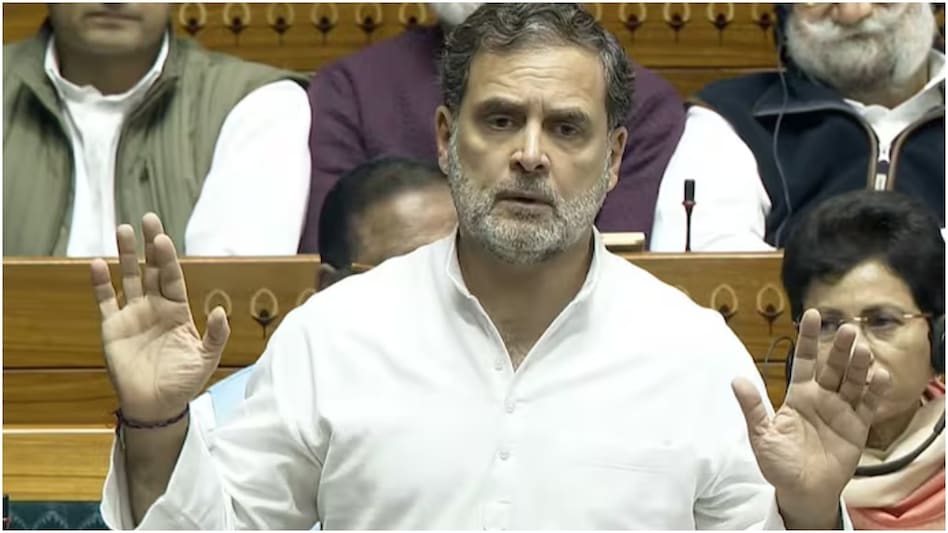
Speaking on electoral reforms in the Lok Sabha, opposition leader Rahul Gandhi accused the Modi government of controlling the Election Commission. He raised the question of why the Chief Justice was removed from the committee that selects election commissioners.
Speaking on electoral reforms in the Lok Sabha on Tuesday during the Parliament’s winter session, opposition leader Rahul Gandhi targeted the central government. He questioned the Modi government on why it is so intent on removing the Chief Justice of India from the panel responsible for selecting the Chief Election Commissioner and other election commissioners. Rahul Gandhi asked, ‘Why was the CJI removed from the selection committee? Do we not have trust in the CJI?’
Lok Sabha
The Lok Sabha is the lower house of India’s bicameral Parliament, located in New Delhi. Established by the Constitution of India in 1952, it is the primary legislative body where directly elected representatives (Members of Parliament) debate and pass laws. Its history is tied to India’s independence, succeeding the Imperial Legislative Council and embodying the democratic principles of the world’s largest democracy.
Election Commission
The Election Commission is an independent governmental body responsible for organizing and overseeing the democratic process of elections in a country. Its history is tied to the development of modern representative democracy, with many nations establishing permanent commissions in the 19th and 20th centuries to ensure free and fair voting, manage voter registration, and enforce electoral laws. By operating impartially, it serves as a fundamental guardian of a nation’s political legitimacy and public trust.
Chief Justice
“Chief Justice” is not a specific place or cultural site, but the title of the presiding judge of a supreme court. Historically, the role is most famously embodied by figures like John Marshall, the fourth Chief Justice of the United States (1801-1835), whose rulings established key principles of American constitutional law and the power of judicial review.
Parliament
The term “Parliament” most commonly refers to the supreme legislative body of a country, with the Palace of Westminster in London—home to the UK Parliament—being one of the most iconic examples. Its history dates to the medieval period, with the current Gothic Revival building largely constructed in the 19th century after a fire destroyed much of the old palace. The UK Parliament, comprising the House of Commons and House of Lords, has evolved over centuries from advisory councils to a central democratic institution, establishing traditions like parliamentary sovereignty.
Modi government
The “Modi government” refers to the administrations led by Prime Minister Narendra Modi of the Bharatiya Janata Party (BJP), which first came to power in India in 2014 and was re-elected in 2019. This period has been marked by significant economic reforms, major infrastructure projects, and a focus on Hindu nationalist policies, representing a decisive shift in India’s contemporary political and cultural landscape. Its history is defined by its origins in the BJP’s ideological framework and its electoral success in modernizing India’s governance while generating both domestic and international debate over its socio-political direction.
Chief Election Commissioner
The Chief Election Commissioner is not a specific place or cultural site, but a high-ranking official position. In countries like India, the Chief Election Commissioner heads the Election Commission, an independent constitutional authority established to administer and oversee the democratic electoral process. The role was created to ensure free and fair elections, with the Indian Election Commission itself being founded on January 25, 1950, just before the nation’s first general elections.
winter session
“Winter session” typically refers to a special legislative or parliamentary session held during the winter months, often to address urgent or pending government business. Historically, such sessions have been used in various parliamentary systems, like in India, where the Parliament meets for a shorter period from November to December to discuss key bills and policies. These sessions help ensure continuous governance and timely decision-making outside the regular parliamentary calendar.
selection committee
A “selection committee” is not a specific place or cultural site, but a group of people convened to evaluate and choose candidates for an award, position, or honor. Historically, such committees have been fundamental to institutions like academies, prize foundations, and organizations to ensure impartial and expert judgment. Their structured process is a key cultural mechanism in fields from science and literature to sports and public service.