“If you make the wrong decision, we will destroy electricity and ports,” America’s open threat to Iran before the second round of talks.
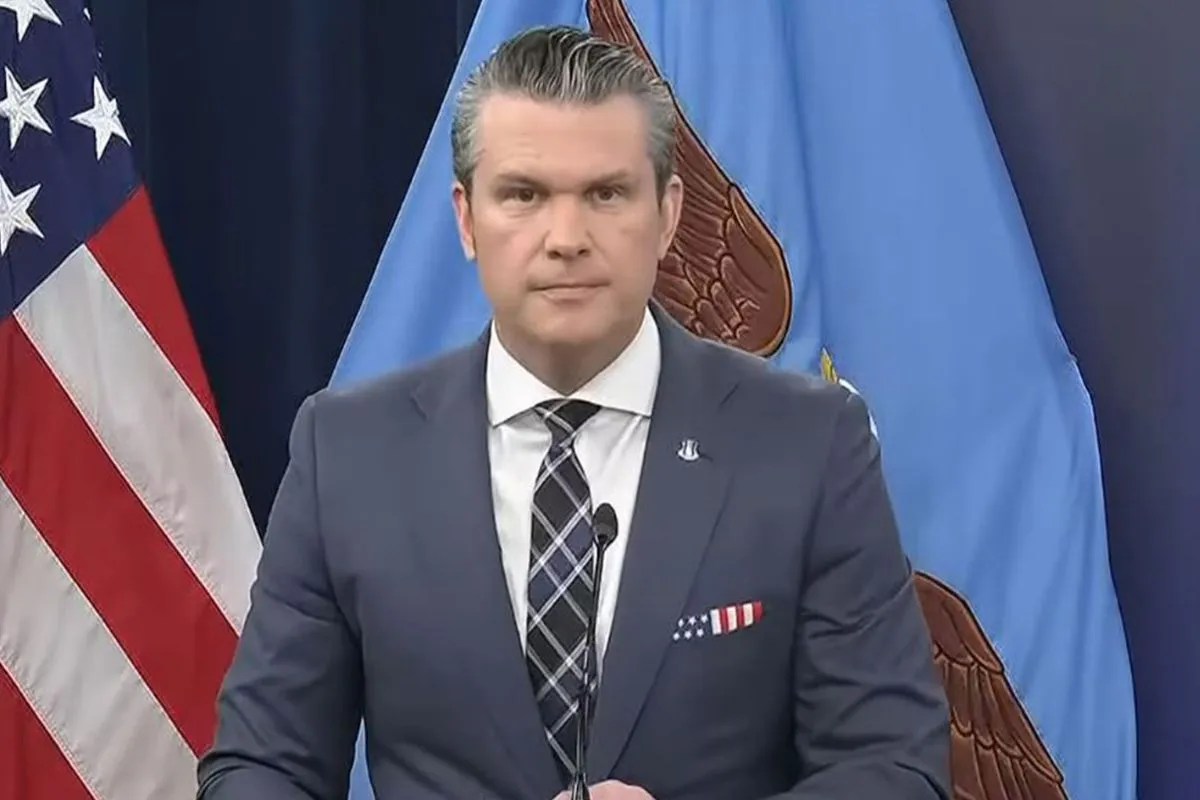
Pete Hegseth and General Dan Kane on US-Iran War: A two-week ceasefire between the United States and Iran has been in effect since April 7. While peace efforts are being made by both countries, several issues remain unresolved. In this context, a major and important statement has been made by US Secretary of War Pete Hegseth. He stated that the US is preparing to re-engage with greater strength than ever before and that the maritime blockade against Iran will continue as long as necessary.
The US Secretary of War warned that if Tehran rejects a potential peace agreement, the US military is prepared to resume military attacks. He said, ‘We will continue this successful blockade of Iran for as long as necessary.’ He reiterated that the US is preparing with greater strength than before.
Irani Parliament Speaker Mohammad Bagher Ghalibaf
Highlighting the current readiness of military forces, he stated that forces have been deployed to launch a war campaign if a diplomatic solution is not reached. He further stated that the clear message to Iran is that ‘we are watching you.’
General Dan Kane, Chairman of the US Joint Chiefs of Staff, emphasized a high level of vigilance, stating that US military forces are fully prepared during the current ceasefire and are ready to resume major war operations at any moment.
Elaborating on the scope of these maritime restrictions, General Kane clarified that these measures are comprehensive. He said, ‘I want to make it clear that this blockade applies to all vessels heading to or coming from Iranian ports, regardless of their country of origin.’
He further explained that this action is not a blockade of the Strait of Hormuz, but a blockade of Iran’s ports and coastline. It will be enforced in Iran’s territorial sea and international waters. Under this same strategy, the General warned that the US military will actively target any vessel or ship flying the Iranian flag that attempts to provide ‘material support’ to the country.
Maintaining military pressure, General Kane urged Tehran’s leadership to consider the long-term consequences of its decisions. He said the regime could choose “a prosperous future and a golden bridge,” which Washington hopes for for the Iranian people. However, he concluded with a warning that if Iran makes the wrong decision, it will face bombs alongside blockades on infrastructure, electricity, and energy.
Russian strikes Ukraine
United States
The United States is a federal republic founded in 1776 after declaring independence from Great Britain, with its modern government established by the Constitution in 1789. Culturally, it is a vast and diverse nation built on immigration, known globally for its influential contributions in areas like technology, cinema, music, and democratic ideals. Key historical sites span from colonial settlements and Civil War battlefields to monuments like the Statue of Liberty, symbolizing freedom and opportunity.
Iran
Iran, historically known as Persia, is a country in Western Asia with one of the world’s oldest continuous civilizations, dating back to the Elamite kingdoms of the 4th millennium BCE. It is home to numerous UNESCO World Heritage sites, including the ancient ruins of Persepolis, the capital of the Achaemenid Empire, and the magnificent Islamic architecture of Isfahan’s Naqsh-e Jahan Square. Today, Iran’s rich culture is a complex tapestry woven from its pre-Islamic Zoroastrian heritage, its central role in the Islamic Golden Age, and its modern national identity.
Tehran
Tehran is the capital and largest city of Iran, officially becoming the national capital in 1786 under the Qajar dynasty. Today, it is a major political and economic hub, home to significant cultural sites like the Golestan Palace, a UNESCO World Heritage site that reflects the opulent Qajar era.
Strait of Hormuz
The Strait of Hormuz is a strategically vital maritime chokepoint connecting the Persian Gulf with the Gulf of Oman and the wider Indian Ocean. Historically, it has been a key trade route for centuries, but in the modern era, its significance is defined by the transit of about one-fifth of the world’s oil supply. Its geopolitical importance has made it a focal point of regional tensions and international security concerns for decades.
Washington
Washington, D.C., the capital of the United States, was founded in 1790 as a planned city to serve as the nation’s permanent seat of government. Its history is deeply tied to American democracy, with iconic monuments like the White House, Capitol Building, and Lincoln Memorial symbolizing key events and figures. The city’s design, influenced by Pierre L’Enfant, features grand avenues and open spaces centered around the National Mall.
Ukraine
Ukraine is a sovereign nation in Eastern Europe with a rich history dating back to the medieval state of Kyivan Rus, a cultural and political precursor to modern Eastern Slavic nations. It has endured periods of foreign rule and, after the dissolution of the Soviet Union, declared independence in 1991. Today, it is known for its diverse cultural heritage, Orthodox Christian cathedrals like Kyiv’s Saint Sophia, and its ongoing struggle to defend its sovereignty and national identity.
Russian
“Russian” broadly refers to the culture, history, and people of Russia, a vast nation spanning Eastern Europe and Northern Asia. Its rich history includes the medieval Kievan Rus’, the Tsardom of Russia, the Russian Empire, the Soviet Union, and the modern Russian Federation, with cultural landmarks like the Kremlin in Moscow and the Hermitage Museum in Saint Petersburg. This heritage is expressed through iconic arts, literature, Orthodox Christian architecture, and traditions that have significantly influenced global history.
US military
The United States military is the national armed forces of the United States, established by the Continental Congress in 1775 during the American Revolutionary War. It has evolved into one of the world’s largest and most technologically advanced militaries, playing a central role in U.S. foreign policy and global security throughout its history, from westward expansion to major world conflicts and modern operations.