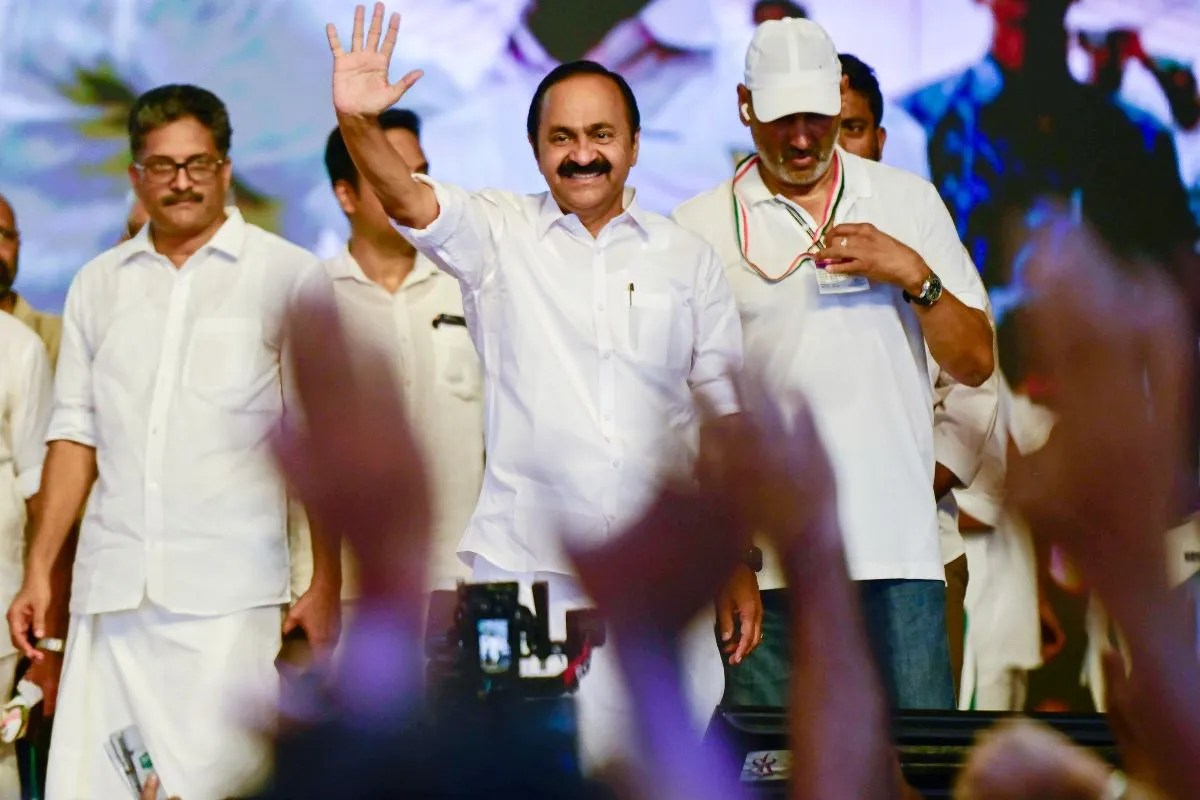
Congress takes first major step to lift Kerala out of economic crisis right after government formation.
This victory has created a celebratory atmosphere across the entire state. Special congratulations were given to Congress candidate K.A. Thulasi for winning from the Kongad seat. It was stated that Thulasi achieved a remarkable victory by breaking the strong communist stronghold.
Kerala Pradesh Congress Committee Vice President VT Balram
Congress workers see this win as a revival of the party. With record representation of women and youth, along with a good number of Dalit faces, the party has gained a new brand image. All eyes are now on how the new government will tackle the state’s economic challenges and fulfill its promises on the ground.
Concerns were also raised about the state’s financial situation. Even though the former finance minister claims the treasury is not empty, the reality is that Kerala’s economic condition is completely deteriorated. Governments have spent thousands of crores of rupees in areas like Attappadi, yet the results have not been satisfactory.
Despite this, the Chief Minister V.D. Satheesan and his team were praised. It was noted that the new cabinet has already started working on fulfilling several promises from the very first day. Regarding the delay in portfolio allocation among ministers, it was said there is no need to worry; such delays have occurred many times before during cabinet formation.
Meanwhile, the Congress government in Kerala has decided to release a comprehensive white paper to pull the state out of its economic crisis. This decision was made at a high-level meeting chaired by Chief Minister V.D. Satheesan.
Former Cabinet Secretary Dr. K.M. Chandrasekhar has been appointed chairman of this committee. Additional Chief Secretary of the Finance Department, K.R. Jyotilal, will serve as coordinator. The committee includes experts such as prominent economist Dr. Narayanan and CDS Director Dr. Veeramani.
Kerala Chief Minister V.D. Satheesan
Attappadi
Attappadi is a tribal settlement in Kerala, India, known for its rich cultural heritage and lush forest landscapes. Historically, it has been home to indigenous communities like the Irula, Muduga, and Kurumba tribes, who have maintained their distinct traditions and lifestyles for centuries. The area is also notable for its role in the Attappadi Reserve Forest and its connection to conservation efforts and tribal welfare programs.
Kerala
Kerala is a state on India’s southwestern Malabar Coast, known for its lush backwaters, palm-fringed beaches, and rich cultural heritage. Its history includes ancient trade with Phoenicians, Romans, and Arabs, and later European colonization by the Portuguese, Dutch, and British. Today, Kerala is celebrated for its high literacy rate, Ayurvedic traditions, and unique festivals like Onam.
Attappadi
Attappadi is a tribal settlement in Kerala, India, nestled in the Western Ghats. It is home to indigenous communities like the Irula, Muduga, and Kurumba tribes, who have lived there for centuries. The area is known for its rich biodiversity and has faced challenges related to land rights and development, with its history deeply tied to the tribes’ traditional forest-based livelihoods.
Attappadi
Attappadi is a tribal belt located in the Palakkad district of Kerala, India, known for its rich cultural heritage and diverse indigenous communities, including the Irula, Muduga, and Kurumba tribes. Historically, the region remained relatively isolated until the mid-20th century, when development projects and settlement schemes brought changes to its traditional way of life. The area is also noted for its scenic landscapes, including hills and forests, and faces ongoing challenges related to land rights and socio-economic integration.
Kerala
Kerala, located on the southwestern coast of India, is known for its lush landscapes, backwaters, and rich cultural heritage. Historically, it was a major center for the spice trade, attracting traders from ancient Rome, China, and later European colonial powers like the Portuguese, Dutch, and British. The region also has a unique history of matrilineal traditions and was formed as a state in 1956, uniting Malayalam-speaking areas.
Western Ghats
The Western Ghats are a mountain range along the western coast of India, recognized as a UNESCO World Heritage Site for their exceptional biodiversity. Geologically older than the Himalayas, these mountains have shaped the region’s climate and culture for millennia, serving as a barrier for monsoon rains and a home for ancient human settlements and trade routes. Today, they are a global biodiversity hotspot, sheltering thousands of endemic species of flora and fauna.