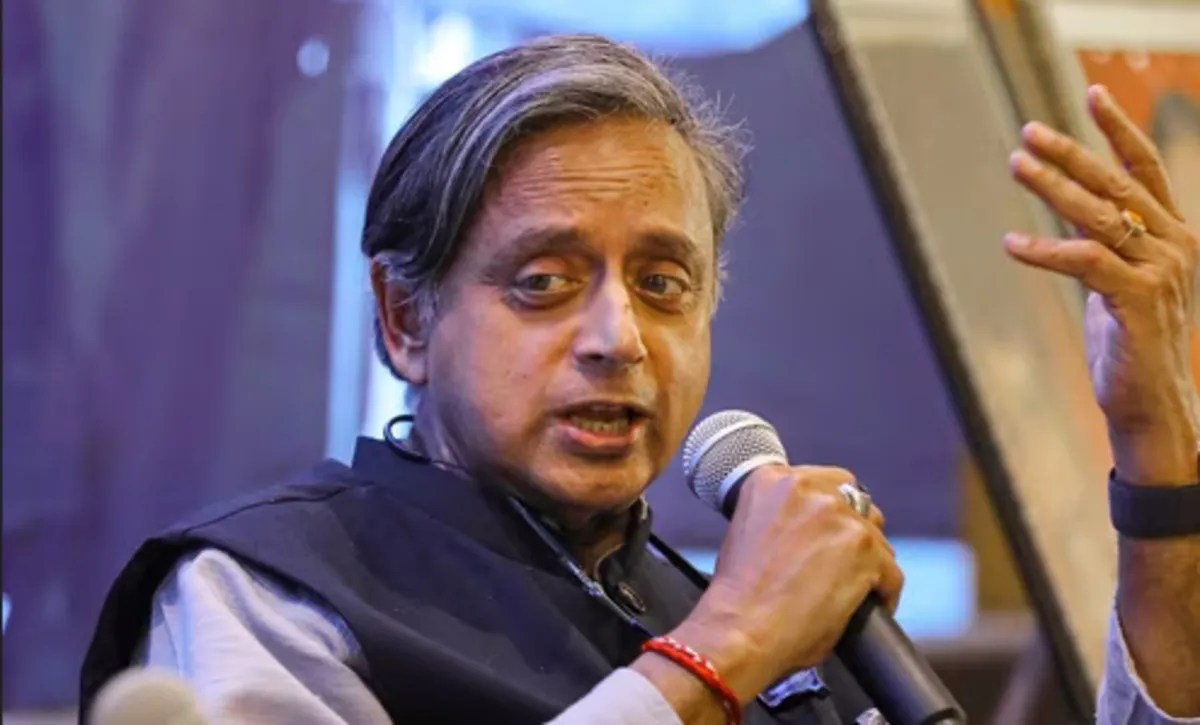
Congress MP and senior leader Shashi Tharoor has raised sharp questions about the electoral process in West Bengal. He stated that the large-scale deletion of names from voter lists and delays in verifying appeals had a decisive impact on the state’s election results. Speaking at the roundtable “India, That Is Bharat” during the Stanford India Conference in the United States, Tharoor mentioned the SIR (Special Summary Revision) in Bengal, saying that about 9.1 million names were removed from the list. Of these, approximately 3.4 million people filed appeals claiming they were genuine voters. According to Tharoor, very few of these cases were resolved before voting, leaving most unresolved at the time of polling.
Tharoor attributed the BJP’s victory in Bengal largely to the deletion of voter names. He said, “The question I have raised about the SIR needs an answer. Look at the case of Bengal. 9.1 million names were removed from the voter list. Of these, 3.4 million living people have appealed, saying they are right here and fully entitled to vote. According to the rules, each case had to be handled individually, so only a few hundred cases were resolved before voting. Even today, there are about 3.1 to 3.2 million people who might prove to be genuine voters during verification in the coming years, but they have lost their chance to vote. The BJP won Bengal by a margin of 3 million votes. Now, you tell me, is this entirely fair and democratic? To be honest, I have no issue with removing names of fake, deleted, absent, or migrated voters.”
Tharoor further added, “In Kerala, the removal of duplicate or multiple voter registrations benefited the Congress. In Kerala, there were cases where the same person’s name was registered two, three, or even four times. Removing these fake names cleaned up the voter list, which had historically been linked to the electoral strategies of opposing political parties. This helped the Congress, because the CPM was long known for things like double enrollment, triple enrollment, four-time enrollment—meaning the same person’s name appearing at four different booths. This used to happen, and so the SIR removed them.”
Stanford India Conference
The Stanford India Conference is an annual academic and policy-focused event hosted at Stanford University, bringing together scholars, industry leaders, and government officials to discuss India’s socio-economic and technological development. Established in the early 2000s, it serves as a platform for cross-disciplinary dialogue on topics ranging from innovation and entrepreneurship to public policy and culture. The conference highlights the growing importance of India-U.S. relations and the role of the Indian diaspora in shaping global discourse.
West Bengal
West Bengal is a culturally rich state in eastern India, known for its history as the epicenter of the Bengal Renaissance and the capital of British India in Kolkata. It was a key region in the Indian independence movement and was partitioned in 1947, with its eastern half becoming East Pakistan (now Bangladesh). The state is famous for its diverse heritage, including the Sundarbans mangrove forest and the artistic traditions of Durga Puja.
Kerala
Kerala is a state on India’s southwestern coast known for its lush landscapes, backwaters, and rich cultural heritage. Historically, it was a major center for the spice trade, attracting ancient traders from Rome, Arabia, and China, and it later became a hub for European colonial powers like the Portuguese, Dutch, and British. Today, Kerala is celebrated for its high literacy rate, unique art forms like Kathakali, and progressive social development.
<h3 class="
Stanford India Conference
The Stanford India Conference is an annual academic and cultural event held at Stanford University, focusing on India’s socio-economic, political, and technological developments. It brings together scholars, industry leaders, and policymakers to discuss India’s role in the global landscape, with its history tracing back to fostering cross-disciplinary dialogue since its inception in the early 2000s. The conference serves as a platform for networking and exploring collaborative opportunities between the U.S. and India.
West Bengal
West Bengal, located in eastern India, is a culturally rich state known for its history as the center of British colonial power in Calcutta (now Kolkata). It was a key hub of the Indian independence movement and later witnessed the partition of Bengal in 1947. Today, it is celebrated for its vibrant festivals, literature, art, and the Sundarbans mangrove forest.
Kerala
Kerala, a state on India’s tropical Malabar Coast, has a rich history as a major spice trading hub, attracting ancient Romans, Arabs, and later European colonizers. Known for its unique cultural traditions, it boasts a high literacy rate and is famous for its backwaters, Ayurvedic treatments, and classical arts like Kathakali. The region was formed in 1956 by merging Malayalam-speaking areas, and it remains a popular destination for its serene landscapes and vibrant festivals.
Bengal Renaissance
The Bengal Renaissance was a cultural, social, and intellectual reform movement that flourished in 19th and early 20th century Bengal, India, primarily in Calcutta. It marked a period of profound change, blending Hindu traditions with Western ideas, and produced major figures in literature, science, and religion, such as Rabindranath Tagore and Swami Vivekananda. This era critically shaped modern Indian thought and nationalism, acting as a bridge between traditional Indian culture and progressive European influences.
Kolkata
Kolkata, the capital of West Bengal, India, was established in 1690 by the British East India Company and served as the capital of British India until 1911. Known for its colonial architecture, vibrant arts scene, and intellectual history, the city was a key center of the Indian independence movement and the Bengali Renaissance. Today, it remains a major cultural hub, famous for its festivals, literature, and iconic landmarks like the Victoria Memorial and Howrah Bridge.
Sundarbans
The Sundarbans is the world’s largest mangrove forest, spanning the delta region of the Ganges, Brahmaputra, and Meghna rivers in Bangladesh and India. Its name derives from the abundant “Sundari” trees, and it has been recognized as a UNESCO World Heritage Site for its unique biodiversity, including the famous Bengal tiger. Historically, the area was largely uninhabited and protected by local rulers as a royal hunting reserve during the Mughal and British colonial periods.
Durga Puja
Durga Puja is a major annual Hindu festival in India, particularly celebrated in West Bengal, that honors the goddess Durga’s victory over the demon Mahishasura. Its origins trace back to ancient traditions, but the modern public spectacle with elaborate temporary temples (pandals) and artistic idols emerged in the 18th century under Bengali aristocracy. Today, it is a five-day event marked by vibrant processions, cultural performances, and communal worship, recognized by UNESCO as an Intangible Cultural Heritage.
Kathakali
Kathakali is a classical Indian dance-drama that originated in the state of Kerala during the 17th century, blending dance, music, and elaborate storytelling. It draws from Hindu epics and mythology, known for its vibrant costumes, detailed makeup, and expressive gestures called mudras. Historically, Kathakali evolved from earlier temple and folk traditions, and it remains a celebrated form of cultural expression today.