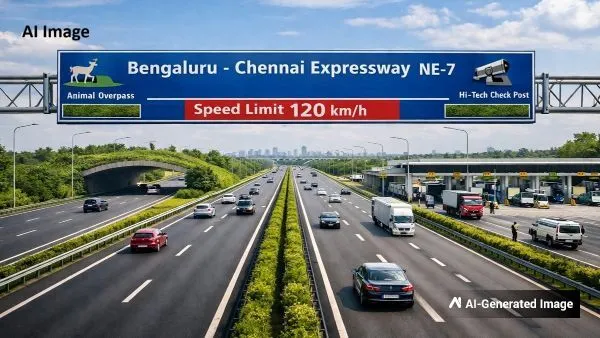
Bengaluru-Chennai Expressway: 120 km/h speed and high-tech features, future-ready 8-lane expressway to be built.
Bengaluru Chennai Expressway: The Bengaluru-Chennai Expressway is one of the country’s most ambitious greenfield highway projects, set to completely transform connectivity in South India. This expressway is being developed as a 4-lane road, with plans to expand it to 8 lanes in the future. Most notably, it will be a fully access-controlled expressway, where vehicle entry and exit will only be possible at designated points.
The maximum speed on this high-speed corridor has been set at 120 km/h, which will significantly reduce travel time between Bengaluru and Chennai. Currently, travel on this route takes 6 to 7 hours, but once the expressway is fully operational, this distance can be covered in just 2 to 3 hours.
Bengaluru Chennai Expressway: To be Equipped with Latest Technology
– Several high-tech features have been included to make the expressway modern and safe.
– Animal overpasses are being constructed for wildlife protection, ensuring animal movement is not disrupted.
– In addition, two large toll plazas, truck lay-by areas, and high-tech border check posts at the borders of Andhra Pradesh and Tamil Nadu are also being developed.
8 Lane Expressway to Start This Year
Regarding this project, the Union Minister for Road Transport and Highways has indicated that the expressway is likely to be fully operational by December 2026. However, according to some media reports, considering local challenges and the pace of construction, there are also speculations that it may be completed by early 2027. This expressway will directly connect two major economic and IT hubs, Bengaluru and Chennai, which will not only make travel easier but also provide a significant boost to the business and logistics sectors. The expressway will give new momentum to industrial development in South India and strengthen the regional economy.
Bengaluru-Chennai Expressway
The Bengaluru-Chennai Expressway is a major 262-kilometer greenfield highway in southern India, connecting the capital cities of Karnataka and Tamil Nadu. Its construction, which began in the late 2010s and opened in phases, was designed to drastically reduce travel time between the two economic hubs to about two hours. As part of India’s National Highways Development Project, it represents a significant modern infrastructure investment to boost regional connectivity and economic growth.
Bengaluru
Bengaluru, the capital of India’s Karnataka state, is a major tech hub known as the “Silicon Valley of India.” Historically, it was founded in the 16th century by Kempe Gowda I and later became a prominent British colonial military station in the 19th century. Today, it blends its historic landmarks like the Bangalore Palace with its modern identity as a center for innovation and cosmopolitan culture.
Chennai
Chennai, formerly known as Madras, is the capital of the Indian state of Tamil Nadu and a major cultural and economic hub on the Coromandel Coast. It was founded in 1639 by the British East India Company, which established Fort St. George, a settlement that grew into a key colonial port. Today, the city is renowned for its classical South Indian arts, historic temples like the Kapaleeshwarar, and as the birthplace of Carnatic music.
Andhra Pradesh
Andhra Pradesh is a state in southeastern India, historically significant as the heartland of the ancient Satavahana dynasty and a major center for Telugu culture and language. It is renowned for its rich heritage, including classical Kuchipudi dance, majestic temples like Tirumala Venkateswara, and historic sites such as the ruins of the Vijayanagara Empire at Hampi (shared with Karnataka). Formed in its current iteration in 2014 after the bifurcation that created Telangana, it remains a key economic and agricultural region, with a long coastline along the Bay of Bengal.
Tamil Nadu
Tamil Nadu is a state in southern India renowned for its rich Dravidian cultural heritage, ancient temples, and classical art forms like Bharatanatyam. Its history dates back over two millennia, with powerful dynasties like the Cholas, Pallavas, and Pandyas leaving a lasting architectural legacy, including the UNESCO World Heritage sites of the Great Living Chola Temples and the monumental shore temple at Mahabalipuram. Today, it remains a vibrant center of Tamil language, literature, and Hindu tradition.