Victory rally of Pravin Ram: “Uproot and throw out BJP’s hooligan rule”, a resounding call in Junagadh.
Pravin Ram’s Victory Trust Rally: "The public will avenge each of my 108 days in jail", his roar in Saurashtra
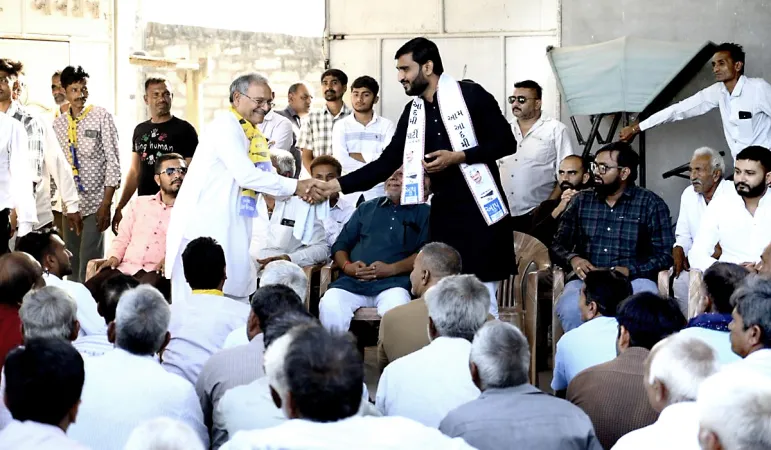
Rajkot/Junagadh: The battle for local self-government elections in Gujarat has now reached the point of bloody politics and saving democracy. Thus, the Aam Aadmi Party has started a vigorous campaign of ‘Victory Trust Rallies’ to breach the BJP’s fortresses. On April 17, Pravin Ram’s Victory Trust Rally was held in Mangrol and Keshad of Junagadh district and Upleta of Rajkot district. In this rally, Pravin Ram launched sharp attacks on the ruling party, stating that it is not a government but ‘goonda raj’ (rule of thugs) that is currently running in Gujarat.
Murder of Democracy: Attack on the game of making 700 seats uncontested
Addressing the crowd at the rally, Pravin Ram thundered that while the right to decide who wins the election belongs to the public, the BJP has snatched away the very right to vote from the people. During Pravin Ram’s Victory Trust Rally, he made a serious allegation that on more than 700 seats, by adopting a policy of coercion, inducement, punishment, and division, the nomination forms of candidates have been withdrawn.
He raised the question, “Who are you to decide even before the public votes?” Stating that the protector has become the predator, he added that today the police, instead of shutting down liquor dens, are working as agents of the BJP to get candidates’ forms withdrawn. Pravin Ram’s Victory Trust Rally proved that even in this atmosphere of fear, Aam Aadmi Party workers are standing firm.
The public demanding an account of 108 days of jail and torture
Becoming emotional in his address, Pravin Ram stated that while fighting for the rights of farmers and the common people, he spent 108 days in jail. During this time, the government subjected him to unbearable physical and mental torture. In Pravin Ram’s Victory Trust Rally, he roared, “The public will now avenge this torture of mine.” He appealed to the people that in the upcoming election, by pressing the button on the broom symbol, BJP’s arrogance should be broken.
He also targeted Congress, saying that Congress is no longer capable and every vote given to it is akin to being wasted. Thousands of people present at Pravin Ram’s Victory Trust Rally raised their hands and pledged to get the Aam Aadmi Party elected with a thumping majority.
Key Highlights of the Rally:
A show of strength amidst crowds of thousands in Mangrol, Keshad, and Upleta.
Exposure of BJP’s attempts to finish democracy.
Statement that voting for Congress is like directly benefiting the BJP.
Strategy to corner the government on farmers’ issues and the Ecozone matter.
Strong Messages from the Victory Trust Rally:
The ground resonated with the slogan: "Make the BJP flee, this time it’s time for a broom sweep."
A call to vote for your property and the future of the next 17 generations.
An appeal to make the broom victorious for a fearless Gujarat.
According to ground reports, after Pravin Ram’s Victory Trust Rally, anger against the BJP is clearly visible in the rural areas of Saurashtra. A picture is emerging as if the public has now taken to the field to save democracy.
Junagadh
Junagadh is a historic city in Gujarat, India, known for its ancient monuments and as a former princely state. Its history spans over 2,300 years, with significant landmarks including the Uparkot Fort (founded around 319 BCE) and the nearby Girnar Hill, a major pilgrimage site with both Hindu and Jain temples. The city’s name means “Old Fort,” reflecting its long-standing strategic importance.
Saurashtra
Saurashtra is a historical region located on the western coast of India, forming a large peninsula in the modern state of Gujarat. Historically, it was known for its ancient ports, maritime trade, and as a center for the early Indus Valley civilization, with sites like Lothal. The region is culturally significant for its association with the legendary figure of Krishna and is home to important Hindu pilgrimage sites like the Somnath Temple.
Rajkot
Rajkot is a major city in the Indian state of Gujarat, historically significant as the capital of the former princely state of Saurashtra and the childhood home of Mahatma Gandhi. It was founded in 1612 by Thakur Sahib Vibhoji Ajoji Jadeja and later became an important center of political activity during India’s independence movement. Today, it is a bustling commercial and industrial hub, known for its educational institutions and museums dedicated to Gandhi.
Mangrol
Mangrol is a historic port town located in Gujarat, India, on the coast of the Arabian Sea. It has a long history as a significant maritime trade center, particularly under the rule of the Jethwa Rajputs and later the Mughal Empire. Today, it is known for its fishing industry and historical landmarks like the ancient Mangrol Fort and several old stepwells.
Keshad
“Keshad” is not a widely recognized historical or cultural site. It may be a misspelling or a local/regional name. If you are referring to **Kesaria** in India, it is the site of the ancient Kesaria Stupa, built in the 3rd century CE and one of the tallest Buddhist stupas in the world, believed to be associated with the Buddha’s final journey.
Upleta
Upleta is a town in the Rajkot district of Gujarat, India, historically known as a center for trade and commerce. Its history is closely tied to the Jadeja Rajput rulers of the region, and it is also recognized as the birthplace of the 19th-century spiritual poet and saint, Shri Devchandji Maharaj. Today, it remains an important local commercial hub with several temples and cultural sites associated with its heritage.
Gujarat
Gujarat is a state in western India with a rich cultural heritage and a long history dating back to the ancient Indus Valley Civilization, including the archaeological site of Lothal. It is renowned for being the birthplace of Mahatma Gandhi and for its vibrant traditions in textiles, handicrafts, and festivals like Navratri. The region’s history also features significant medieval trade ports and the architectural legacy of the Solanki dynasty.
Ecozone
“Ecozone” typically refers to a large-scale ecological region or biome, such as the Palearctic or Neotropical realms, defined by its distinct climate, geography, and biodiversity. In a cultural or tourism context, it can also describe an immersive educational park or reserve designed to showcase and conserve a specific natural environment. For example, the Clark Museum & 4D Theater in the Philippines features an “Ecozone” exhibit that highlights the local natural history and the transformation of the former U.S. airbase into a thriving commercial and ecological area.