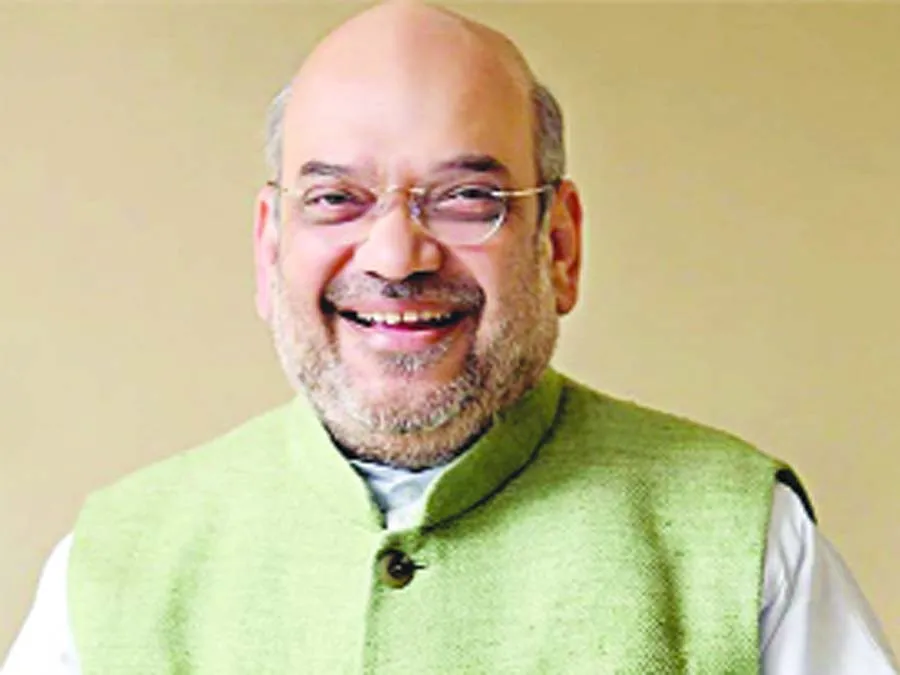
New Delhi, May 25. The Union Home Minister Amit Shah urged members of the tribal community not to fear the Uniform Civil Code (UCC), stating that it would cause them no harm.
Addressing a tribal cultural gathering titled “You and I are of one blood, forest dweller-villager-city dweller, we are all Indians” at the historic Ramlila Maidan here, Shah said, “This gathering will be known as the ‘Mahakumbh’ of tribes for years to come.”
“You have come from remote areas of the country, in traditional attire, with your musical instruments, singing songs of your culture. I can say with full certainty that I have never seen Lord Birsa Munda in my life, but today Lord Birsa Munda has appeared before me in person. I bow to you all.”
He said, “Our constitution makers gave every individual the right to live with self-respect in their original religion. People will not be forced to convert by temptation.”
“Now we must take a pledge from this land of Delhi to protect our religion, and this will keep us connected to our culture and our country.”
The Union Home Minister said, “I wholeheartedly welcome all my brothers and sisters from Madhya Pradesh and Gujarat, the Bhil and Munda communities from Madhya Pradesh and Gujarat, the Gond and Kolam communities from Chhattisgarh, the Santhal and Oraon communities from Jharkhand and Odisha, the Bodo, Karbi, Dimasa, Khasi, Garo and Chakma communities from the Northeast, and the Chenchu communities from Andhra Pradesh.”
“I want to express deep gratitude to both organizations for giving me this opportunity to witness this wonderful event in my lifetime.”
He said that this year marks the 150th birth anniversary of Lord Birsa Munda. “This water, this forest, and these mountains are the source of livelihood for our tribal brothers and are an impregnable fort that protects their identity and culture.”
“Today, if there is any model in the world that is the most sustainable, it is the model created by our tribal communities, and we have come forward to protect it. All tribes have worked to realize the mantra of ‘unity in diversity’ and ‘diversity in unity’ without any written rules.”
Shah said, “Thousands of years ago, in the Treta Yuga, Lord Ram ate the half-eaten berries of Shabari and made it very clear that we are all one. Those who want to divide us do not know that when Nishad Raj extended a helping hand, Lord Shri Ram honored the forest dwellers by making him his closest friend.”
“Today’s conference and the lakhs of tribal people present here are a big message for those who are working to create divisions.”
He said, “A conspiracy has started regarding the Uniform Civil Code (UCC) that it will deprive tribal people of their culture, traditions, customs, and their right to live.”
“Today, as the Home Minister of the Narendra Modi government, I want to make it clear from this platform that no restriction of the UCC will be imposed on the tribal community or tribal individuals.”
“The UCC will not violate any tribal rights. We have implemented the UCC in two states where the Bharatiya Janata Party is in power, especially Gujarat and Uttarakhand. By making special provisions, the Narendra Modi government has kept all tribal communities out of the UCC.”
“With this message, go to your villages, mountains, and forests and make all tribal communities aware that there is no need to fear the UCC.” The organizers presented this event as a cultural expression of tribal identity and ‘national unity’, with the slogan ‘You and I are of one blood, forest dweller-villager-city dweller, we are all Indians.’ Participants are expected to come from various parts of the country in traditional attire, while volunteers in Delhi have arranged accommodation, food, transport, and medical facilities through 20 different committees.
At this event organized on the 150th birth anniversary of Lord Birsa Munda, people from tribal societies from across the country arrived in the national capital in traditional attire and took out a procession with folk culture.
This gathering was organized by the ‘<div class="my-4