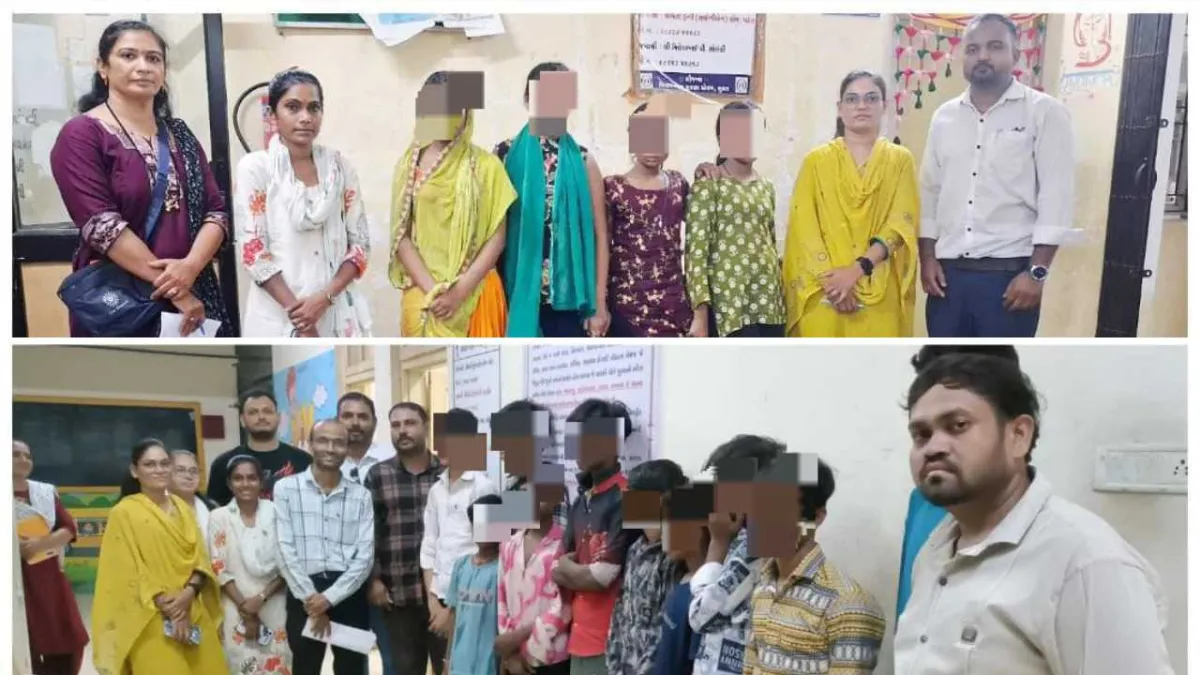
Surat. Under the child labor eradication campaign, the Surat District Task Force conducted a special inspection drive in Muktidham Society in the Varachha area and freed 14 children from child labor. All children have been taken into safe custody, and further legal proceedings have been initiated.
In this special drive held on May 30, officials from the Labor Department, Surat Municipal Corporation, Factory Inspection Department, District Child Protection Unit, 1098 Child Helpline, AHTU, She-Team, and other related departments jointly carried out the operation.
During the inspection, various units and houses involved in hot fixing work were searched. A total of 14 children were found working, including 6 adolescent boys, 4 child laborers, and 4 adolescent girls. All children are reported to be residents of Rajasthan and Bihar.
Preliminary investigation revealed that the children’s ages ranged from about 10 to 17 years, and the adolescent girls were between 14 and 18 years old. They had been working for the past one to two months, from 8 a.m. to 7 p.m. daily, with a one-hour break at noon. The children were being paid a monthly salary of between 5,000 and 10,000 rupees.
No age-related documents were found with any of the children during the inspection. Consequently, all children were immediately freed from child labor and presented before the Child Welfare Committee (CWC).
The rescued boys have been placed in V.R. Popawala Children’s Home, Katargam, and the girls in Children’s Home for Girls, Rander, for safe custody.
Officials from the District Child Protection Department stated that after verification of the children’s age-related documents and other evidence, strict legal action will be taken against the concerned owners and responsible persons under the Child Labour (Prohibition and Regulation) Act and other applicable laws.
Surat
Surat is a major port city in the Indian state of Gujarat, historically renowned as a thriving center for trade and textile manufacturing during the Mughal era. It was a key hub for the diamond and silk industries, famously known as the “Gate to Mecca” for pilgrims departing from its port. Today, Surat remains a global leader in diamond cutting and polishing, blending its rich mercantile history with modern industrial growth.
Varachha
Varachha is a suburban area in Surat, Gujarat, India, known for its strong connection to the Jain community and its role as a hub for the diamond polishing and trading industry. Historically, it developed rapidly in the late 20th century as many Jain families migrated from Saurashtra, bringing with them expertise in diamond craftsmanship. Today, Varachha is famous for its bustling diamond markets and the annual Jain festival of Paryushan, which draws large crowds to its temples.
Muktidham Society
Muktidham Society is a residential locality in the city of Vadodara, Gujarat, India, known for its planned layout and community-focused environment. The area is named after the nearby Muktidham Temple, a prominent Hindu temple complex built in the 1970s that features intricate marble carvings and replicas of major pilgrimage sites. Over the years, the society has developed into a peaceful suburban neighborhood, reflecting the cultural and religious heritage of the region.
Rajasthan
Rajasthan, located in northwestern India, is a state renowned for its vibrant culture, majestic forts, and vast Thar Desert. Its history is deeply rooted in the era of Rajput kingdoms, which flourished between the 6th and 20th centuries, leaving behind a legacy of heroic tales and architectural marvels like the Amer Fort and City Palace in Jaipur. Today, Rajasthan is a major tourist destination, celebrated for its colorful festivals, traditional arts, and desert landscapes.
Bihar
Bihar, located in eastern India, is one of the country’s oldest inhabited regions with a rich history dating back to ancient kingdoms like Magadha. It was a major center of learning and culture, home to the ancient university of Nalanda, and played a pivotal role in the rise of Buddhism and Jainism. Today, Bihar is known for its historical sites, vibrant festivals, and as the birthplace of several important Indian leaders and scholars.
V.R. Popawala Children’s Home, Katargam
The V.R. Popawala Children’s Home in Katargam, Surat, is a charitable institution dedicated to the care and shelter of orphaned and underprivileged children. Established through philanthropic efforts, it provides education, healthcare, and a nurturing environment for children in need. The home serves as a vital community resource, reflecting the region’s commitment to child welfare.
Children’s Home for Girls, Rander
The Children’s Home for Girls in Rander, located in Surat, India, is a residential care facility established to provide shelter, education, and support to vulnerable and orphaned girls. Its history is rooted in social welfare efforts, likely tied to local charitable or missionary initiatives aimed at protecting and empowering young girls in need. The home continues to serve as a safe haven, focusing on the holistic development of its residents.
Child Welfare Committee (CWC)
The Child Welfare Committee (CWC) is a statutory body established under India’s Juvenile Justice (Care and Protection of Children) Act, 2015, to address the needs of children in need of care and protection. Each district has a CWC, which functions as a quasi-judicial authority responsible for ensuring the safety, rehabilitation, and social reintegration of vulnerable children, including those who are orphaned, abandoned, or trafficked. The committee plays a critical role in upholding children’s rights and making decisions regarding their placement in foster care, adoption, or institutional care.