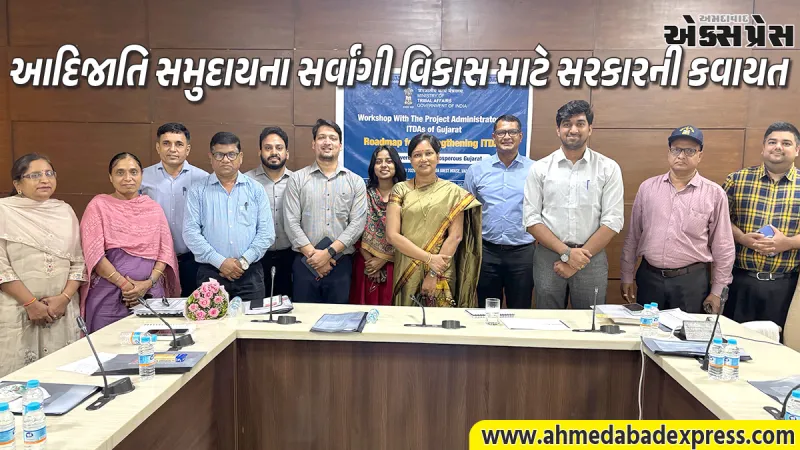
State-level workshop held in Vadodara on new roadmap for tribal development through ITDA/ITDP.
A state-level workshop was held in Vadodara under the chairmanship of Dr. Vernali Deka, Director of the Central Tribal Ministry, to develop a roadmap for ITDA/ITDP. Officials from 14 tribal districts of the state engaged in extensive discussions on the robust implementation of developmental schemes and addressing administrative shortcomings.
The Ministry of Tribal Affairs, Government of India, organized a state-level workshop in Vadodara on capacity building and the future roadmap for ITDA/ITDP (Integrated Tribal Development Agency/Project). Chaired by Dr. Vernali Deka, Director of the Central Tribal Ministry, the workshop saw officials from 14 tribal districts of the state brainstorm on the robust implementation of developmental schemes and ‘gap analysis.’
On this occasion, Dr. Vernali Deka stated that the team from the Tribal Ministry is conducting direct visits to 17 states with tribal populations across the country. The purpose of these visits is to understand the administrative or geographical shortcomings in schemes aimed at the comprehensive development of the tribal community. Additionally, the team is collecting a ‘status report’ on the ITDA/ITDP roadmap from each state, which will prove very important for future policy-making.
During the workshop, Director of the Tribal Development Office, Mr. Ashishkumar, joined online and outlined the excellent work being done under ITDA/ITDP in the state. Based on the ‘gap analysis,’ he provided necessary guidance on making the administrative process more transparent and people-centric in the coming times.
At the workshop, Executive Director of the Tribal Research Institute Gujarat, Dr. C. C. Chaudhary, gave a formal welcome and outlined the entire program.
On this occasion, Joint Commissioner of the Tribal Development Department, Mr. C. G. Rabadiya, presented a detailed presentation on the various tribes residing in Gujarat, their geographical area, population analysis, the administrative structure of the department’s various offices, and the role of officials.
The main objective of this workshop was to conduct extensive discussions on the shortcomings in the planning, implementation, monitoring, and evaluation of various tribal development schemes implemented by ITDA/ITDP, and to gather important suggestions for their improvement.
More than 40 senior officials attended the workshop, including Executive Director of Gujarat Tribal Development Corporation, Mr. C. B. Balat; Joint Commissioner of Gujarat Landless and Halpati Housing Board, Gandhinagar; Assistant Commissioner of Gujarat State Tribal Education Society; Project Officers from various districts; Assistant Commissioners; TDOs; ATDOs; and staff from TRI.
Vadodara
Vadodara, also known as Baroda, is a city in the western Indian state of Gujarat, historically ruled by the Gaekwad dynasty of the Maratha Empire. It is renowned for its rich cultural heritage, including the magnificent Laxmi Vilas Palace, which is four times the size of Buckingham Palace, as well as its vibrant arts scene and educational institutions like the Maharaja Sayajirao University. The city’s history is deeply tied to its progressive rulers, who modernized infrastructure and promoted art, making it a key cultural and industrial hub in the region.
Central Tribal Ministry
The Central Tribal Ministry, officially known as the Ministry of Tribal Affairs, is a government body in India responsible for the socio-economic development and welfare of the country’s Scheduled Tribes. Established in 1999 after being carved out from the Ministry of Social Justice and Empowerment, it formulates policies and implements programs related to tribal education, health, and livelihood. The ministry plays a crucial role in preserving tribal cultural heritage while promoting integration and empowerment.
Gujarat Tribal Development Corporation
The Gujarat Tribal Development Corporation (GTDC) is a government agency established to promote the socio-economic development and welfare of tribal communities in the Indian state of Gujarat. It focuses on implementing various programs related to education, health, livelihood, and infrastructure, while also working to preserve and market the unique tribal arts, crafts, and cultural heritage of the region. Through these efforts, the GTDC aims to empower tribal populations and integrate them more fully into the state’s mainstream development.
Gujarat Landless and Halpati Housing Board, Gandhinagar
The Gujarat Landless and Halpati Housing Board, located in Gandhinagar, is a government agency established to address housing needs for landless laborers and the Halpati community, a historically marginalized tribal group in Gujarat. It was formed under state housing initiatives to provide affordable housing and improve living conditions for these communities. The board plays a key role in implementing social welfare schemes aimed at reducing homelessness and poverty in rural and urban areas of Gujarat.
Gujarat State Tribal Education Society
The Gujarat State Tribal Education Society (GSTES) is a government body established in 1996 to promote education and socio-economic development among tribal communities in Gujarat, India. It manages residential schools, hostels, and skill-training programs to improve literacy and livelihood opportunities for tribal students. The society plays a key role in preserving tribal culture while integrating modern education.
Tribal Research Institute Gujarat
The Tribal Research Institute in Gujarat, India, is a key institution dedicated to the study, documentation, and preservation of the state’s diverse tribal cultures and heritage. Established to conduct ethnographic research and support the socio-economic development of tribal communities, it houses a museum showcasing artifacts, traditional tools, and cultural exhibits. The institute plays a vital role in promoting awareness and understanding of Gujarat’s indigenous groups, such as the Bhils and Dangs.