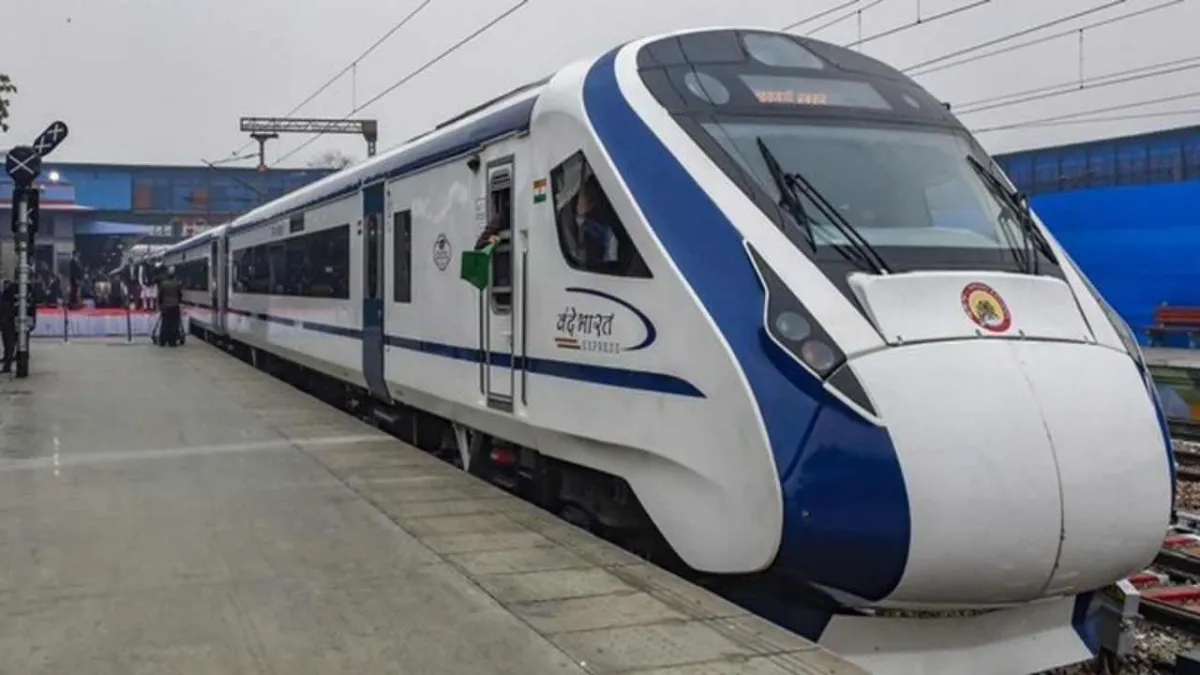
A significant announcement has been made regarding Indian Railways’ most ambitious ‘Vande Bharat Sleeper Train’ project.
It has been clarified that the first prototype of the state-of-the-art sleeper train will be ready for testing within the next year.
Under this project, a total of 120 trains are to be manufactured, which will make long-distance travel accessible with semi-high-speed and better facilities. According to the Railway Board, this project will prove to be a milestone in modernizing the country’s rail infrastructure.
Although construction work is progressing at a fast pace, there are different speculations regarding its definite launch date. Indications have been given that it could be ready by June 2026, while some technical experts believe that final testing might take a little longer due to the complex design and stringent safety standards.
It is notable that the country’s first Vande Bharat Sleeper Train was launched this year on January 17 between Kamakhya and Howrah.
The railway’s entire focus is now on getting the prototypes of the remaining trains on track as soon as possible.
These new sleeper trains are being designed specifically with the convenience of overnight and long-distance passengers in mind. They will feature improved ergonomics, modern interiors, and advanced safety features, providing an experience superior even to current trains like the Rajdhani Express.
For now, no official announcement has been made regarding future routes, but there is discussion that these trains will be prioritized on busy routes connecting major metro cities.
This project will not only reduce travel time but also provide passengers with world-class facilities.
Indian Railways
Indian Railways is a state-owned national railway system, founded in 1853 during British colonial rule with the first passenger train running between Bombay (Mumbai) and Thane. It has since grown into one of the world’s largest rail networks, spanning over 67,000 km and serving as a vital economic and social artery for modern India, connecting millions of people daily across diverse regions.
Vande Bharat Sleeper Train
The Vande Bharat Sleeper Train is an upcoming, upgraded variant of India’s existing Vande Bharat Express trains, designed for overnight long-distance travel. While the original Vande Bharat trains (introduced in 2019) are high-speed chair-car day trains, the sleeper version is being developed to combine similar modern amenities and energy efficiency with berth compartments. This new iteration aims to expand the reach of India’s flagship indigenous train series, offering faster and more comfortable overnight journeys across the country.
Railway Board
The Railway Board is the apex administrative body for Indian Railways, established in 1905 during British rule. It functions under the Ministry of Railways, formulating policies and overseeing the vast network’s operations, infrastructure, and safety. Its creation centralized the management of India’s railway system, which remains one of the world’s largest.
Kamakhya
The Kamakhya Temple is a revered Hindu shrine located atop the Nilachal Hill in Guwahati, Assam, dedicated to the mother goddess Kamakhya. It is one of the oldest and most important centers of Shakti worship and Tantric traditions, with its current structure dating back to the 16th century, rebuilt by the Koch dynasty after earlier destruction. The temple is particularly famous for its annual Ambubachi Mela, which celebrates the goddess’s annual menstrual cycle, a unique aspect of its mythology.
Howrah
Howrah is a major city in West Bengal, India, located on the western bank of the Hooghly River opposite Kolkata. It is historically and culturally significant as a vital transportation hub, most famously for the iconic Howrah Bridge (completed 1943), a cantilever bridge that is one of the world’s busiest. The city’s history is deeply intertwined with the colonial-era growth of Kolkata as a port and commercial capital.
Rajdhani Express
The Rajdhani Express is not a specific place or cultural site, but a prestigious network of high-speed, fully air-conditioned passenger trains in India operated by Indian Railways. Introduced in 1969 between New Delhi and Howrah, it was the country’s first superfast train, designed to connect the national capital, New Delhi (“Rajdhani”), with major state capitals and important cities. Its history reflects India’s post-independence modernization of rail travel, offering faster journeys with included meals, and it remains a symbol of efficient long-distance connectivity.