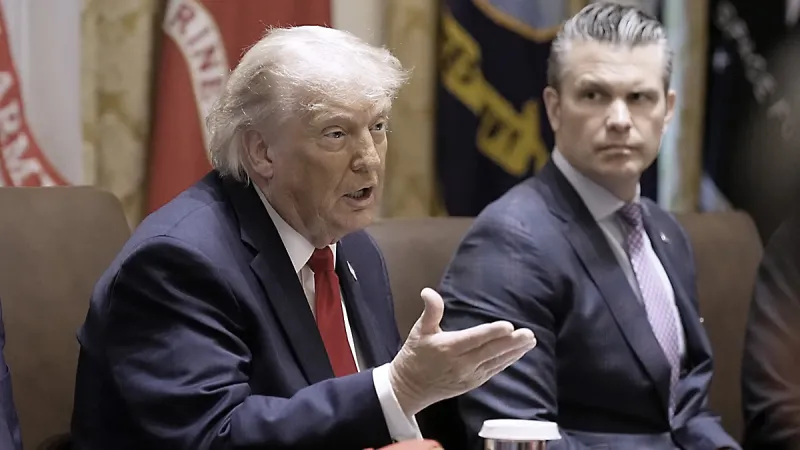
Donald Trump made a major claim about the America-Iran peace agreement.
Donald Trump stated that a historic peace agreement between the United States and Iran could be reached over the weekend. Both countries are very close to a deal. Click for more details.
Donald Trump made a major claim about the US-Iran peace agreement
Donald Trump has made a highly surprising claim regarding the ongoing peace talks between the United States and Iran. He told reporters at the White House that both countries are going to sign a historic agreement very soon. According to government sources, an official agreement between the two countries could be reached by this weekend.
America’s special efforts for the Strait of Hormuz and a solution to the Lebanon violence
According to US President Donald Trump, talks between the two countries are currently taking place in a very positive atmosphere. According to a representative’s report, the United States is working to reopen the Strait of Hormuz route for the safety of commercial ships.
His administration is seriously working to resolve the Lebanon violence and maritime route disputes at different levels. According to sources, Trump has taken a tough stance on Iran’s enriched uranium program. The United States wants Iran to completely halt its nuclear ambitions in the near future. If this Memorandum of Understanding (MoU) is finalized, the entire agreement will be implemented in four phases.
This development comes at a time when tensions in West Asia have reached their peak. The first phase of peace talks held in Islamabad failed because Iran flatly refused to discuss nuclear issues. The Strait of Hormuz is considered the most important waterway for global oil trade.
Iran’s official stance on the Lebanon issue and the US draft
Additionally, reports from Iran’s news agency ‘Fars’ are presenting a contrasting picture. According to a correspondent, Iran’s negotiating team has not yet sent any official response to Washington’s latest proposal.
Their foreign minister told the news channel ‘Al Mayadeen’ that diplomatic contact with the United States is certainly ongoing. However, no major or concrete progress has been seen in the talks yet. Iran has made it clear that it will never accept any unilateral agreement made by ignoring Lebanon. Despite Trump’s optimistic claims, a major deadlock over the issue of nuclear enrichment remains between the two countries.
Future impacts on the global market and Middle East peace
Specifically, if an agreement is reached between the US and Iran this weekend, crude oil prices could drop rapidly in the global market. According to reports, international diplomats may hold a secret meeting in New York in the next few hours to finalize these documents.
After this major claim made by Donald Trump, will Iran actually bend and be ready to sign this peace agreement? How successful this American diplomatic move will be in bringing stability to the Middle East will become clear in the next two days.
Strait of Hormuz
The Strait of Hormuz is a narrow, strategically vital waterway connecting the Persian Gulf to the Gulf of Oman and the Arabian Sea. Historically, it has been a crucial trade route for centuries, controlling the flow of goods like spices and textiles, but today it is most famous as the passage for about 20% of the world’s oil. Its geopolitical importance has made it a frequent site of international tensions, particularly between Iran and other global powers.
Lebanon
Lebanon is a country in the Middle East with a rich history dating back thousands of years, once home to the ancient Phoenician civilization. It has been influenced by various empires, including the Romans, Ottomans, and French, which shaped its diverse cultural heritage. Today, Lebanon is known for its vibrant cities like Beirut, historic sites such as Baalbek, and a unique blend of traditions from its many religious communities.
West Asia
West Asia, often referred to as the Middle East, is a region rich in history as the cradle of ancient civilizations, including Mesopotamia, the Persian Empire, and the birthplace of major religions like Judaism, Christianity, and Islam. Its cultural sites, such as the ruins of Persepolis in Iran and the ancient city of Petra in Jordan, reflect millennia of trade, conquest, and cultural exchange. Today, the region remains a diverse and historically significant crossroads between Asia, Africa, and Europe.
Islamabad
Islamabad is the capital city of Pakistan, established in the 1960s to replace Karachi as the national capital. Designed by Greek architect Constantinos Apostolou Doxiadis, it is known for its modern, planned layout and lush greenery. The city is home to key landmarks such as the Faisal Mosque, one of the largest mosques in the world, and serves as the political and administrative hub of the country.
White House
The White House is the official residence and workplace of the President of the United States, located in Washington, D.C. Construction began in 1792 under the direction of George Washington, and it was first occupied by President John Adams in 1800. The building was set on fire by British troops during the War of 1812 and has since undergone numerous renovations and expansions, becoming a globally recognized symbol of the U.S. presidency.
New York
New York City, originally settled by the Dutch as New Amsterdam in 1624, became a major hub for immigration and commerce after being taken over by the English in 1664. It served as the first capital of the United States under the Constitution and grew into a global center for finance, culture, and innovation by the 20th century. Today, it remains iconic for landmarks like the Statue of Liberty, Times Square, and Central Park, reflecting its rich and diverse history.
Middle East
The Middle East is a historically and culturally rich region spanning Western Asia and parts of North Africa, often considered the cradle of civilization. It was home to ancient Mesopotamia, the birthplace of writing and law, and later became the heartland of the Islamic Golden Age, fostering advancements in science, mathematics, and philosophy. Today, the area remains a crossroads of diverse cultures, religions (including Islam, Christianity, and Judaism), and political significance.
United States
The United States of America is a vast and diverse country in North America, founded in 1776 after declaring independence from Great Britain. Its history includes rapid westward expansion, the Civil War over slavery and states’ rights, and its rise as a global superpower in the 20th century. Today, it is known for its cultural influence, economic power, and landmarks like the Statue of Liberty and the Grand Canyon.