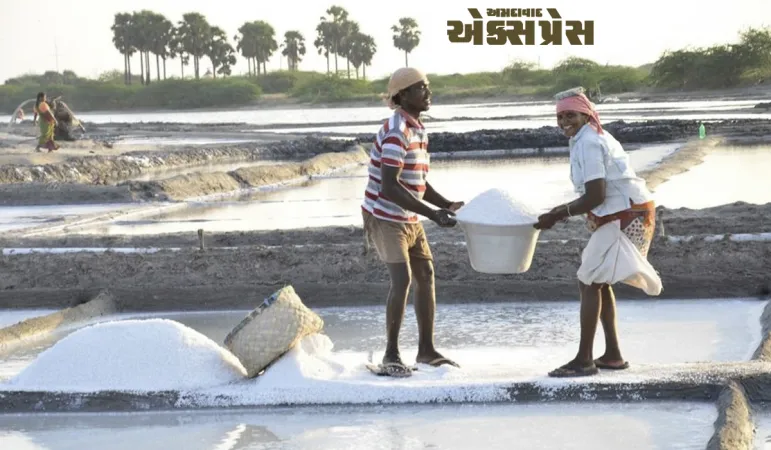
Diesel shortage sparks fear in the small Rann’s Agaria community, with potential losses of ₹250 crore.
Due to a diesel shortage, the Agariya community of the Little Rann is facing a severe situation. Congress has claimed that the salt industry could suffer losses exceeding ₹250 crore.
Diesel Shortage Causes Fear in the Little Rann Agariya Community, Estimated Loss of ₹250 Crore
The situation in the Little Rann is rapidly becoming serious.
The diesel shortage has now directly impacted the livelihoods of the Agariyas.
Ready salt harvests in the salt pans are stuck.
If a solution is not found within a few days, heavy losses could occur.
This issue was raised during a press conference held in Gandhinagar. According to him, the diesel shortage is severely affecting both salt production and transportation.
Direct Impact on the Salt Industry from Diesel Shortage
A spokesperson stated that approximately 70 percent of India’s total salt production comes from Gujarat.
Thousands of salt pans are operational in the areas around the Little Rann, including Santalpur, Maliya, Kharaghoda, Adesar, Dhrangadhra, Halvad, and Radhanpur.
According to officials, over 50,000 people are directly connected to the salt pan industry.
Additionally, more than one lakh people indirectly find employment.
However, due to the current diesel shortage, transporting salt from the pans to warehouses has become difficult.
Many transporters have stopped their runs.
Some transporters are imposing conditions on the Agariyas to bring their own diesel.
This is having the greatest impact on small traders.
Growing Concern in the Little Rann Agariya Community
The coming days are considered crucial for the Agariyas working in the Little Rann of Kutch.
According to reports, small Agariyas are currently being given only 20 liters of diesel.
While their daily requirement exceeds 500 liters.
This disparity has slowed down the pace of salt production.
On the other hand, the monsoon season is approaching.
If the rains start, millions of tons of ready salt could be washed away in the water.
This has raised fears of losses exceeding ₹250 crore.
The diesel shortage is no longer just a supply issue.
It has become a question connected to the future of thousands of families.
What Could Happen Next?
The Gujarat Congress has demanded immediate intervention from the state government.
An appeal has been made to make special arrangements to provide sufficient diesel to the Agariyas.
According to sources, a review of the supply from the government side may take place in the coming days.
If a decision is not made quickly, the salt industry could face long-term impacts.
Uncertainty is currently being seen in the areas connected to salt production.
The Agariya community is now watching the government’s next steps.
If a solution to the diesel shortage does not come soon, the Little Rann’s salt industry could fall into a major economic crisis.
Related News
Little Rann
Little Rann of Kutch is a vast salt marsh located in the Gujarat state of India, known for its stark, arid landscape and unique biodiversity. Historically, it was part of the ancient sea bed and later served as a crucial route for trade caravans, while today it is famous as the last refuge of the endangered Indian wild ass. The area also hosts seasonal salt farming and is a key site for birdwatching, especially during the winter migration.
Little Rann of Kutch
The Little Rann of Kutch is a vast salt marsh located in the Gujarat state of India, covering approximately 5,000 square kilometers. Historically part of the Arabian Sea, it was cut off by geological changes and is now a seasonal desert that floods during monsoons, leaving a salt-encrusted landscape. It is also renowned as the last refuge of the endangered Indian wild ass, protected within the Indian Wild Ass Sanctuary.
Gandhinagar
Gandhinagar is the capital city of the Indian state of Gujarat, named after Mahatma Gandhi. It was built in the 1960s to replace Ahmedabad as the state capital, designed as a well-planned, green city with a unique sector-based layout. The city is also home to the Akshardham Temple, a major cultural and spiritual landmark.
Santalpur
Santalpur is a town located in the Banaskantha district of Gujarat, India, known for its proximity to the Thar Desert and its role as a key trading and transit hub near the Rajasthan border. Historically, it has been part of the broader region influenced by the Solanki dynasty and later the Mughal Empire, contributing to its cultural and architectural heritage. Today, Santalpur is recognized for its vibrant local markets and as a gateway to the nearby Rann of Kutch, attracting visitors interested in desert landscapes and traditional crafts.
Maliya
Maliya is a historic town in Crete, Greece, best known for the Minoan palace of Malia, which was a major center of the Minoan civilization during the Bronze Age (c. 1900–1450 BCE). The palace complex, featuring storerooms, workshops, and a central court, was destroyed and rebuilt several times before its final abandonment. Today, the archaeological site offers insight into Minoan culture, while the modern town nearby is a popular tourist destination with beaches and tavernas.
Kharaghoda
Kharaghoda is a historic salt-producing town located in the Little Rann of Kutch, Gujarat, India. It was once a major center for salt extraction and trade during the British colonial period, connected by a narrow-gauge railway that transported salt to the rest of the country. Today, it remains known for its salt pans and nearby archaeological sites, such as the ancient Indus Valley settlement at Dholavira.
Adesar
Adesar is a village in the Kutch district of Gujarat, India, known for its ancient Sun Temple, which dates back to the 9th-10th centuries CE. The temple, built in the Solanki architectural style, features intricate carvings and a stepped tank, reflecting the region’s rich cultural heritage. Historically, it served as a significant center for solar worship, though it now stands partially ruined and is maintained as a protected archaeological site.
Dhrangadhra
Dhrangadhra is a historic town in the Surendranagar district of Gujarat, India, known for its rich cultural heritage and the former princely state of Dhrangadhra-Halvad. The town was the capital of the Jhala Rajput dynasty, which ruled the region for centuries, and features landmarks such as the Dhrangadhra Palace and ancient stepwells. Its history is marked by a blend of Rajput and Islamic architectural influences, as well as its role in salt production and the Indian independence movement.