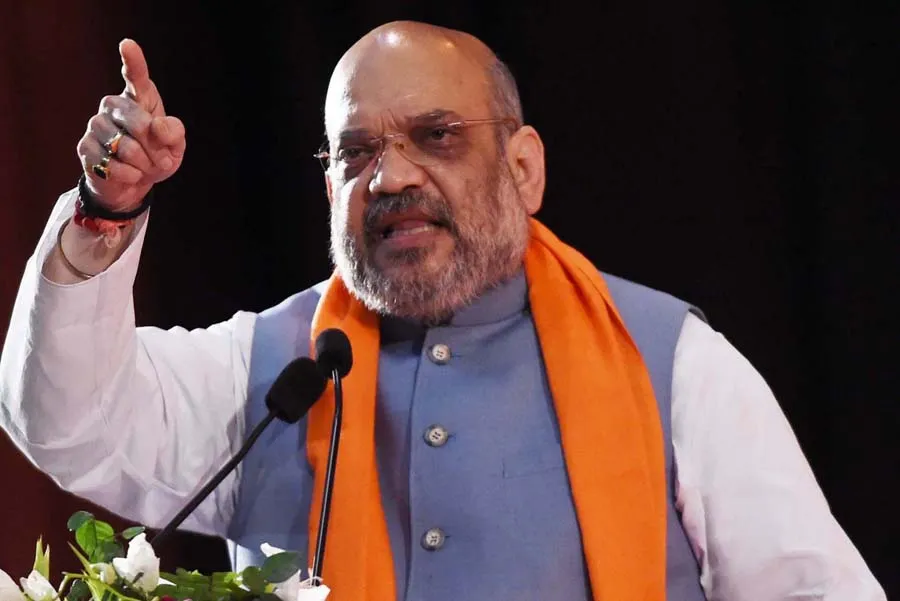
Central Home Minister Amit Shah said on Tuesday that if the Bharatiya Janata Party (BJP) comes to power in West Bengal after the two-phase assembly elections scheduled for the end of this month, it will end the practices of ‘Love Jihad’ and ‘polygamy’ prevalent in the state by implementing a Uniform Civil Code (UCC).
Addressing an election rally in Manikchak, Malda district, he said that some people have the freedom to have four marriages at once, but do not worry.
The UCC will be implemented next month after the government is formed in Bengal. The practice of having four marriages at a time will end. There will be no ‘Love Jihad’ or ‘Land Jihad’ in the state anymore.
Speaking on the occasion, the central minister issued a stern warning to those involved in various corruption cases in the state during the Trinamool Congress government’s 15-year tenure.
The Union Home Minister said that if they think they will escape, they are mistaken. Let the results be declared and let the new government be formed. Every person involved in corruption will be behind bars.
He also said that if anti-social elements of the Trinamool Congress try to disrupt the voting process on April 23 and 29, they will be dealt with strictly.
The central minister said that is why he is warning them to stay in their homes on the voting days. Otherwise, they will have to face serious consequences.
At the same time, the Union Home Minister also said that former Trinamool Congress legislator Humayun Kabir’s dream of building a Babri Masjid in West Bengal will never be fulfilled.
He further said that Babar had demolished the Ram Temple. Our Prime Minister Narendra Modi got the Ram Temple rebuilt. Therefore, Humayun Kabir should listen carefully that no one will be able to build a Babri Masjid anywhere in India. The dream of building a Babri Masjid will never be fulfilled.
He also said that just as the BJP has eliminated terrorism and left-wing extremism in West Bengal, it will also stop illegal infiltration in the country, including West Bengal.