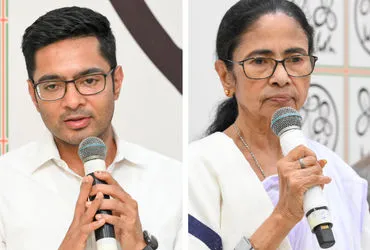
To quell the unprecedented internal strife and rebellion within the TMC, party supremo Mamata Banerjee has finally attempted to establish discipline by making large-scale organizational changes. According to information received, these changes aim to address the ongoing discontent within the party.
Mamata Banerjee’s nephew and the party’s national general secretary, Abhishek Banerjee, who was until now considered the party’s de facto boss, has had his power significantly reduced. Known as ‘Bhaipo’ (nephew), Abhishek Banerjee’s dominance in the party was a major cause of deep dissatisfaction among ordinary workers and leaders. He will no longer be able to make decisions alone in the party.
Mamata Banerjee has appointed two more national joint secretaries alongside him. From now on, MPs Derek O’Brien and Dola Sen will ‘assist’ Abhishek Banerjee in party work going forward. With this decision, the high command has sent a clear message that Abhishek Banerjee’s stature has been reduced and power has been decentralized.
The current unrest within the Trinamool Congress is seen more as a revolt against Abhishek Banerjee’s working style than against Mamata Banerjee. In a meeting held after the party’s defeat in the West Bengal assembly election, Mamata Banerjee reportedly asked leaders to praise her nephew’s role in the election. According to sources, this angered many party leaders, as they believed Abhishek Banerjee’s working style itself was the main reason for the party’s unpopularity and defeat.
Following this incident, cracks began to appear in the Trinamool Congress legislative party. Then, at another meeting held on May 19 at Kalighat, ‘rebel’ leaders Ritabrata Banerjee and Sandipan Saha openly expressed their opposition for the first time. As this opposition turned into a full-blown rebellion, Mamata Banerjee decided to correct the mistake through these organizational changes.
These major party
Trinamool Congress
West Bengal
Kalighat
Kalighat Kali Temple
West Bengal
Kolkata
Related news
Natural gas reservoir found in Andaman, major success for Ocean Exploration Mission.

Motor India shareholders approve appointment of Tarun Garg as Managing Director and CEO.

Petrol and diesel prices drop in several cities, increase in some places.
Final warning to Gopal Rai’s government: “Resolve the paper leak issue, or the youth will take to the streets.”