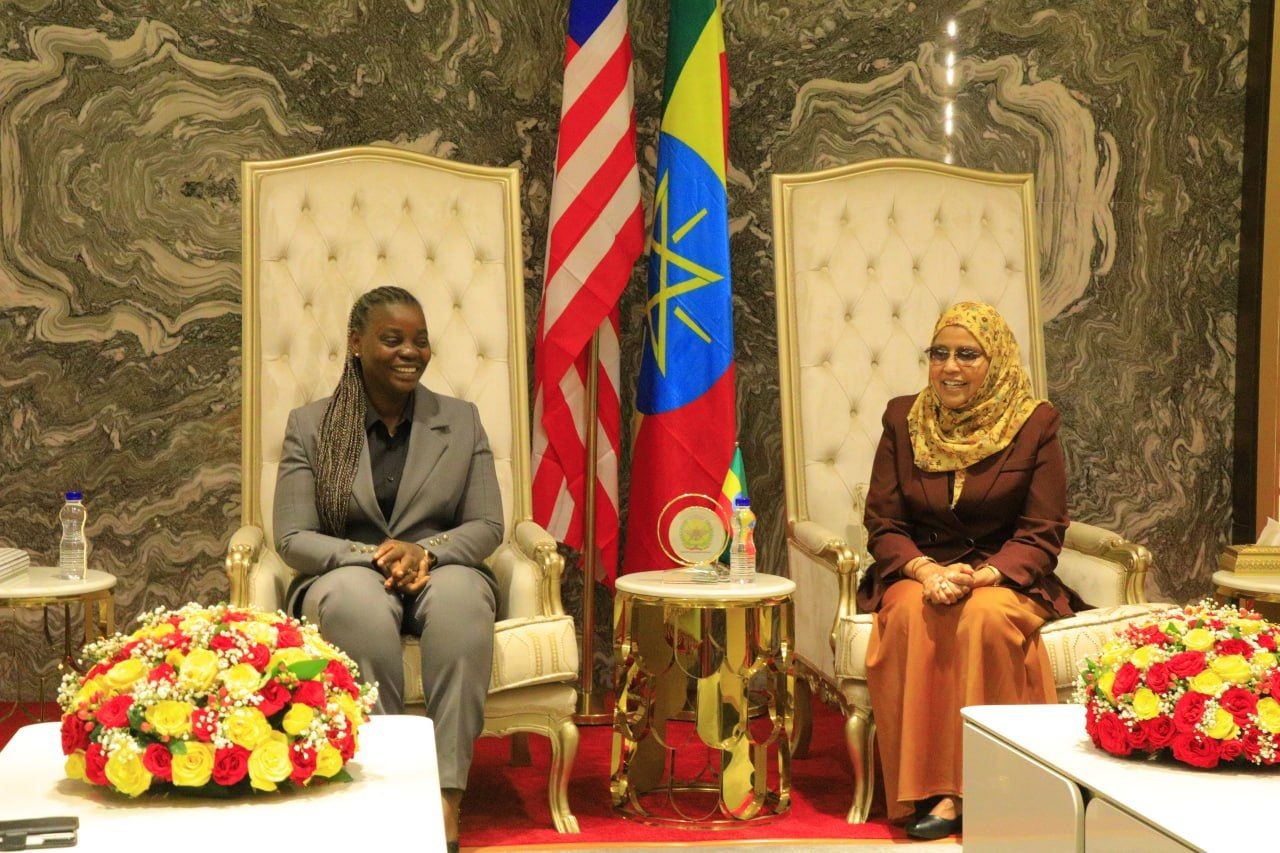
The Ethiopian Defense Minister emphasized the importance of leveraging shared African expertise to enhance collective defense capabilities.
It was noted that the two countries share a historical legacy as symbols of African independence, a foundation that continues to shape their modern partnership.
Meanwhile, the Liberian Defense Minister praised Ethiopia’s experience in peacekeeping and military science, highlighting its critical importance for building Liberia’s capacities.
It was affirmed that Ethiopia’s contribution to peacekeeping efforts during the Liberian civil war remains a cornerstone of their bilateral relations.
Building on this foundation, the two countries agreed to enhance cooperation in military industries and technology, marking a key achievement of the official visit by President Boakai.
During the visit, the Liberian delegation inspected key facilities within the Information Technology complex, including a data center supporting cloud services and digital infrastructure, as well as a business process outsourcing center focused on software development, international cooperation, and creating job opportunities for Ethiopian IT specialists.
It was reaffirmed that Ethiopia holds a leading position as a major hub for innovation in Africa, underscoring the importance of these initiatives for developing digital technology across the continent.
Ethiopia
Ethiopia is a historically rich nation in the Horn of Africa, widely recognized as one of the world’s oldest countries and the only African nation to never be fully colonized. It is home to ancient sites like the rock-hewn churches of Lalibela and the ruins of Aksum, which was a major empire and an early adopter of Christianity. Its diverse cultural heritage encompasses numerous ethnic groups, unique traditions like the Ethiopian Orthodox Church, and a distinct calendar and alphabet.
Liberia
Liberia is a country on the West African coast, founded in 1847 by freed and free-born African Americans and freed slaves from the Caribbean, with support from the American Colonization Society. Its capital, Monrovia, is named after U.S. President James Monroe, and the nation’s history is marked by its unique origins as a republic modeled on American governance, followed by periods of political instability and civil war in the late 20th century.
African independence
“African independence” broadly refers to the mid-20th century wave of decolonization, where nations across the continent achieved sovereignty from European colonial powers. This historic period, often called the “African Spring,” was driven by nationalist movements, pan-Africanism, and changing global politics after World War II. It fundamentally reshaped the continent’s political map, beginning with Libya in 1951 and Ghana in 1957, with most nations gaining freedom by the mid-1960s.
Liberian civil war
The Liberian Civil War was a devastating conflict that lasted from 1989 to 2003, primarily sparked by the overthrow of the Americo-Liberian elite’s long-standing political dominance. It was characterized by extreme violence, the use of child soldiers, and factional fighting, leading to the deaths of an estimated 250,000 people and the displacement of many more. The war finally ended with a peace agreement and the exile of President Charles Taylor, paving the way for a fragile recovery and democratic elections.
Information Technology complex
The Information Technology complex is a modern facility designed to house tech companies, research centers, and startups, often serving as a hub for innovation and digital development. While it lacks a long historical legacy, such complexes typically emerge in the late 20th and 21st centuries, frequently located in planned business parks or “tech cities” to foster collaboration and economic growth in the digital sector.
data center
A data center is a specialized facility that houses computer systems and networking equipment to store, process, and distribute digital information. While the concept evolved with mainframe computers in the mid-20th century, the modern internet-driven data center emerged in the 1990s to support the explosive growth of online services. Today, these highly secure and energy-intensive facilities form the critical physical infrastructure of the global internet, cloud computing, and digital economy.
business process outsourcing center
A business process outsourcing (BPO) center is a modern commercial facility where a company contracts specific business operations, like customer service or data entry, to a third-party provider. This model grew rapidly with late 20th-century globalization and telecommunications advances, with countries like India and the Philippines becoming major hubs due to skilled, cost-effective labor. While not a historical site, these centers represent a significant shift in global business practices and economic development for many regions.
Africa
Africa is a vast continent, not a single place or site, with a history beginning with the emergence of the earliest humans. It is the cradle of ancient civilizations like Egypt and Aksum, and later saw the rise of powerful kingdoms and empires, followed by periods of colonization and the struggle for independence. Today, it is a continent of immense cultural, linguistic, and ecological diversity, comprising 54 sovereign nations.