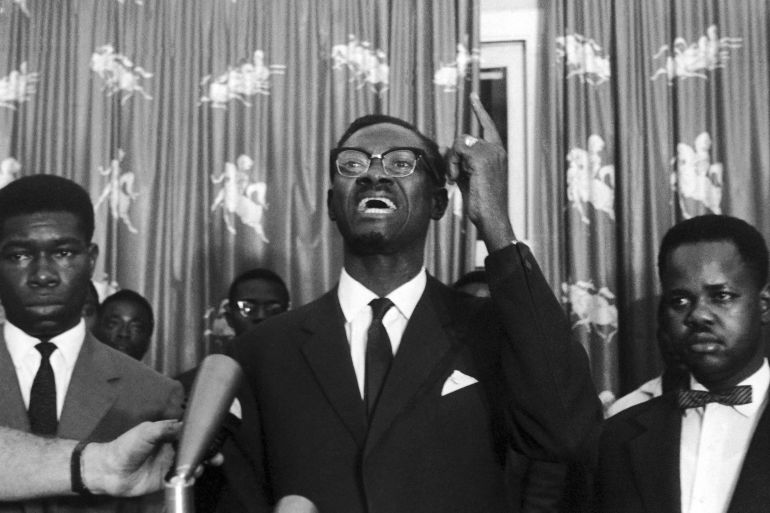
Belgian justice has begun considering the possibility of trying the last surviving official accused in the case of the assassination of Congolese leader and first prime minister after independence, who was killed in 1961.
The court in held a closed session last Tuesday to examine the case file of former Belgian diplomat Étienne Davignon (93 years old), accused of participating in the “unlawful detention and transport” of Lumumba, in addition to “degrading and humiliating treatment.” The public prosecutor’s office considers him the last figure who could face trial in this case that has shaken the history of the Belgian colonization of the Congo.
Lumumba’s family, which has been demanding for 15 years a judicial recognition of the responsibility of Belgian figures in the crime, attended the session through several of his grandchildren. His granddaughter stated, “We are here to affirm that this struggle continues, and we will continue until the end.”
The court is expected to issue its decision in the coming weeks on whether it will open a formal trial. The family’s lawyer stated that he hopes the trial will begin at the start of 2027, emphasizing that a refusal would mean “entrenching impunity for major colonial crimes.”
The assassination of Lumumba months after the Congo’s independence is considered one of the most prominent crimes associated with the colonial era. His family asserts that the crime was the result of a “broad conspiracy” involving Belgian officials in collaboration with separatists and mercenaries.
Patrice Lumumba
Patrice Lumumba was a prominent Congolese independence leader and the first democratically elected Prime Minister of the Democratic Republic of the Congo in 1960. His advocacy for national unity and anti-colonialism led to his assassination in 1961, making him a major martyr and symbol of pan-African liberation. Today, monuments, universities, and streets across Africa and beyond bear his name, honoring his legacy and the struggle for African sovereignty.
Justin Bomboko
“Justin Bomboko” refers to the Justin Bomboko Library, a major public library located in Kinshasa, Democratic Republic of the Congo. It is named in honor of Justin-Marie Bomboko, a key Congolese independence leader and the country’s first Minister of Foreign Affairs. The library serves as an important educational and cultural center, preserving knowledge and promoting literacy in the capital.
Leopoldville
Leopoldville was the colonial name for the capital city of the Democratic Republic of the Congo, founded in 1881 by the explorer Henry Morton Stanley. It served as the capital of the Belgian Congo and, after the country’s independence in 1960, was renamed Kinshasa in 1966. Today, it is a major cultural and economic hub in Central Africa.
Congo
The Democratic Republic of the Congo, located in Central Africa, is a vast country with a complex history marked by the powerful pre-colonial Kingdom of Kongo, the brutal period of the Congo Free State under King Leopold II of Belgium, and a challenging post-independence era. Culturally, it is renowned as the birthplace of vibrant musical genres like soukous and rumba, and it is home to significant natural sites, including the Congo River Basin and Virunga National Park, a UNESCO World Heritage Site known for its mountain gorillas.
Belgian justice
The Palace of Justice in Brussels is a monumental 19th-century courthouse, one of the largest built in that era. Its construction, completed in 1883 under King Leopold II, was part of a major urban renewal project and symbolized the power and independence of the Belgian judicial system. Today, it remains the most important court building in Belgium and a prominent landmark in the capital.
Étienne Davignon
Étienne Davignon is not a place or cultural site, but a prominent Belgian statesman. He served as a European Commissioner and is best known for authoring the influential “Davignon Report” in 1970, which laid the groundwork for European political cooperation. His career has been central to the development of the European Union’s foreign policy coordination.
Belgian colonization
Belgian colonization primarily refers to Belgium’s rule over the Congo Free State (1885-1908) and the Belgian Congo (1908-1960) in Central Africa. This period was initiated under King Leopold II, whose personal control of the Congo was marked by extreme brutality and exploitation of resources like rubber. Belgium’s formal colonial administration that followed, while less overtly violent, was still a paternalistic and economically extractive system that ended with Congo’s independence in 1960.
Senate
The **Senate** is a legislative governing body, most famously represented by the **Roman Senate** of ancient Rome. Originating as an advisory council of elders around the 8th century BCE, it became the central and most powerful institution of the Roman Republic, guiding foreign and financial policy. The concept later inspired many modern governments, including the United States Senate, which forms the upper house of the U.S. Congress.