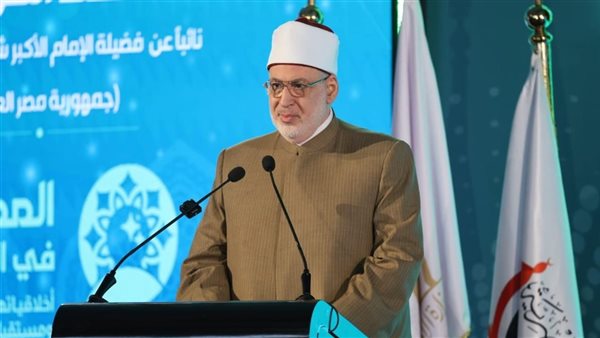
The Representative of Al-Azhar Al-Sharif stated that the 36th International Conference of the Supreme Council for Islamic Affairs embodies the Egyptian state’s interest in establishing the status of professions in Islam as an authentic civilizational and moral value that contributes to construction and development, and looks toward their future in light of the accelerating transformations of artificial intelligence technologies.
He added, during his speech held under the patronage of the President of the Republic and titled ‘Professions in Islam,’ that the conference aims to enhance the national leadership of the Egyptian state in employing modern technologies and directing them to serve the nation, building a human capable of creativity and development, and positively contributing to the renaissance of his society, in line with Egypt’s Vision 2030.
The representative moved on to talk about the future of professions in the age of artificial intelligence, stressing that this issue necessitates achieving a balance between scientific progress and ethical constants, and between technical development and human dignity. He pointed out that artificial intelligence has become one of the drivers of transformation in the labor market, reshaping the nature of professions and affecting human roles and tasks.
He emphasized that scientific and advocacy institutions are required to be present with sound visions that regulate this transformation and do not leave it without a moral compass to guide it. He affirmed that the future of professions is measured not only by the speed and accuracy of the machine, but by the extent to which humans maintain their central role in guidance, regulation, and bearing responsibility. He explained that the real challenge posed by this conference is how to preserve the ‘humanization of professions’ in the age of artificial intelligence, noting that artificial intelligence, despite possessing speed and accuracy, lacks the conscience, mercy, and moral responsibility that distinguish humans, which are the essence of professions in Islam.
He continued that artificial intelligence must remain a tool that serves humans, not replaces them; a means that aids in mastery but does not replace conscience; and helps in production without abolishing values. He warned that the most dangerous challenges lie not in adopting modern technologies, but in how to integrate them ethically in a way that preserves justice in job opportunities, safeguards workers’ rights, and prevents technology from becoming a tool for exclusion or unethical exploitation.
He clarified that if the human mind has been able to create an artificial intelligence, it is obliged to weigh that with the scales of conscience and legal and moral responsibility. He affirmed that ethical and value-based oversight represents the safety bridge between scientific innovation and professional work, and that the absence of this oversight could turn technology from a means of serving humanity into a tool for weakening or stripping it of its humanity. He stressed that the future of professions in light of artificial intelligence depends on establishing that technology does not replace integrity, that science does not replace character, and that a profession is only complete with the beauty of values and the oversight of conscience.