Northern regions feel cool and refreshing, while southern areas will face another round of rainfall starting on the 6th.
Today and tomorrow (June 4 to 5), thunderstorms will still be frequent in Northeast and North China, with local areas experiencing strong convective weather like thunderstorm winds or hail. If encountering such weather, the public should quickly take shelter indoors. Around June 6, a new round of rainfall is expected in the South, with local heavy rain. People should pay attention to nearby warnings and forecasts, and be careful with traffic safety when going out. Affected by rainfall, many areas in the North will feel cool, but muggy weather will persist in South China, with high temperatures continuing in some places for the next three days. Heatstroke prevention is needed.
Thunderstorms are still expected in Northeast and North China today and tomorrow.
The core rainfall area in the South will shift slightly southward.
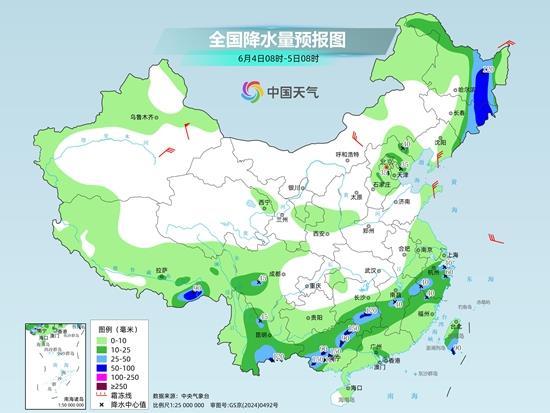
Yesterday, rainfall continued in the Northeast, with stronger downpours in the southern part. Meanwhile, the South entered the core period of rainfall, with heavy rain hitting many areas such as Guizhou, Jiangxi, and Hunan. Monitoring shows that from yesterday to this morning, some parts of eastern Yunnan, southern Guizhou, northwestern Guangxi, central Hunan, northern Jiangxi, southern Anhui, southern Hebei, and northern Shandong experienced heavy rain or torrential rain.
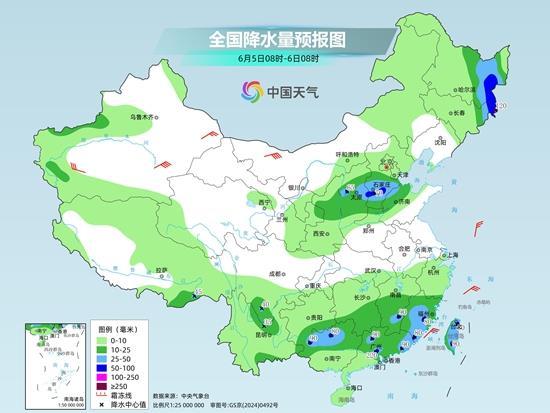
Today and tomorrow, influenced by a high-altitude cold vortex, thunderstorms will be frequent in Northeast, North China, and the Huanghuai region, with local areas seeing thunderstorm winds or hail. At the same time, as cold air moves southward, the core rainfall area in the South will shift slightly southward, and rainfall will gradually weaken.
The Central Meteorological Observatory forecasts that today, areas including eastern Northeast China, northeastern and southern Jiangnan, southern western Sichuan Plateau, southwestern Yunnan, northern and western South China, and Taiwan Island will see moderate to heavy rain. Among these, parts of eastern Heilongjiang, eastern Jilin, southern Hunan, southwestern and northeastern Guangxi, southern Yunnan, southeastern Tibet, and southern Taiwan Island may experience heavy rain or torrential rain.
Rainfall in the South will remain frequent in the coming period. Starting June 6, warm and moist air currents will strengthen again, followed by cold air moving southward to form a shear line, leading to another round of rainfall in the South. From June 6 to 9, areas including southwestern East China, Jiangnan, and South China will experience heavy to torrential rain, with local extreme downpours. Some areas may see overlapping rainfall, so caution is needed against the potential disaster risks of cumulative rainfall.
Many areas in the North feel cool.
Muggy weather persists from southern Jiangnan to South China.
The cold air will not only bring rainfall to Northeast and North China but also cause significant cooling. Over the next week, maximum temperatures in the Northeast will be consistently lower than the average for this time of year, mostly around 20 to 25°C, feeling cool. In big cities like Harbin, the high today will drop to 21°C, and the low will be just over 10°C, showing a clear chill. The public should pay attention to temperature changes and adjust clothing accordingly.
In many parts of the South, muggy weather will persist for the next three days, with high temperatures frequently appearing from southern Jiangnan to South China. Cities like Guangzhou, Fuzhou, and Haikou may hit the high temperature threshold today, and with high humidity, the weather will be sultry. When going out, people should stay hydrated to prevent heatstroke.
Northeast
The Northeast region of the United States, often called New England and the Mid-Atlantic, is historically significant as the landing point of the Pilgrims and a center of the American Revolution. It was the birthplace of American industry during the Industrial Revolution, with cities like Boston, New York, and Philadelphia serving as early hubs for commerce, culture, and government. Today, it remains a densely populated area known for its historic landmarks, prestigious universities, and vibrant autumn foliage.
North China
North China is a historically significant region that includes the cradle of Chinese civilization along the Yellow River, where early dynasties like the Shang and Zhou emerged. It encompasses major cities such as Beijing and Xi’an, the latter serving as the capital for several ancient dynasties and home to the Terracotta Army. The region’s cultural landscape features the Great Wall, imperial palaces, and a deep legacy of Confucian and Buddhist influences.
Guizhou
Guizhou is a mountainous province in southwest China known for its stunning karst landscapes, diverse ethnic minority cultures, and rich history. Historically, it was a remote frontier region that became more integrated into China during the Ming and Qing dynasties, and it played a significant role in the Long March of the Chinese Communist Party in the 1930s. Today, it is famous for attractions like the Huangguoshu Waterfall and the ancient town of Zhaoxing.
Jiangxi
Jiangxi is a province in southeastern China known for its rich cultural heritage and natural beauty. Historically, it was a cradle of Chinese porcelain production, particularly in Jingdezhen, which has been a center for ceramics for over a thousand years. The region also features significant landmarks like Lushan Mountain and the Poyang Lake, and played a role in the development of Neo-Confucianism during the Song Dynasty.
Hunan
Hunan is a province in south-central China known for its lush landscapes and spicy cuisine. Historically, it was the birthplace of Mao Zedong and played a key role in the Chinese Communist Revolution. The region is also famous for Zhangjiajie National Forest Park, which inspired the floating mountains in the movie *Avatar*.
Guangxi
Guangxi is an autonomous region in southern China known for its stunning karst landscapes, ethnic diversity, and the Li River. Historically, it was part of the ancient Baiyue tribes and later became a key area for trade and cultural exchange along the Maritime Silk Road. Today, it is famous for cities like Guilin and Yangshuo, which attract visitors with their natural beauty and rich Zhuang minority culture.
Yunnan
Yunnan, a province in southwestern China, is renowned for its stunning natural landscapes and rich ethnic diversity, home to 25 indigenous minority groups. Historically, it was a key region on the ancient Southern Silk Road, connecting China to Southeast Asia, and later became a frontier for Chinese imperial expansion. Today, Yunnan is celebrated for its vibrant cultures, UNESCO World Heritage sites like Lijiang Old Town, and iconic attractions such as the Stone Forest and terraced rice fields.
Taiwan Island
Taiwan Island, located off the southeastern coast of China, has a rich history shaped by indigenous cultures, Chinese settlement starting in the 17th century, and periods of Dutch, Spanish, and Japanese colonization. After World War II, it was placed under the control of the Republic of China (ROC), which relocated there in 1949 following the Chinese Civil War. Today, Taiwan is known for its vibrant democracy, advanced technology, and diverse natural landscapes, though its political status remains a subject of international debate.