Guangdong is a major economic and cultural province, as well as a strong province and industrial hub for copyright creation and utilization. Currently, a new round of technological revolution and industrial transformation is accelerating, with new technologies and business forms such as the digital economy and artificial intelligence flourishing. This brings unprecedented development opportunities to the copyright industry while also raising higher requirements for copyright confirmation and protection.
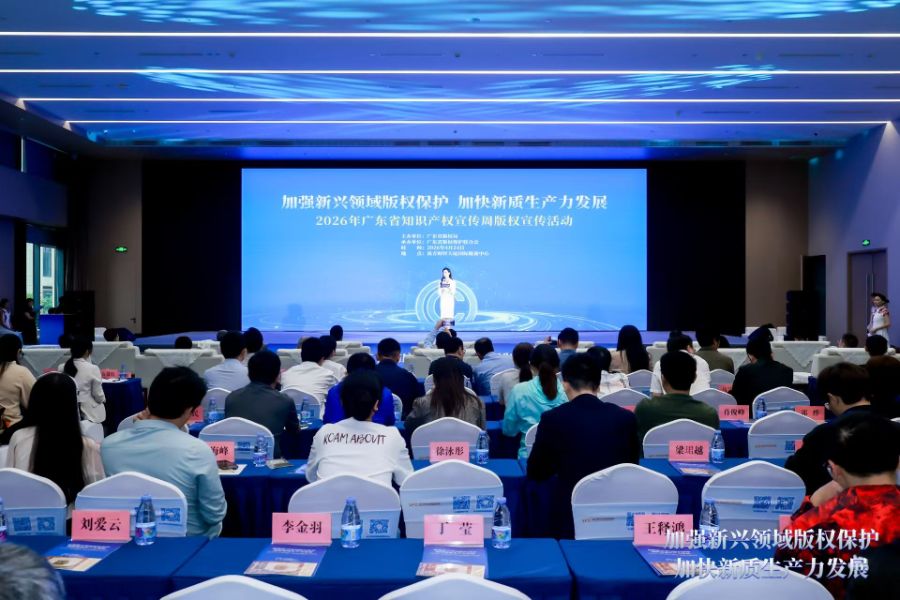
On April 24, the 2026 Guangdong Province Intellectual Property Publicity Week Copyright Promotion Event was held at the Southern Financial International Roadshow Center. The event closely focused on the theme of “Copyright Protection in Emerging Fields,” delving into cutting-edge topics such as AI-generated content, digital copyright, and data intellectual property.
The copyright system ensures that creators receive reasonable economic returns from their intellectual labor by granting them exclusive rights for a statutory period. Without copyright protection, digital content with near-zero reproduction costs would struggle to form a sustainable business model, fail to support the large number of jobs across the entire industry chain of creation, distribution, and derivative development, and would be unable to promote cultural trade exports or enhance national soft power.
According to the latest research data from the China Academy of Press and Publication, the industry added value of Guangdong’s copyright industry reached 1.280215 trillion yuan, an increase of 11.28% compared to 2022. It accounted for 9.04% of the province’s GDP, up 0.13 percentage points from 2022. The copyright industry employed 6.1073 million people in Guangdong, a growth of 2.65% from 2022, representing 8.65% of the province’s total employment, an increase of 0.03 percentage points.
Industry insiders believe that the widespread use of the internet has driven the cost of copying and distributing content to near zero, presenting unprecedented challenges to copyright protection. Establishing a complete and effective copyright mechanism is a necessary means to regulate the order of cyberspace and protect the legitimate rights of creators. The faster new business forms represented by AI-generated content develop, the more urgently copyright protection needs to keep pace. Only with clear ownership of rights and robust protection measures can creative vitality be fully unleashed and the healthy and orderly development of the industry be ensured.
Focusing on “Original Input”
The rapid development of digital technology and artificial intelligence has brought unprecedented opportunities and challenges to the existing copyright ecosystem. Among these, the determination of copyrightability for AI-generated content is the most controversial frontier issue in the global copyright field, directly affecting the balance between industrial innovation vitality and creators’ rights.
As the first specialized court in the country to centrally handle cross-regional network copyright disputes, the Guangzhou Internet Court has taken the lead in conducting in-depth judicial exploration in this area.
“Last year, we accepted nearly 700 copyright disputes related to AI-generated images. Most plaintiffs withdrew their lawsuits due to a lack of evidence of the creative process,” said a judge from the Second Comprehensive Trial Division of the Guangzhou Internet Court. During trials, the court established a review path centered on “original input.” AI technology, as a tool, cannot be considered an author, and whether the content is protected depends on the creator’s original labor input.
“Simply inputting keywords for AI to autonomously complete the creation constitutes a technology outsourcing model and does not qualify as a work. However, through meticulously designed prompts and repeated parameter adjustments involving original creation, protection is granted,” the judge emphasized. To address the difficulty of distinguishing AI-generated content from traditional works with the naked eye, the Guangzhou Internet Court strictly reviews evidence of the creative process, requiring original materials that demonstrate the creative trajectory and original ideas, rather than simple unfinished works.
At the same time, the Guangzhou Internet Court issued judicial suggestions to multiple copyright registration authorities across regions, urging strengthened substantive review of ownership materials for AI-generated content and requiring the addition of identifiers to AI-generated images. These suggestions have been adopted by various registration authorities.
“Currently, there is no mature approach to copyright management for AI-generated content among creators, administrative agencies, or judicial bodies,” the judge said. The Guangzhou Internet Court has extended the “original input” review standard to AI application areas such as micro-dramas and written works, guiding creators
Guangdong
<div class="