June 3, Shanghai – Feature: Yang Ning, representative inheritor of the intangible cultural heritage technique, makes Shanghai-style embroidery balls a “token of friendship” for the world.
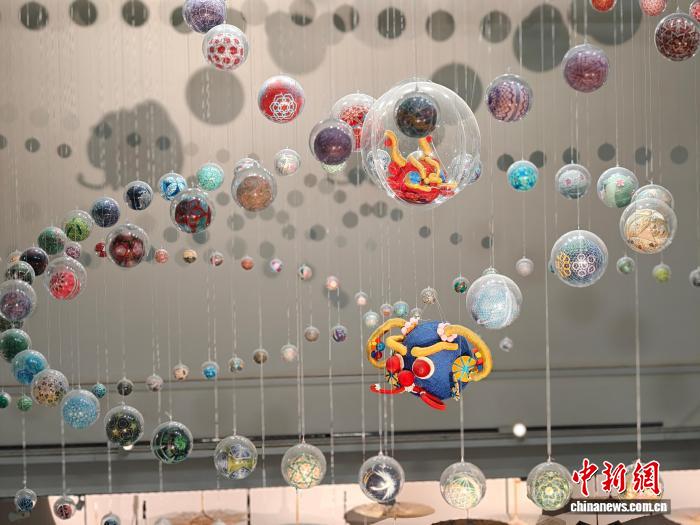
From delicate earrings with 48 petals on a ball less than a centimeter in size, to a ten-meter-long, spirited “Eastern Dragon,” from Shanghai’s Oriental Pearl Tower to Rome’s circular dome… It may be hard to imagine that these varied items, differing greatly in size and style, all originate from a unique intangible cultural heritage technique: the craft of making Shanghai-style embroidery balls. With colorful threads crisscrossing, the Shanghai-style embroidery ball gives a new interpretation to traditional Chinese embroidery ball culture. It has transformed from a token of affection in olden times into artistic pieces that adorn ears and chests, embellish daily life, and appear in major exhibitions. Thus, the ancient craft of embroidery ball making has been revitalized in public aesthetics.
“The beauty of the embroidery ball lies in its thousand-year history. It carries the ancient traditions of Chinese folk marriage customs, dance and music, as well as auspicious meanings. A small embroidery ball condenses our history and culture in its patterns and functions. Its beauty also lies in the making process, which combines complex craftsmanship such as painting, design, embroidery, and local aesthetic features. These are treasures of traditional folk crafts, making the embroidery ball a work of art,” said Yang Ning, the representative inheritor of the Shanghai-style embroidery ball making technique, an intangible cultural heritage of Changning District, Shanghai.
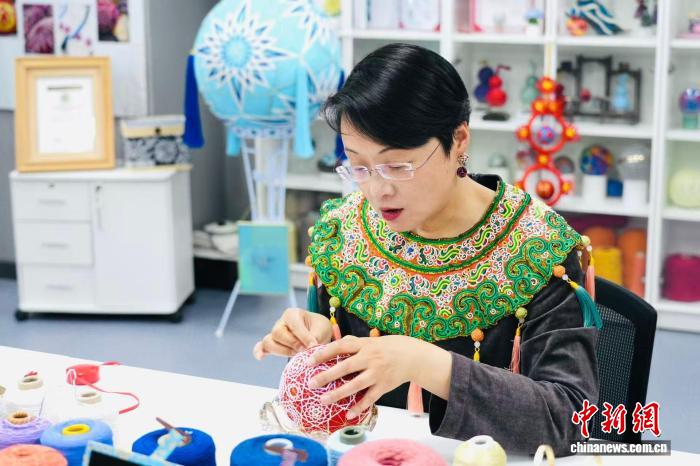
In Yang Ning’s studio, several embroiderers are focused on their work, with needles and threads flying over embroidery balls of various sizes. The stitches are fine and the threads echo each other, gradually highlighting three-dimensional patterns, showcasing the ingenuity of the intangible cultural heritage technique.
The embroidery ball did not originate from Shanghai’s local culture. How did it gain “new life” in Shanghai?
“Over 30 years ago, I visited relatives in Guangxi and encountered the local custom of ‘throwing embroidery balls.’ At first, what attracted me to the embroidery ball was that it was both beautiful and fun,” Yang Ning said. “Since childhood, I have been very interested in traditional Chinese culture, such as embroidery, patterns, and colors, and I have been learning about them. At the same time, I am a science student who genuinely loves precise geometric patterns and the ever-changing beauty they create through combinations. So I suddenly realized that the round embroidery ball and its various patterns perfectly hit my aesthetic point. I then thought of bringing the embroidery ball technique back to Shanghai, a city that embraces all cultures, to deepen and perfect it.”
That endeavor has lasted thirty years. To “deepen and perfect” the craft, Yang Ning, the “science student,” specifically studied at the Academy of Arts & Design, Tsinghua University, to learn professional design and creation. She also obtained professional titles such as National Level 1/Senior Technician, and even traveled to over 100 cities in more than 30 countries worldwide to draw inspiration from diverse cultures and cross-border innovation. “In this process, I also confirmed my deep love for the art of embroidery balls. To this day, whenever I pick up a needle and thread to embroider, I feel an immense sense of peace and happiness inside.”
With solid professional skills and a broad vision, the embroidery ball in Yang Ning’s hands has undergone a transformation in Shanghai that surpasses traditional imagination. It can be a blooming hydrangea, allow Van Gogh’s “Starry Night” to swirl and flow, present a realistic bamboo weaving effect, or incorporate domestic and international city landmarks into geometric patterns to become a “messenger of friendship”…
“When you have accumulated enough knowledge, learning, and thinking, inspiration naturally ‘overflows.’ You can integrate and innovate many seemingly unrelated elements, achieving a blend of traditional style and modern aesthetics, and a connection between Chinese style and international flair,” Yang Ning said. The technique of making embroidery balls is Chinese, but its colors and patterns can be more diverse and international. “The world changes