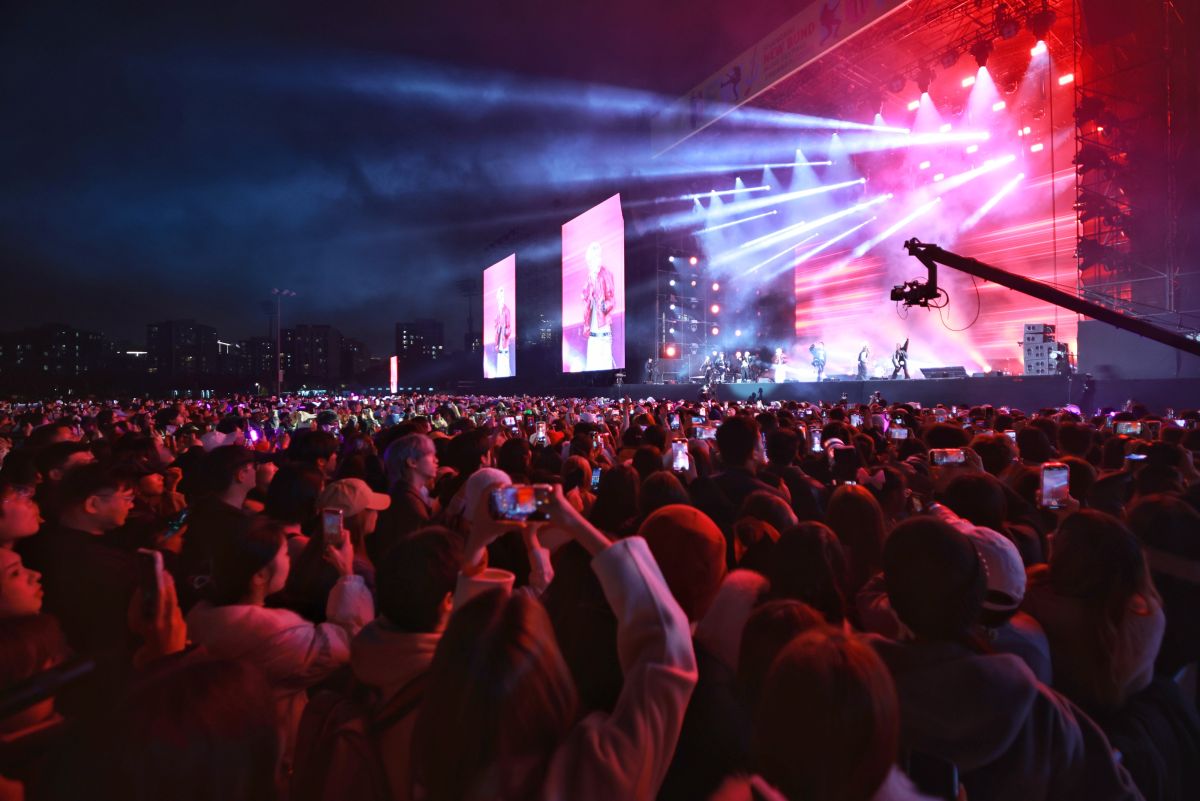
The story goes back to this past summer. When the proposition of “whether Shanghai’s central urban area—the Expo Qiantan zone—could create a large-scale outdoor venue for 30,000-50,000 people, comparable to top-tier international and domestic outdoor music festivals” was placed before Pudong, a series of challenges followed: performance positioning, traffic management, emergency evacuation, commercial amenities, operational calculations, stress testing, and more.
Large-scale outdoor music festivals, especially those of tens of thousands of people operating regularly, have no precedent in Shanghai’s central urban area. They test a city’s comprehensive coordination, commercial operation, and support capabilities.
The “Leading Area Speed” was activated immediately. Feasibility studies, simulations, calculations, and planning… all tasks progressed rapidly in parallel. In just one month, Pudong produced a comprehensive feasibility report. Benchmarking against top global outdoor events like the US Coachella Valley Music and Arts Festival, the UK’s O2 music festivals, South Korea’s Incheon Pentaport Rock Festival, and China’s Changzhou Taihu Bay Music Festival, and after comprehensive consideration, the “Shanghai Qiantan Music Festival” was positioned as a venue for hosting large-scale outdoor concerts primarily featuring pop music.
As the “home ground” for the “Shanghai Qiantan Music Festival,” the approximately 230,000 square meter Qiantan Sports Park underwent critical hardware upgrades. Originally a sports and leisure space with 7 soccer fields and 2 tennis courts, a series of renovation projects were completed with unprecedented efficiency: the 1,400-meter perimeter road was widened to 10 meters, the main stage area was hardened, access points were increased from 4 to 9, and systems for power, communications, broadcasting, and security were upgraded.
For a successful music festival, a first-class venue is the “hardware,” while the artists are the “software.” Many artists often need their schedules locked in up to 8 months in advance, but Pudong only had about a month left. Relevant departments in Pudong entered a mode of frequent business travel, practically visiting the doorsteps of major entertainment companies in Beijing and elsewhere. It became routine to “fly in late at night, hold meetings in the morning, and return to Shanghai by noon.” It was precisely this relentless effort, coupled with the unique locational advantage and immense potential of hosting a “large-scale outdoor music festival in Shanghai’s central urban area,” that successfully persuaded the event’s main organizer. From reaching an initial agreement to signing the contract and entering the venue took only two weeks.
“Having such a space in downtown Shanghai capable
Shanghai Qiantan Music Festival
The Shanghai Qiantan Music Festival is a major annual outdoor music event held in the modern Qiantan area of Shanghai’s Pudong district. Launched in 2021, it was created to establish a new cultural landmark in the city, featuring a diverse lineup of international and domestic artists across multiple genres. The festival leverages the area’s contemporary urban landscape to provide a large-scale, immersive live music experience for the public.
Qiantan Sports Park
Qiantan Sports Park is a modern public recreational area located in the Pudong district of Shanghai, China. It was developed as part of the city’s urban green space expansion and opened in the early 2020s, designed to serve the growing Qiantan international business zone. The park features extensive sports facilities, walking paths, and landscaped gardens, promoting an active lifestyle for residents and visitors.
Huangpu River
The Huangpu River is a 113-kilometer waterway flowing through Shanghai, historically serving as the city’s main commercial artery and port since the Ming Dynasty. It gained international prominence in the 19th century as the heart of the foreign concessions and remains iconic today, dividing Shanghai into the modern Pudong skyline on the east bank and the historic Bund on the west.
Pudong Leading Area
The Pudong Leading Area is a special economic zone in Shanghai, China, established in 1990 to spearhead the country’s economic reform and opening-up. Once largely farmland, it has been transformed into a global financial hub, symbolized by its iconic skyline including the Shanghai Tower and the Oriental Pearl TV Tower.
Mercedes-Benz Arena
The Mercedes-Benz Arena in Berlin, Germany, is a major multi-purpose indoor arena that opened in 2008. Built on the historic site of the former East Berlin’s “World Time Clock,” it is renowned for hosting major concerts, sporting events like ice hockey, and was a key venue for the 2015 EuroBasket championship. Its naming rights were acquired by Mercedes-Benz in 2015.
Qiantan 31
Qiantan 31 is a modern cultural and commercial complex located in the Qiantan area of Shanghai’s Pudong district. It was developed as part of the city’s urban expansion and opened in recent years, designed to be a vibrant hub integrating retail, dining, and arts. The site reflects Shanghai’s contemporary growth, transforming what was once largely undeveloped land along the Huangpu River into a dynamic urban space.
Oriental Sports Center
The Oriental Sports Center, also known as the Shanghai Oriental Sports Center, is a major multi-purpose sports complex in Shanghai, China. It was constructed for the 2011 FINA World Aquatics Championships and features a distinctive “sea shell” architectural design. Today, it hosts a wide range of sporting events, concerts, and public fitness activities.
Expo Qiantan zone
The Expo Qiantan zone is a modern urban development area in Shanghai, China, built upon the site of the 2010 Shanghai World Expo. It repurposes several iconic national pavilions from the event, transforming the former exhibition grounds into a dynamic district featuring parks, cultural venues, and commercial spaces. This redevelopment symbolizes Shanghai’s post-expo urban regeneration, blending historical legacy with contemporary innovation.