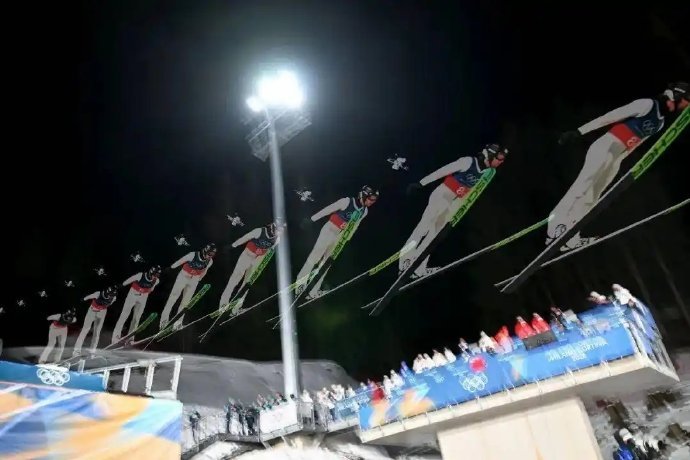
When athletes at the 2026 Milan Winter Olympics soar, spin, and sprint on the ice and snow, the audience will witness not only the pinnacle of competition but also a visual feast woven together by high-speed drones, AI-powered analysis, and photographers with the skills of “ice dancers.” These cutting-edge technologies are bringing an unprecedented level of immersion to the screen, capturing every millisecond breakthrough and the tension of every micro-expression.
⚡ 1. The Eye of Speed: FPV Drones Revolutionize the Viewing Angle
25 small, high-speed drones will act as “invisible tracking cameras” on the field, flying close to athletes at speeds exceeding 100 km/h. Compared to traditional aerial photography, they are smaller, more agile, and capable of performing complex maneuvers like serpentine weaving and sharp dives on intricate courses. For instance, footage following a snowboarder throughout their run, combined with real-time telemetry data overlay, creates an immersive viewing experience reminiscent of video games. The audience can not only see the athlete’s trajectory over jumps from above but also feel, from a first-person perspective, the spray of ice and the pressure of the wind during high-speed turns.
🤖 2. The Deconstructor of Time and Space: AI-Powered 360° Replay and Motion Visualization
360° Spatiotemporal Slicing Technology: For the first time, an AI system from the Chinese tech company Alibaba Cloud will provide 360-degree replay coverage for all events. This technology deconstructs an athlete’s key movements (like Ning Zhongyan’s record-breaking speed skating turn) into millisecond-level spatiotemporal slices, generating multi-dimensional motion trajectory maps. Viewers can rotate the perspective, pause, or slow down the replay to clearly see the angle of body rotation and the precise point where the skate blade contacts the ice.
3D Motion Modeling: The figure skating arena will be equipped with 14 8K cameras to capture athletes’ jump trajectories in real-time and generate 3D dynamic models. The system quantifies data such as the number of rotations and jump height, overlaying it onto the replay footage. This makes the biomechanical beauty and technical details of complex maneuvers (like a switch 1620) immediately clear.
⛸️ 3. The “Ghost Shooter” on Ice: A Revolution in Dynamic Human-Machine Collaborative Filming
Former US ice dancer Jordan Cowan will transform into an “ice dancer,” holding a stabilizer and skating backwards and spinning on the rink. His professional skating ability allows for zero-distance synchronization with the competitors.
In figure skating competitions, this “smooth camera movement” breaks the limitations of fixed camera positions, continuously tracking the athlete’s aerial posture during consecutive jumps, even capturing micro-expressions and flying droplets of sweat at the moment of landing.
Combining his dynamic trajectory with high-speed lenses, artistic moments like Yuzuru Hanyu’s spread eagle glide or Eileen Gu’s switch grab are presented with the fluid narrative feel of a cinematic long take, hailed by audiences as “a technical feat worthy of a medal.”
⚖️ 4. The Millisecond Arena: High-Speed Imaging and Virtual Technology Empower Fairness and Experience
Finish Line Light-Sensing Cameras: Ultra-high-speed imaging capturing 40,000 frames per second will serve as the “electronic hawk eye” for determining results. For example, in the men’s snowboard parallel giant slalom bronze medal race, the camera clearly showed that Bulgarian athlete Zanfirov’s board crossed the line with a 0.001-second advantage, ensuring objective judgment in millisecond-level disputes.
Virtual Performance Comparison System: In bobsleigh, virtual synthesis technology will overlay the starting footage of different athletes onto the same track, creating a real-time side-by-side sprint effect. This visually presents performance gaps, enhancing the audience’s understanding of the competition.
🌟 The Value of Technology: A Dual Breakthrough in Athletic Beauty and Public Education
The camera technology at the Milan Winter Olympics serves not only competition judging and broadcast quality but also acts as a bridge for the public to understand winter sports. AI trajectory visualization helps casual viewers grasp the technical thresholds of difficult maneuvers, drone perspectives allow the audience to become “virtual participants,” and the dynamic aesthetics of on-ice photographers are redefining the artistic height of sports imagery. As stated, these technologies are narrowing the gap between elite competition and public perception, transforming the Winter Olympics into an immersive, accessible technological carnival.
Milan Winter Olympics
Alibaba Cloud
Ning Zhongyan
Jordan Cowan
Yuzuru Hanyu
Eileen Gu
Zanfirov
To provide an accurate summary, could you please verify the spelling or provide additional context, such as the country or region where it is located?