With one week left until the Spring Festival, the number of citizens shopping for New Year goods is gradually increasing, leading to concentrated passenger flow in some large commercial districts within Beijing. Traffic management departments have added traffic posts around certain malls, dynamically deploying police forces for guidance to ensure safe and smooth travel for citizens.
A little after 9 a.m., the area in front of the Bairong World Trade Mall on Yongdingmenwai Street in Dongcheng District was already bustling. Citizens carrying shopping bags arrived one after another, able to get all their supplies in one stop—from Spring Festival couplets and snacks to New Year decorations. This long-established mall, known as “Beijing’s Little Yiwu,” is located at the core of the Muxiyuan commercial district. Its convenience of direct bus and subway access makes it a popular choice for Beijing residents to purchase New Year goods. However, the surge in holiday客流 also brings challenges for traffic management.
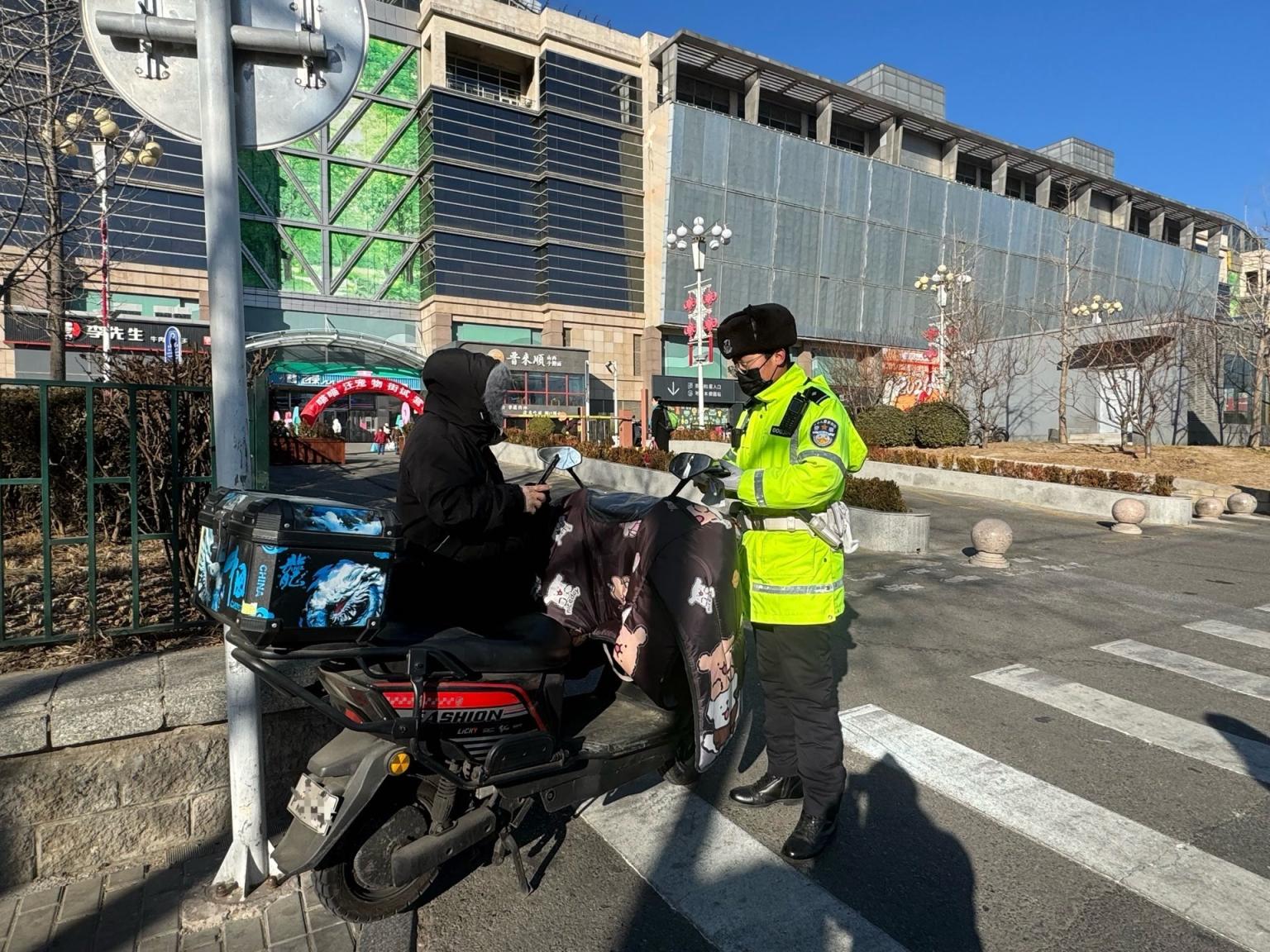
At the mall entrance, electric bicycles were occasionally seen going the wrong way or riding on sidewalks, while newly arrived buses were parked not far from the entrance, creating a potentially hazardous interwoven scene.
At the north gate parking lot entrance, vehicles were slowly driving in. “This entrance is relatively narrow. If the barrier arm lifts just a bit slowly, the queue of vehicles can instantly back up onto the service road,” explained a representative from the traffic management team. Before the Spring Festival, mall客流 is significantly higher than usual, with traffic peaks occurring daily from 11 a.m. to around 3 or 4 p.m., leading to queues at parking lot entrances and exits.
In response to pre-holiday traffic pressure, Dongcheng traffic police have collaborated with mall property management to implement a series of保障 measures. For motor vehicles, the mall has cleared space to add temporary parking spots, increased parking management staff to guide order within the lot, fully opened all payment booths, and added two new access channels on the south side to prevent congestion caused by payment processing or searching for parking. For non-motor vehicle management, dedicated parking areas have been designated around the mall. Police are coordinating with shared bike operators to promptly remove improperly parked vehicles and dynamically adjust vehicle distribution, ensuring sufficient parking space.
Furthermore, traffic police have set up posts at the northern and southern ends of the roads around the mall to promptly advise against violations like non-motor vehicles going the wrong way. The command center also conducts video patrols to dynamically deploy officers to handle sudden congestion.
“These measures are specialized保障 for the pre-Spring Festival period and are also our standard procedure for handling large events in commercial districts,” explained the representative. In response to concentrated promotional activities and客流 before the holiday, police have established a coordination mechanism with property management in advance. Property management is responsible for order inside, while traffic police focus on疏导 outside, creating an internal-external联动 to ensure smooth passage.
It is reported that this保障 model will also be applied to other key Spring Festival venues in Dongcheng District, such as the Longtan Temple Fair and the Tiantan Park New Year activities. Police have conducted advance research on surrounding roads and parking conditions, adding traffic guidance设施.
During the Spring Festival period, Dongcheng traffic management departments will activate an upgraded保障 plan. For key areas like Qianmen and Longtan Lake, temporary traffic control measures or one-way routes on some sections may be implemented as needed. Simultaneously, parts of some roads will be closed to create temporary parking lots,全力应对 the doubling tourist客流 and ensuring orderly交通运行 during the holiday.
Traffic management departments also remind the public that交通压力 in areas with dense人流 like commercial districts and scenic spots will be significant during the Spring Festival, and urban parking resources are limited. It is建议 that citizens尽量 choose green travel methods like buses or subways and travel during off-peak hours for shopping or park visits.