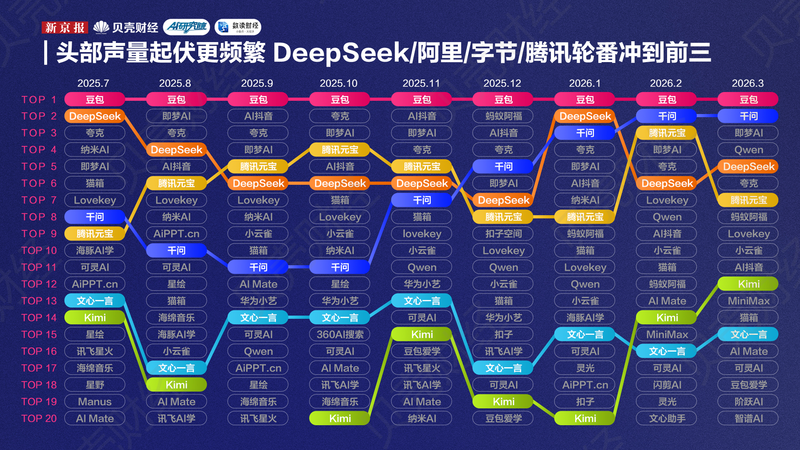
On April 24, 2026, at the 2026 New Think Tank Spring Forum’s sub-forum “AI+ in Progress: From Technology Race to Scenario Deepening,” the AI Research Institute released the “2026 Spring AI Application Competitiveness Report” in collaboration with Xsignal Singularity Factor. The report shows that as AI application competition shifts from “model capability” to “user entry points,” the market landscape is undergoing structural changes.
One of the most direct observation windows is the “All-Media Star” Chinese AI application ranking. From July 2025 to March 2026, this ranking has been released for nine consecutive issues. Based on changes in the ranking, the market visibility distribution of AI applications is showing a trend toward concentration at both ends: on one end, leading major companies like ByteDance and Alibaba continue to strengthen their advantages; on the other end, new startup forces outside major companies are significantly recovering, while products from mid-level manufacturers in the middle are facing more noticeable pressure.
From the perspective of the top tier, the landscape has initially stabilized, but competition is not yet over.
Doubao has ranked first for nine consecutive periods, holding a relatively stable top position; however, places 2 to 5 are still in constant rotation, with products like DeepSeek, Quark, Jimeng AI, Qianwen, and Tencent Yuanbao alternately rising. This shows that although the top tier has largely formed, internal competition remains intense. Who can enter the top ranks at key moments often depends on the combined effects of ecosystem coordination, platform resources, and model capabilities.
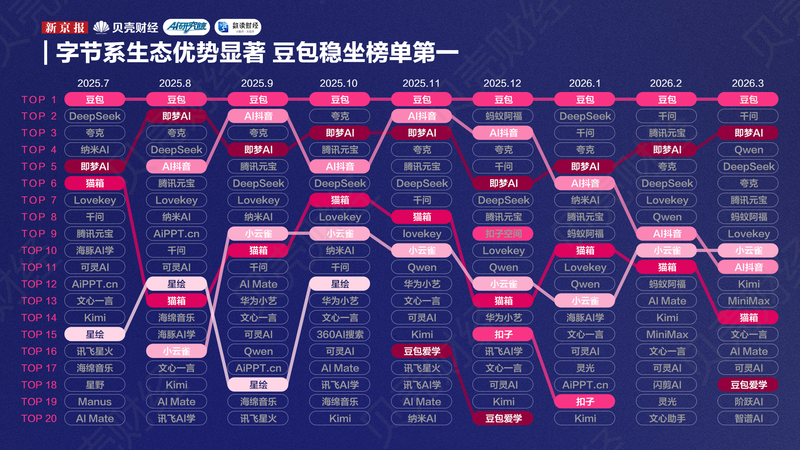
Among them, ByteDance’s ecosystem advantage is the most significant. Besides Doubao, Jimeng AI and AI Douyin also consistently rank high, while AI applications in different niche segments like Cat Box and Little Lark also maintain considerable visibility, allowing ByteDance to hold multiple positions in the top 20 visibility ranking for a long time.
The Alibaba system, on the other hand, achieved an overall rise in its AI application market visibility in the first quarter of this year. Last December, Ant Ah Fu debuted on the ranking and immediately jumped to second place; from January to March, Qianwen’s ranking steadily moved up to second, combined with the joint exposure of Quark, Qwen, and Ant system products, allowing Alibaba’s presence in the ranking to shift from single-point advantages to a systematic layout.
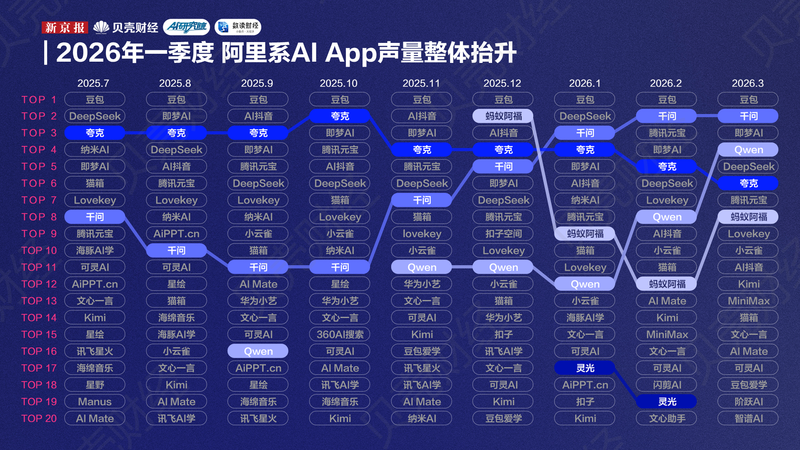
By March this year, ByteDance and Alibaba products together occupied 10 of the top 20 spots in the visibility ranking, while seats from other major companies like 360 and iFlytek continued to shrink, dropping to zero seats.
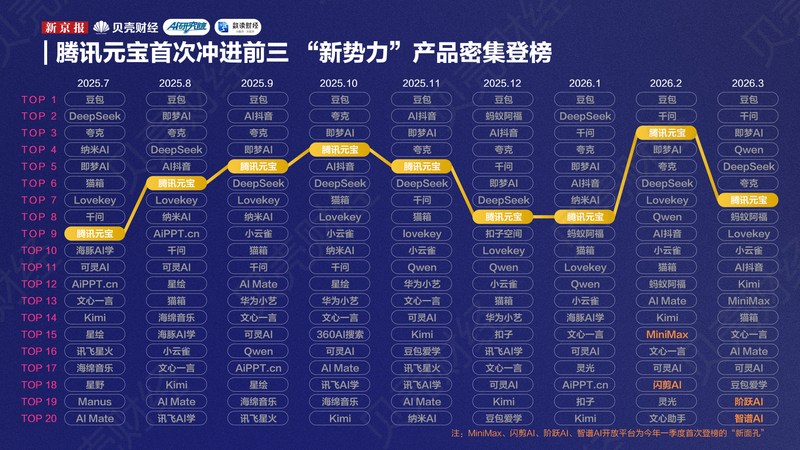
Notably, competition is not limited to major companies. In the first quarter of this year, the visibility ranking welcomed several new faces outside the major company systems, including MiniMax and FlashCut AI, which debuted in February this year, while Step AI and Zhipu AI also climbed onto the ranking in March.
Correspondingly, the number of seats occupied by new startup forces outside major companies in the ranking increased from 3 seats in December 2025 to 7 seats in March 2026. This change is partly related to natural improvements brought by model capabilities and product innovation, and also reflects that, under the accelerated pressure from major companies, independent AI companies are actively increasing investment, seizing the high-attention window of the first quarter to enter public view.
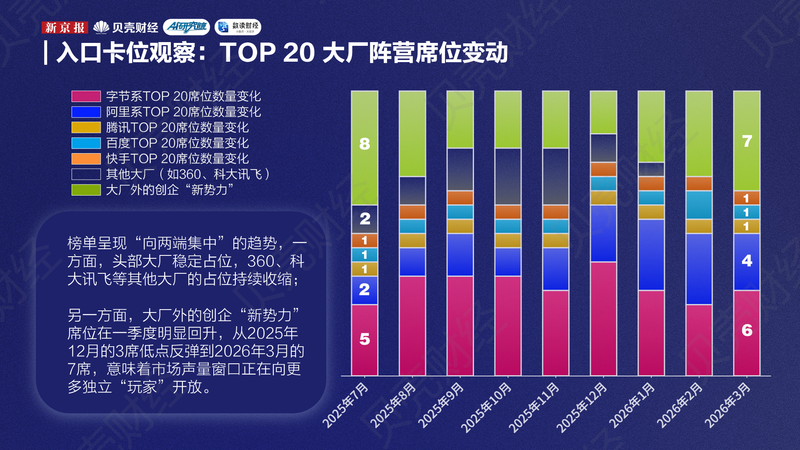
The differentiation trend in the AI application market is intensifying. Top products continue to amplify their advantages through ecosystems, traffic, and product capabilities, while new startup forces still have opportunities to gain attention through innovation and window-period momentum. However, similar mid-level products are becoming more easily overwhelmed by the market. In short, competition is becoming harsher, and products that lack both ecosystem advantages and a distinct label will be accelerated in elimination during this round of competition.