Survey in Changping District
Coordinate the integrated development of education, science and technology, and talent to create a multiplier effect for high-quality development
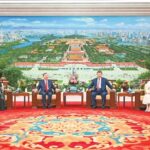
Yesterday morning, a survey was conducted in Changping District on the theme of “thoroughly implementing the spirit of an important speech during an inspection of Beijing, and promoting the integrated development of education, science and technology, and talent.” It stressed the need to fully leverage the capital’s resource advantages, coordinate the integrated development of education, science, technology, and talent to create a multiplier effect for high-quality development, and accelerate the building of a world-class science center, talent center, and innovation hub. As an important carrier area for Beijing’s International Science and Technology Innovation Center construction, Changping District should focus on tackling future technologies, laying out future industries, and gathering future talent, making new and greater contributions to the capital’s modernization.
The Tsinghua Nankou National Key Laboratory Base will centrally host 15 national key laboratories from Tsinghua University, with several laboratories already completed. Information about the base’s planning, construction, and industrial development was learned, and the national key laboratories were visited to observe related test platform operations and research progress. The Peking University Industry-Education-Research Integration Innovation Center will host scientific innovation platforms such as Peking University’s national key laboratories, creating three functional zones: innovation platform clusters, project incubation and acceleration industrial bases, and housing and education supporting facilities. The overall planning and construction of the innovation center were learned about, and the project’s progress was inspected. It was pointed out that the Tsinghua Nankou National Key Laboratory Base and the Peking University Industry-Education-Research Integration Innovation Center are not only beneficial for strengthening national strategic scientific forces but also bear the significant mission of promoting high-level scientific and technological self-reliance and self-strengthening. Construction must be accelerated, functional layout and space utilization optimized around the work and life needs of teachers and students, and construction safety and laboratory safe operation ensured. Research team entry should be expedited, resources integrated focusing on major national needs, and more landmark achievements produced. Efforts should be made to transform scientific and technological achievements, strengthen industrial space support and key team docking services, and promote more innovative achievements to land in Beijing. Improve surrounding infrastructure and public service facilities to create a vibrant center balancing work, residence, commerce, and services.
During the survey, it was pointed out that education, science and technology, and talent are the foundational and strategic pillars of Chinese-style modernization. It is necessary to continuously strengthen the function of scientific and technological innovation as a source, deeply implement the leading action of basic research, and coordinate the advancement of original innovation and key core technology breakthroughs. Fully leverage the role of national laboratories as the general platform and general chain leader, support the cluster development of national key laboratories, enhance the systematic tackling capability of strategic scientific forces, and actively undertake more major national research tasks. Strengthen world-class new research institutions such as the Beijing Institute of Life Sciences and the Beijing Research Center for Brain Science and Brain-Inspired Intelligence, striving to produce a batch of leading and disruptive innovative achievements.
It was emphasized to vigorously develop new productive forces, deepen cooperation with universities, institutes, and central enterprises in the region, jointly build platforms such as university-enterprise joint laboratories and pilot test bases, and promote deep integration of the innovation chain, industrial chain, capital chain, and talent chain. Promote efficient linkage of the “Three Cities and One District,” and elevate the development level of characteristic industrial parks such as Zhongguancun Life Science Park and Life Valley Industrial Base. Expand and strengthen advantageous industries such as biomedicine and advanced energy, and prospectively lay out future industries such as synthetic biology and brain-computer interfaces, forming more modern industrial clusters with international competitiveness. Improve the scientific and technological service system, accelerate scenario cultivation and opening, and increase the efficiency of in-situ transformation of scientific and technological achievements.
It was emphasized to deepen industry-education collaborative education and continuously expand the scientific and technological talent team. Support universities in unconventionally laying out a batch of frontier, interdisciplinary, and emerging disciplines, focusing on cultivating top innovative talents. Vigorously introduce strategic scientists and leading scientific and technological talents, creating a development environment that respects and retains talent. Deepen the integrated reform of education, science and technology, and talent, creating a good innovation ecology and stimulating innovation and creativity. Vigorously develop scientific and technological finance, guiding patient capital to invest early, invest small, and invest in hard technology. Promote the initiation of international big science plans and big science projects, expand the international influence of brand activities such as the Zhongguancun Forum, the International Congress of Basic Science, and the Changping Life Science Forum, and better link global innovation resources.