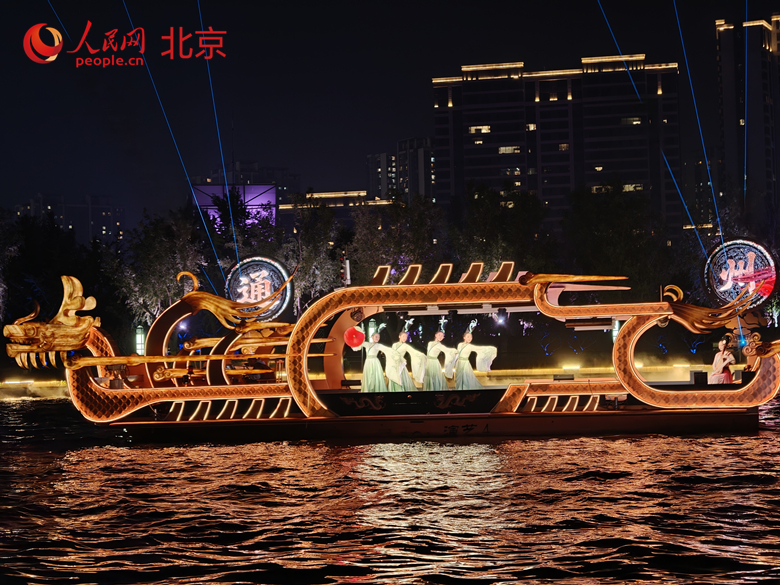
As night falls, the Grand Canal in Beijing’s Tongzhou becomes a stage of light and shadow, with boats gliding on the green waves and the dazzling nightscape on both sides fully visible. Visitors listen to the thousand-year story of the canal while experiencing the modern canal scenery interwoven with light and shadow.
Along the boat journey, every spot offers a view, and every section tells a story. Amid the rippling water, one can grasp the profound heritage of the Grand Canal spanning a thousand years.
“It’s absolutely stunning. This trip was totally worth it,” said a resident surnamed Zhou after watching the performance.
“Yunshangxing” water scenery poetic music performance.
This is the first moving water-immersive grand show created by the sub-center of the city—”Yunshangxing” water scenery poetic music. During the recent May Day holiday, “Yunshangxing” became a popular performance for residents and tourists, allowing everyone to experience the new scenes and vitality of the sub-center’s cultural tourism industry amid the integration of the thousand-year-old canal and modern cultural tourism.
Over the past decade of planning and construction, cultural tourism and other industries have become pillar industries of Beijing’s sub-center. The thriving industries have turned the former “sleeping city” into a place full of vitality everywhere.
Zhangjiawan, once known as the “first dock of the Grand Canal,” was famous for its prosperous grain transport. Twenty years ago, Jiang Lihua moved from her hometown in Hunan to Zhangjiawan in Tongzhou, Beijing. At that time, Zhangjiawan was still a suburban town with weak infrastructure and relatively poor transportation. Now, Zhangjiawan has become a “design town, smart town, and vibrant town” that the sub-center focuses on developing, with thriving industrial vitality and a concentration of high-end talent. The company where Jiang Lihua works has grown from a small enterprise with fewer than a hundred employees to a listed company.
This is also a microcosm of the sub-center’s industrial upgrade. Over the past decade, advanced manufacturing industries represented by smart connected vehicles, biomedicine, and integrated circuits have grown strongly, the financial sector has continued to expand, with its added value steadily accounting for about 10% of GDP, and cultural tourism has risen to become a pillar industry. The added value of the cultural, sports, and entertainment industry has increased 10.7 times over the decade, showcasing the sub-center’s vibrant industrial activity.
More and more industry professionals like Jiang Lihua are choosing to settle here, build careers, and pursue their dreams. Beijing’s sub-center is becoming a city of hope and dreams for more people.
On the banks of the North Canal, ten “Beijing Sails” rise above the Beijing Tongzhou Station, becoming another landmark of the sub-center. About 800 meters west of the station lies the Beijing-Hangzhou Grand Canal. Now, the new hub is setting sail, injecting new momentum into the coordinated development of the Beijing-Tianjin-Hebei region and bringing happiness to cross-provincial commuters.
Software engineer Zhang Dong lives in Dachang, Hebei. Previously, he had to get up at six in the morning and spend nearly two hours on buses and subways to get to his company in Tongzhou, spending a total of four hours on the road each day.
After the Beijing Tongzhou Station opened, Zhang Dong can take a high-speed train and arrive at the sub-center in less than 20 minutes. He no longer needs to get up early to rush, and can enjoy a warm breakfast at home.
Currently, 12 cross-border roads have been built between Tongzhou and the three northern counties of Hebei, with roads like Changtong Road and the Chaobai River Bridge open to traffic, and expansion projects like Tongbao Road accelerating. The rail transit line Pinggu, spanning Beijing and Hebei, is expected to be operational by the end of this year. The Baiminan and Baimabei checkpoints have been renovated, increasing traffic efficiency by about 41% and 26% respectively, making cross-provincial commuting a “minute-level” affair.
Convenient transportation has turned the “same-city life” of Beijing-Tianjin-Hebei into a daily reality. Working in Tongzhou and living in Hebei is no longer an unattainable dream.
The clustering of industries and smooth transportation have injected surging momentum into the development of Beijing’s sub-center. While accelerating its rise, the sub-center continues to promote ecological optimization